
On The Other Hand -
Book Reviews
Lifestyle, Cigars & More
Musings
About
On The Other Hand -
  • Book Reviews
  • Lifestyle, Cigars & More
  • Musings
  • About
Biography

At Stalin’s Side by Valentin Berezhkov

July 15, 2026 by Barry J. Klazura No Comments

At Stalin’s Side: His Interpreter’s Memoirs by Valentin Berezhkov

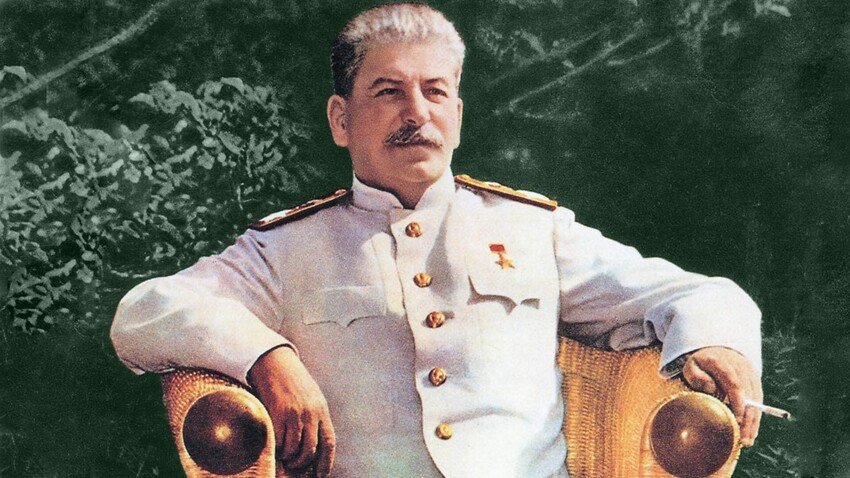
Although Valentin Berezhkov was not Stalin’s primary interpreter, he attended numerous important meetings with Stalin during the Second World War, including Yalta and the talks in Moscow. With a natural flair for languages, Berezhkov found himself chosen for important work by Molotov, the number two man in the country, and was suddenly thrust into the middle of history making events. His memoirs, which run from the October Revolution to the fall of the dictator’s empire, are valuable because they capture the mindset of suspicion, fear and ambition at the very highest levels of Soviet government. The leaders of the State were constantly looking over their shoulders and testing the ground beneath their feet while their leader, Stalin, the consummate politician and absolute ruler, watched them for any inkling of disloyalty or lack of duty.

The Need to Show Absolute Loyalty

Those same leaders had to submit to the grossest demands. Molotov’s wife, Polina, was arrested and sent to the Gulag. When Molotov went to Stalin for help, Stalin pointed out that all of his own relatives were also in prison. In fact, almost all the relatives of Stalin’s first and second wives were either in prison or had been shot. The same was true for the wife of the Soviet President, Kalinin, and for Stalin’s chief assistant, Poskrebyshev. To add salt to the wound, Beria, the feared head of the Soviet secret police, would whisper to Molotov from time to time, “Polina is still alive.”

Living in such an atmosphere was obviously stressful, and the stress increased when Beria suggested, during the Second World War, that Berezhkov’s parents might still be alive in Kiev, which had been overrun by the Nazis. Anyone living in an occupied area was automatically suspected of collaboration, and so Berezhkov, being so close to Stalin, could be seen as a threat.

Survival in Stalin’s Inner Circle

Fortunately for Berezhkov, Stalin never uttered those dreaded words, “he knows too much,” in his direction. He was spared arrest, the Gulag, and death by car accident, which was one of the favorite methods of disposing of potential threats, real or imagined. Allowed to take other work, he survived the Stalin years and ended up as a senior researcher at the Institute of USA and Canada Studies of the Russian Academy of Sciences. He later taught political science at Claremont College and at the Monterey Institute of International Studies before his death in the late 1990s.

Opinion: Is the Book Worth Reading?

This is a fine book, tracing his early life and his belief in the Communist ideal through to his awakening about the reality of the Soviet state. We see through his eyes the hopes and dreams of a better life, and the realization of the terrible cost that hundreds of millions paid for their participation in the Communist experiment. In the end the problem was not Stalin, but rather a system which claimed to be based on “science” and which allowed men like Stalin and Beria to rise to the top of the State machinery.

Share:
Reading time: 2 min
Book Reviews

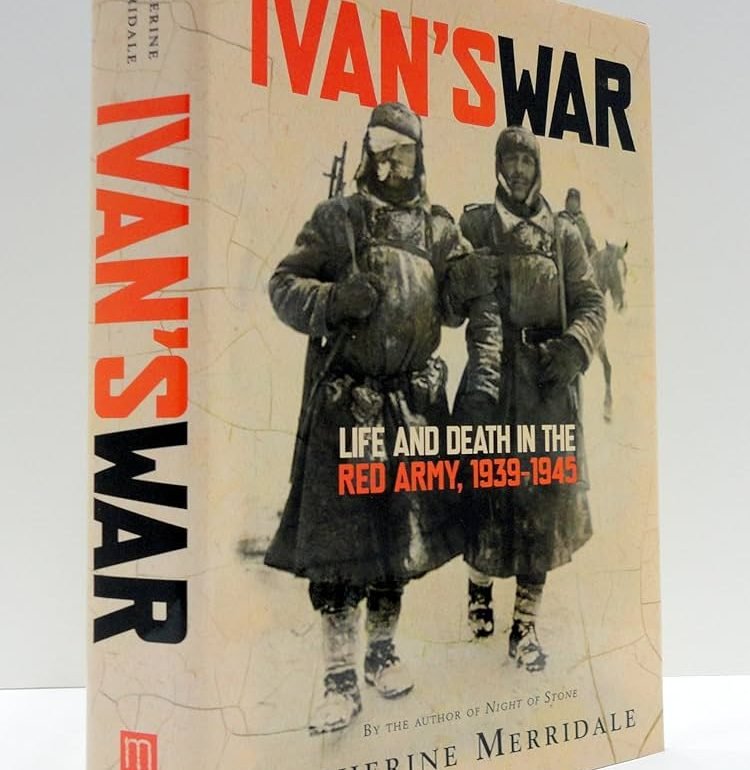
Ivan’s War, Life and Death in the Red Army, 1939-1945 by Catherine Merridale

March 10, 2026 by Barry J. Klazura No Comments

There is a popular vision of the war on the “Eastern Front” (so termed by Western historians as opposed to the “Great Patriotic War as the battle field is called by Soviet historians), that especially after the battle of Kursk, the German army was driven back by a better equipped resurgent Red Army.  The sufferings of the average Soviet soldier, especially during the first weeks after the invasion are remembered briefly but another popular image of a bedraggled German army from late 1943 through the end of the war persists.

Merridale, in this excellent book, does much to dispel the first myth (a better equipped Red Army), especially in the area of the life of the ordinary Soviet infantryman.  While it is true that once Soviet war production was brought fully on line, their ability to concentrate on one front (as opposed to the Germans who had to face battle in Western Europe, Italy, the Balkans, etc.) gave them a huge material advantage vs. the Wehrmacht.  At the sharp end of the bayonet, food shortages, worn out boots, poor medical care, an almost total lack of rotation and home leave as well as poor Generalship (charge across an undefended mine field, the losses would be the same as if there were no mine field but the Germans had protected it with machine guns) led to decreasing morale, insubordination and even a hope that once the Germans were driven off Soviet soil (as opposed to driving onto Berlin) that everyone could go home.  There was an increasing belief and hope that the sacrifices of the troops would lead to a better, easier life after the war as the people would have proven themselves capable of a better life.

She covers the subject of the general behavior of the Soviet troops, especially after leaving Soviet soil.  Wide spread rape, looting and sheer destruction, all justified as revenge for the acts of the Wehrmacht was seen even at the time as damaging to the image of the Soviet Union.  Yet, after three or more years of life at the front and the vicious propaganda  (officially approved) by writers such as Ilya Ehrenburg, the soldiers felt it was their right to degrade the Germans (and almost anyone else who fell in their clutches) with the worse punishments. Any Soviet citizens who were found in concentration camps (as prisoners) were also brutally treated as they were regarded as potential traitors (regardless of how they were captured and what they had endured).

The book also covers, to a lesser extent, the problems faced by couples who were separated for years, often within weeks after a hasty marriage. The average Soviet citizen also had a terrible war, even if they were not in German occupied territory.  Food rationing, strict security measures and the rule that any unaccounted Soviet soldier (due to death, capture, etc.) would be treated as a deserter and his family cut off from government assistance (including food coupons) left literally millions of mothers, wives and children on the verge of starvation. The readjustment to civilian life was difficult as any what we call PTSD was viewed as un-Soviet weakness and officially discounted.  That, plus the general poverty after the war, the cost of rebuilding thousands of destroyed villages and cities and a return to pre-war tight security and policing lead to the burying of bitterness and disillusionment.

Perhaps nothing puts the plight of the average Soviet soldier in perspective better than the fact that during the war, the Soviets executed over 150,000 of their own troops for desertion, cowardice, insubordination, etc.  This during a war when the U.S. executed one soldier for desertion.  There was after the war, for nearly two decades, little official recognition of the sacrifices by Soviet troops in their own land.  For decades, their sacrifices and those of their families were ignored and as the last of that generation dies out, for all their sins and foibles, they deserve a place of honor.
Share:
Reading time: 3 min
Book Reviews

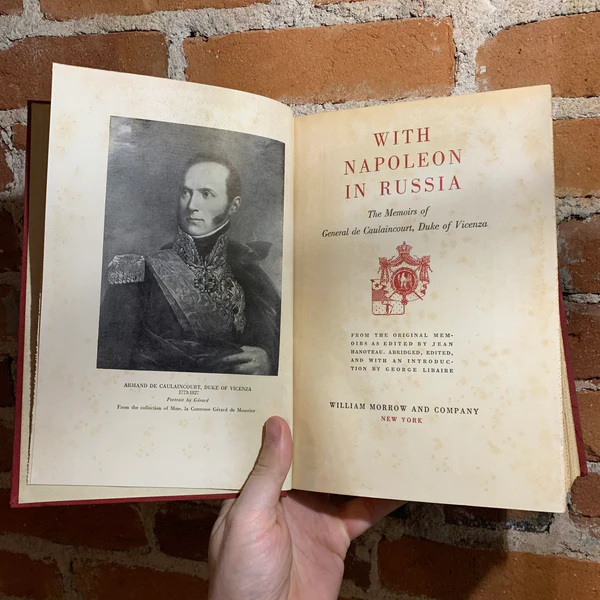
:  With Napoleon in Russia (1935 edition) by General de Caulaincourt, Duke of Vicenza

February 5, 2026 by Barry J. Klazura No Comments

The general (of a military and diplomatic career) provides an excellent intimate look at the thinking and logic of Napoleon at that critical time of the Empire.  Having served extensively at the court of the Tsar, de Caulaincourt was able to provide Napoleon with extensive information on the thinking of the Tsar, the country, etc.  The information provided however, was not to Napoleon’s liking and therefore was largely ignored, much to the agony of the Grand Army.  Yet Napoleon kept de Caulaincourt close to him (he was willing to keep those who provided excellent service close to him even if they provided information not to his liking) to the point where on the retreat from Moscow, and especially when Napoleon left the Grand Army, de Caulaincourt escorted him on that long and cold ride through Prussia, into Warsaw, and onto Paris.

 After the fall of Napoleon, he retired from public life and died of cancer in 1827.

This book is a must read for students of Napoleon as it gives an excellent view of his thinking, logic, prejudices, etc.  His views on the restoration of Poland, misreading of the Tsar, etc. are clear and fascinating. 

Share:
Reading time: 1 min
Book Reviews

The Tide at Sunrise: A History of the Russo-Japanese War, 1904-1905 by Denis and Peggy Warner

September 29, 2025 by Barry J. Klazura No Comments

Originally published almost fifty-years ago, this book is considered a classic history of the first war in which an Asian power defeated a European power. The authors do a wonderful job of putting the war in context, firstly by providing a thorough review of the Japanese response to the “opening of Japan” by the Americans and surprisingly, the Russians. They review the various strong warrior clans in a developing Japan and how the politics between those clans colored the strategy and conduct of the war.

They also provide a good overview of Russia which was as always, seeking to absorb more lands. Holding together the vast Russian empire was the trans-Siberian railroad. A single tracked ribbon of steel stretching nearly 9300 kilometers (about 5800 miles), was built poorly and with minimum safety. Entire sections of the track would shift and fall apart every year as they were laid directly on the permafrost, which could melt just enough to make sections subject to disintegration. To make communications, travel, and supply movements more difficult, the track stopped at Lake Baikal, the world’s seventh largest lake. Everything on the trains would have to be unloaded and shipped across the lake during the warmer months of the year. Trying to supply an army using this one-track railway extended the war and led to poor discipline within the army as munitions and food were slow in arriving.

The two nations clashed over several areas, including Korea, Manchuria, and China. China, having suffered defeats by the Japanese and force infringements by Russia, lay all but helpless as Russia and Japan moved to seize and hold what land they could. Land and resources were seized, railroads built to the distress of the Chinese and Chinese officials were corrupted even more than was standard practice within the Chinese government.

The siege of Port Arthur and the great naval battle of Tsushima of course are the main parts of the history. Both opponents faced difficulties which ended up limiting the length of the war. For the Russians, the main problem was the huge distance between Moscow and Port Arthur. Communications were poor, providing munitions to the slowly transported army was daunting, along with an officer corps that had few professional skills made any moves by the field army difficult, slow, and usually always a bit late. The Japanese were like the Russians, willing to throw manpower at any problem. But manpower was not enough so Japan’s limited technological base and lack of capital meant that the Japanese had to seek a quick victory as time could favor the Russians.

Eventually Port Arthur fell to the Japanese but one great test was still ahead for the waring powers; could the Russians said a fleet from the Baltic to fight the Japanese and could the Japanese navy which had suffered telling losses to the Russians, defeat the approaching Russian ships. The fact that the Russian fleet completed the voyage is amazing as they had to put up with poor food, an revolutionary undercurrent between the officers and men, numerous mechanical failures and the fact that every extra inch was occupied by bags of coal which were not only dirty, but hindered the efficiency of the ships. In the end, although the Japanese defeated their foe, it was not a battle loaded with brilliance, but rather a battle determined by luck and poor shooting on the part of the Russians.

Wars eventually come to an end and the mediation of Theodore Roosevelt took two exhausted nations and provided them with at least a modem of national honor. But, as no good deed does not go unpunished, in the end both Japan and Russia viewed the American effort as decidedly negative, thus tainting relations between the three nations for decades to come.

This is a fine book, professionally researched and footnoted, professionally written and showing a grasp not just of the top of history, but the real forces that move events. My only regret was that it took me almost fifty-years to reread it.

Share:
Reading time: 3 min
Book Reviews

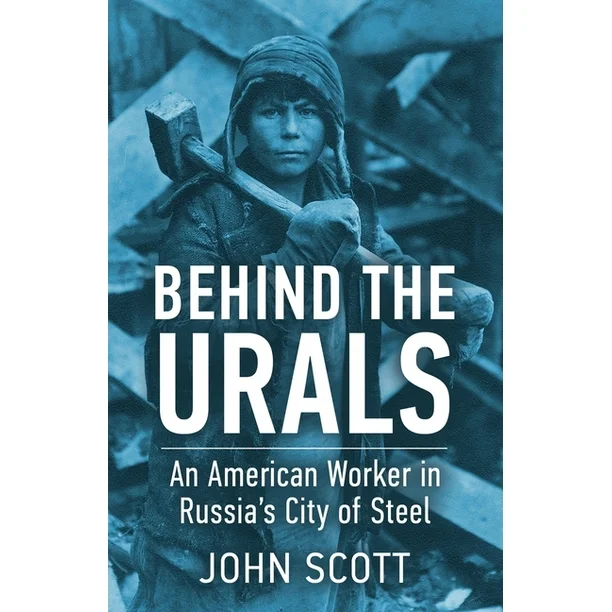
Behind the Urals: An American Worker in Russia’s City of Steel by John Scott

January 30, 2025 by Barry J. Klazura No Comments

During the Great Depression, thousands of Americans went to work in the Soviet Union which seemed to hold the answer to the failed policies of Capitalism. Stalin’s demand that electrification be brought to every corner of the Soviet Union meant that dams, railroads, in fact, all the basics of a modern industrial state be built in record time. In order to do this, Stalin made agreements with major U.S. firms, such as Ford, G.E., etc for entire factories including their key workers. U.S. citizens were promised good working conditions, housing, etc. on multi-year contracts to provide the managerial and technical expertise to complete and help manage those projects. Other thousands of Americans signed contracts to work in the Soviet Union on various projects. The history of this migration is told in an excellent book by Tim Tzovliadis, The Forsaken. In his book, he describes how they had to surrender their U.S. passports and for thousands, it meant they could not leave the Soviet Union. As Stalin’s projects were completed, or his paranoia increased, many were arrested and sent to various prisons and gulags.

Scott’s book gives us a ground level view of the living and working conditions at the steel city of Magnitogorsk. That city, built literally in the middle of nowhere, was sited there due to the proximity of the raw materials needed for the production of steel. Unpaved streets, lack of sewers, communal living with poor food, extremes in weather, lack of proper clothing, tools and no safety procedures give us an image of a wild west town which fought against nature and man’s stupidity rather than against rampaging Indians. Yet, people flocked to the area for work and because they believed they could be instrumental in building a better, freer, more equal world. Their idealism is wonderful to see, but also sad as what they are doing is helping to build a totalitarian state which would slaughter millions of their co-citizens.

This is an excellent book which gives the reader a look at history from the trenches.

Share:
Reading time: 1 min
Book Reviews

Siberia and the Exile System by George Kennan

September 11, 2024 by Barry J. Klazura No Comments

George Kennan (not to be confused with George F. Kennan, remembered for his famous “Long Telegram”) was a journalist and explorer. He wrote a number of books, including Tent Life in Siberia where he wrote about living with a number of Siberian tribes such as the Koraks, Yakoots, Gakouts and others. It was this experience that opened the door for him to return to Czarist Russia to author a book about the exile system in Siberia.

He initially was positive about the exile system as he felt it was a positive way to bring settlers to Siberia who would be able to repay society for their various crimes. Because he authored several positive articles on that system, he was granted almost unlimited access to the camps and officials despite the skepticism of various Czarist officials. 

Daniel Beer’s book, The House of the Dead: Siberian Exile Under the Czars reviewed here on 4/21/2023) wrote of an earlier version of the system and although he did not have firsthand experience, it outlines a terrible blot on the face of Czarism. Kennan’s book goes further as he spent months travelling across Siberia, visiting way stations, camps, and work sites as well as speaking to many Czarist officials himself.

Kennan very quickly changes his mind about the system as he immediately comes across suspicious officials who only put up with him due to his letters of introduction and directives signed by high officials from the capital. He describes the towns and villages of Siberia, mostly small, dirty, and rudimentary with only a thin veil of civilization and little culture. The European Russian inhabitants attempt to build some sort of livable community life, but they are the end of an exceptionally long and thin line, far from the capital and of no significant importance to the national concerns.

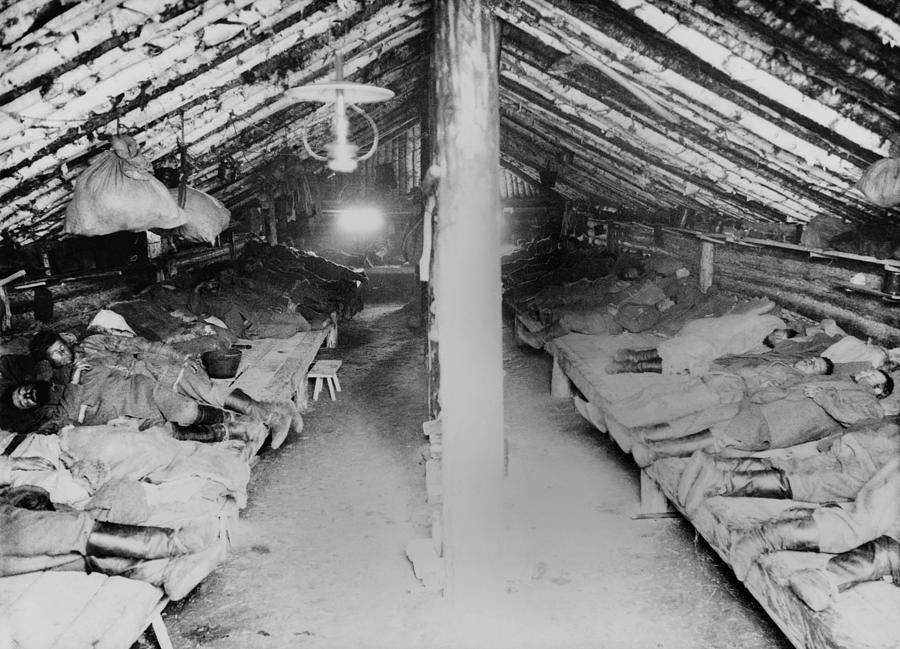
In visiting the actual camps themselves, he does find some dedicated officials (normally having served a shorter time in the system) as the system is simply overwhelmed by the sheer numbers of prisoners. There are more prisoners than camp buildings so the weaker prisoners sleep outside which is not that bad during the milder months as the interiors of the camp buildings are dark, poorly ventilated, and filthy due to the lack of proper sanitation. He writes that at times he is choaking from the stench of the buildings. Some officials show him stacks of letters they sent to their superiors asking for additional funds to construct new facilities, for more manpower to manage the prisoners, all to no avail. Most letters are never even acknowledged.

Continue reading
Share:
Reading time: 3 min
Book Reviews

Retribution: The Soviet Reconquest of Centrol Ukrain, 1943 by Prit Buttar

August 30, 2024 by Barry J. Klazura No Comments

Bloodlands, his 2010 history of Eastern Europe, Timothy Snyder presented a graphic picture of the continual wars, revolutions and famines which has plagued Ukraine and surrounding lands. We have seen for over two years with the Russian invasion of Ukraine more heartless killing and terror. In Prit Buttar’s Retribution we witness a merciless war of attrition between the Soviet Union and Nazi Germany as the Soviets drive to recapture an area which was overrun in 1941 and which suffered under the Nazi regime.

This is a detailed military book of that campaign which totally ignores the suffering of the local population. Caught between two gigantic military forces, we can only image the terrible cost that the locals faced when thousands of tanks, airplanes and hundreds of thousands of men on both sides fought in a no mercy military campaign driven and directed by military and political commanders who gave little if any thought to their own troops, let alone the civilians.

In a book of nearly five hundred pages, there are numerous eyewitness accounts by soldiers and field grade officers (most of them from the German side) which can very well lead the reader to exhaustion after only a few pages. The fighting was so brutal and unrelenting that it makes the battles of attrition of World War One almost seem to be less horrific than they were. Why? Because which World War One introduced the war between machines which replaced the wars between men, the leap in technology and lethality of the means of killing had exploded exponentially. Although the German army still had a slight professional edge, the Soviets had learned well from the Germans and had increased their ability to adapt and foresee the German defensive moves. Yes, the Soviets still used on many occasions the blunt force of superior numbers in both men and material, but the constant drain of experienced German officers, NCOs and material, though endless battles deprived the average German soldier of any hope of relief let alone victory.

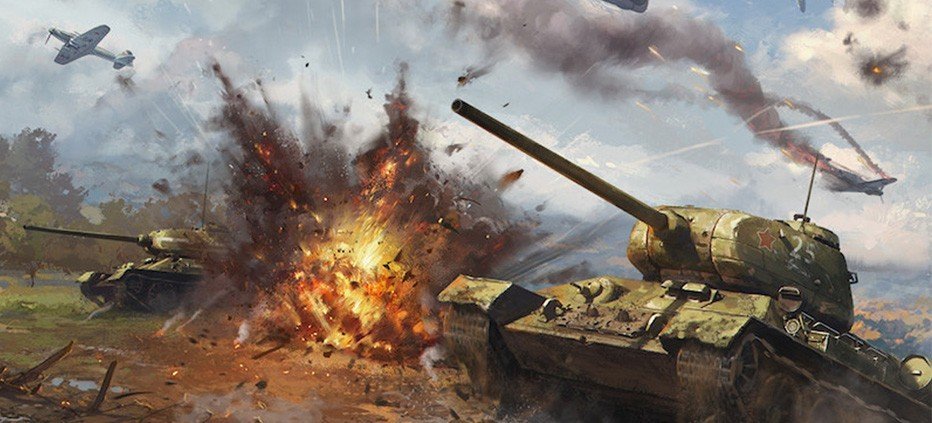
The individual German tank crews were still, tank for tank and man for man, superior to the average Soviet tank crew, but as would be the case in Western Europe in the next year, the Soviets like the Americans were willing to lost three or four tanks in order to kill one German tank.  The Soviets outproduced German production by a ratio of two, three and even four to one, and while the Soviets could concentrate their efforts in one continuous theater, the Germans had to spread their production and manpower over several theaters.

Was the reconquest of Central Ukraine a forgone conclusion? Nothing is ever guaranteed in war, but nothing short of a miracle could stop the Soviets. The mistakes of the Germans earlier in the war such as not knocking out England, or their defeat in North Africa, even the German declaration of war on the United States all came home to be paid in this campaign. The Germans decided to fight the world knowing that time was not on their side. When they committed serious errors which upset their timetable, they faced the reality they created.

The shame of it all is that we see another war of attrition in the same area today. Once again, the average person will pay the price for a tyrant’s illusions.

Share:
Reading time: 2 min
Book Reviews

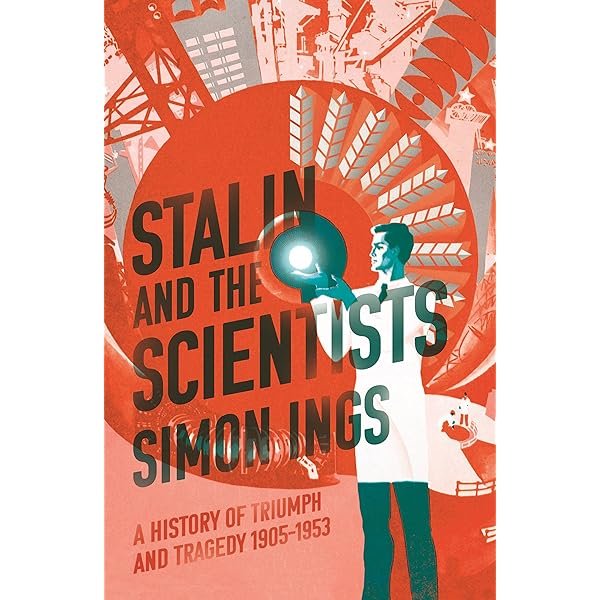
Stalin and the Scientists: A History of Triumph and Tragedy, 1905-1953 by Simon Ings

June 24, 2024 by Barry J. Klazura No Comments

According to Marxist “scientific thought”, man is shaped by his environment; change the environment and you can create a “New Man”.  The same belief applies to plants and animals.  Thus, it was that while the Soviet Union spent more on scientific research than any other nation, they also managed to produce some of the worse examples of what we would call “junk science”. 

Part of the problem was that it was believed that the masses which were held down by the forces of reaction, exploitation, etc., contained within them the seeds of greatness.  Thus, it was possible for a poorly educated individual like Trofim Denisovich Lysenko and others of his ilk to make fantastic claims of break throughs in agriculture and dominate the Soviet scientific community.  With the right backing (Stalin), Lysenko, who denied the existence of genes, kept many of the older, traditionally educated scientists in a scientific limbo.  They were forced to work secretly in small poorly equipped labs while millions of rubles and huge tracks of land were given over to dubious experiments and the results doctored to fit “Marxist scientific” thought.  Attempts were made to grow lemon trees above the artic circle, millions of trees were planted in arid waste lands in an attempt to change the environment (the trees all died from lack of water, brutal winters or scorching summers), etc.  Foreign species were introduced into areas where the wolves had been killed off with the result that those populations greatly expanded by they passed along their diseases to the local domestic cattle which caused a great death toll and thus shortage of beef in the country.  There was even a theory that apes could be used to inseminate women to create a new race.

During World War II, in the face of national disaster, the strict guidelines of adhering to Marxist theory was relaxed with the result that a newly educated generation of scientists were allowed more freedom.  The results were staggering as break throughs not only in weapon development, but also in agriculture and genetic research helped to save the State.  After the war however, many scientists were forced to adhere more closely to the pre-war scientific theories.  This included theory related to such fields as psychoanalysis, social psychology or individual psychology (Pavlov had not ventured into these areas, so research was not considered necessary).  The only psychologic theory that seemed to hold any sway was that anyone who did not adhere to Soviet thought must be schizophrenic.

While there was hope for greater freedom after Stalin’s death, the agricultural experiments and failures under Khrushchev were examples of the continuation of the continued life of the theories of Lysenko.  To this day, Russian agriculture continues to suffer for the errors of previous times.  The amazing thing is that even under the warped science theories of the time, there were positive break throughs which have been beneficial to the scientific and non-scientific worlds. 

This book is one great story of political correctness in the scientific world at that time and should serve as a warning to all of us, both scientist and non-scientist of the dangers of the concept of “settled science”, a frightening term if ever one existed.

Share:
Reading time: 2 min
Book Reviews

Stalin: Breaker of Nations by Robert Conquest

February 27, 2024 by Barry J. Klazura No Comments

There is certainly no shortages of histories and biographies of Stalin, one of the greatest mass murderers in history. His crimes, his murders were taken unlike his contemporary, Hitler, against for the most part, his own people. He did not have a policy of racial superiority or any underlying moral rationale for his crimes; his sole purpose was to achieve and maintain his power and in this, he is unique among the “big three” of mass murderers: Mao, Hitler, and Stalin.

Robert Conquest, perhaps the top historian of the Soviet Union has in this short book (just over three hundred pages), an excellent overview of Stalin’s drive, achievement, and maintenance of power. Although not as detailed as his other excellent histories which go deeper into the Stalin regime (The Harvest of Sorrow, The Great Terror: A Reassessment, Inside Stalin’s Secret Police: NKVD Politics 1936-39, etc.), Conquest along with Robert C. Tucker and Orlando Figes has provided a comprehensive analysis of the man and his times.

Conquest as always, manages to provide a certain analytical approach that can bring the reader up short: in this case, it is his comparison of the followers of Nazism and Communism. He quotes Hugh Seton-Watson’s comments that:

“Hitler’s Nazis were ‘fanatics with an ersatz religion,’ who rejected not only Christianity but also traditional morality as such. Nazism’s central feature was ‘moral nihilism’…. (it) is not only the central feature of National Socialism, but also the common factor between it and Bolshevism.” 

This statement is backed up by a review of leading Nazis, including Hitler, Goebbels, Mussolini, the dreaded Gauleiter of the Ukraine, Koch, and others who all started out as Socialist and ended up as either Fascists or Nazis. And it was not unusual after the war for die hard Nazi’s to reverse their coat and be taken into the Soviet camp. On one hand, the Nazis use race, the Communist used social origin as the determining factor for life or death; both were (are) based on “moral nihilism.”

Conquest is an outstanding historian, but for the amateur historian, his writing may be a bit too intellectual. He has a firm grounding in the Russian mindset and his analysis of Stalin’s legacy on modern day Russians is excellent. His works not only encompass history, as he has had published a collection of poetry, verse translation, fiction, and criticism so to read Conquest is to be exposed to a man of great intellect. A faster read but no less excellent Soviet historian is Orlando Figes brings a more human touch to his histories.

As one learns Conquest’s style, one is drawn increasingly to it and like a favorite composer, one eagerly looks forward to the next work of his that one shall read.

Share:
Reading time: 2 min
Uncategorized

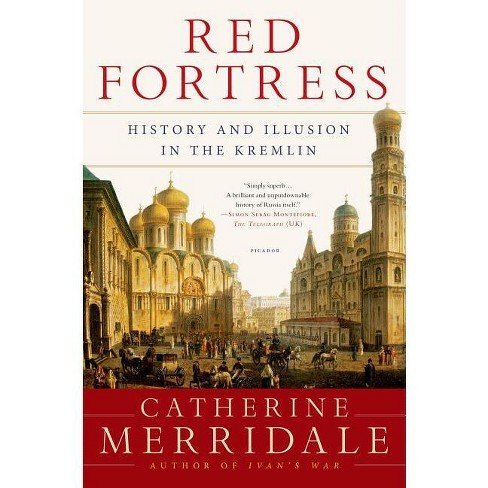
Red Fortress: History and Illusion in the Kremlin by Catherine Merridale

February 2, 2024 by Barry J. Klazura No Comments

When one thinks of Russia, the image of the Kremlin comes to mind.  In modern times (since 1917), the Kremlin has stood as the powerful image of a country which is difficult to grasp regarding its size, peoples and politics.  And, for most of history, the Kremlin has been used as the political seat of power in Russia.  Possession of this complex, which was built of wood for most of history and which has been destroyed by fire numerous times, has legitimized and symbolized the power of its owner.

Peter the Great moved his seat of government from Moscow to his new city on the sea (St. Petersburgh, then Petrograd, then Leningrad and finally St. Petersburgh) in order to start anew, away from the boyars (nobles) so he could make Russia look to the West.  The Bolsheviks moved the seat of power back to the Kremlin to show their break with the past and today the Kremlin remains the seat of Russian power, poised half way between the West and the East.  The Kremlin symbolizes the strength, stability and secret nature of the Russian state.

Burned, rebuilt, burned again and again, many treasures of the Kremlin have been lost, rebuilt and lost over the centuries.  Precious icons, jewels, rich gowns not to mention at times, the nations gold reserves were stored in the Kremlin.  Additionally, numerous churches and palaces of the closest noblemen were within it walls and all subject to the drives and whims of the Czar. It is as if Ft. Knox, the Library of Congress and the Smithsonian were all gathered together in a few square acres and closed to the public.  Then, time after time again the complex suffered from massive fires.

No one really knows the full extent of the secret rooms and tunnels within the compound. And, it represents an opportunity for miracles to the Russian people; a few years ago a sacred icon rumored to have been destroyed by the Bolsheviks were “found” as they had been secretly preserved by workers when they were sealed behind a false wall.  Although church attendance in Russia is falling, the “miraculous” recovery of the long-lost icon showed again the eternal strength and power of the Kremlin and its current “Czar” Vladimir Putin.

Share:
Reading time: 1 min
Page 1 of 61234»...Last »

Barry J. Klazura

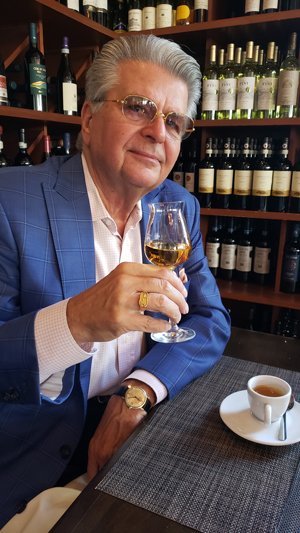
Barry Klazura sipping grappa

With a Masters Degree in Guerrilla Warfare and Totalitarianism, Mr. Klazura was well prepped for a career in Sales and General Management, consulting on corporate startups and turnarounds as well as lecturing on history and politics.  For the past twenty years he has focused on being a financial advisor and consulting.

Delivered To Your Inbox

Sign up to get an email when a new article is published.

Topics

  • American Civil War
  • Biography
  • Book Reviews
  • Cigar Reviews
  • Coronavirus
  • Current Affairs
  • Education
  • Environment
  • Factoids
  • Government
  • Lifestyle, Cigars & More
  • Liquid Refreshments
  • Musings
  • Quips and Historical Facts
  • Society
  • Travel
  • Uncategorized
  • World War I

Subjects

book Books-Russia/Soviet Union Books 21st Century Books 1919-2000 Books Ancient to 1900 Books Asia Books Biography Books Fiction Books Germany 1919-1945 Books Pre-WWI books Viet Nam books world war I Books WW1 Books WWI Books WWII Cigar Friendly Location Amsterdam Cigar Friendly Locations-London Cigar Friendly Locations-New Orleans Cigar Friendly Locations-New York Civil War Coronavirus Environment Korean War World War I World War One

Recent Articles

At Stalin’s Side by Valentin Berezhkov

July 15, 2026
The Price of Victory by N.A.M. Rodger

The Price of Victory by N.A.M. Rodger

June 26, 2026
Frontsoldaten: The German Soldier in World War II by Stephen G. Fritz

Frontsoldaten: The German Soldier in World War II by Stephen G. Fritz

June 5, 2026
Organizer of Victory, 1943-1945, George C. Marshall by Forrest C. Pogue

Organizer of Victory, 1943-1945, George C. Marshall by Forrest C. Pogue

May 26, 2026
Illegals Released & Our Leaders

Illegals Released & Our Leaders

May 10, 2026

Inquiries and Comments

For general inquiries and comments, email AOTOHcomments@gmail.com.

Facebook
© 2020 And On The Other Hand. All rights reserved.