
There is a popular vision of the war on the “Eastern Front” (so termed by Western historians as opposed to the “Great Patriotic War as the battle field is called by Soviet historians), that especially after the battle of Kursk, the German army was driven back by a better equipped resurgent Red Army. The sufferings of the average Soviet soldier, especially during the first weeks after the invasion are remembered briefly but another popular image of a bedraggled German army from late 1943 through the end of the war persists.
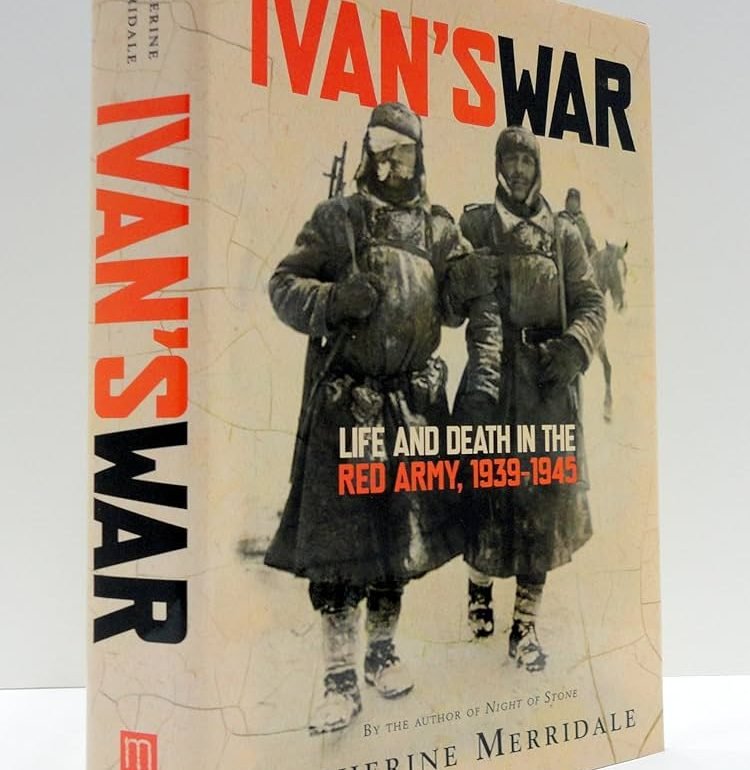
Merridale, in this excellent book, does much to dispel the first myth (a better equipped Red Army), especially in the area of the life of the ordinary Soviet infantryman. While it is true that once Soviet war production was brought fully on line, their ability to concentrate on one front (as opposed to the Germans who had to face battle in Western Europe, Italy, the Balkans, etc.) gave them a huge material advantage vs. the Wehrmacht. At the sharp end of the bayonet, food shortages, worn out boots, poor medical care, an almost total lack of rotation and home leave as well as poor Generalship (charge across an undefended mine field, the losses would be the same as if there were no mine field but the Germans had protected it with machine guns) led to decreasing morale, insubordination and even a hope that once the Germans were driven off Soviet soil (as opposed to driving onto Berlin) that everyone could go home. There was an increasing belief and hope that the sacrifices of the troops would lead to a better, easier life after the war as the people would have proven themselves capable of a better life.
She covers the subject of the general behavior of the Soviet troops, especially after leaving Soviet soil. Wide spread rape, looting and sheer destruction, all justified as revenge for the acts of the Wehrmacht was seen even at the time as damaging to the image of the Soviet Union. Yet, after three or more years of life at the front and the vicious propaganda (officially approved) by writers such as Ilya Ehrenburg, the soldiers felt it was their right to degrade the Germans (and almost anyone else who fell in their clutches) with the worse punishments. Any Soviet citizens who were found in concentration camps (as prisoners) were also brutally treated as they were regarded as potential traitors (regardless of how they were captured and what they had endured).
The book also covers, to a lesser extent, the problems faced by couples who were separated for years, often within weeks after a hasty marriage. The average Soviet citizen also had a terrible war, even if they were not in German occupied territory. Food rationing, strict security measures and the rule that any unaccounted Soviet soldier (due to death, capture, etc.) would be treated as a deserter and his family cut off from government assistance (including food coupons) left literally millions of mothers, wives and children on the verge of starvation. The readjustment to civilian life was difficult as any what we call PTSD was viewed as un-Soviet weakness and officially discounted. That, plus the general poverty after the war, the cost of rebuilding thousands of destroyed villages and cities and a return to pre-war tight security and policing lead to the burying of bitterness and disillusionment.
Perhaps nothing puts the plight of the average Soviet soldier in perspective better than the fact that during the war, the Soviets executed over 150,000 of their own troops for desertion, cowardice, insubordination, etc. This during a war when the U.S. executed one soldier for desertion. There was after the war, for nearly two decades, little official recognition of the sacrifices by Soviet troops in their own land. For decades, their sacrifices and those of their families were ignored and as the last of that generation dies out, for all their sins and foibles, they deserve a place of honor.