

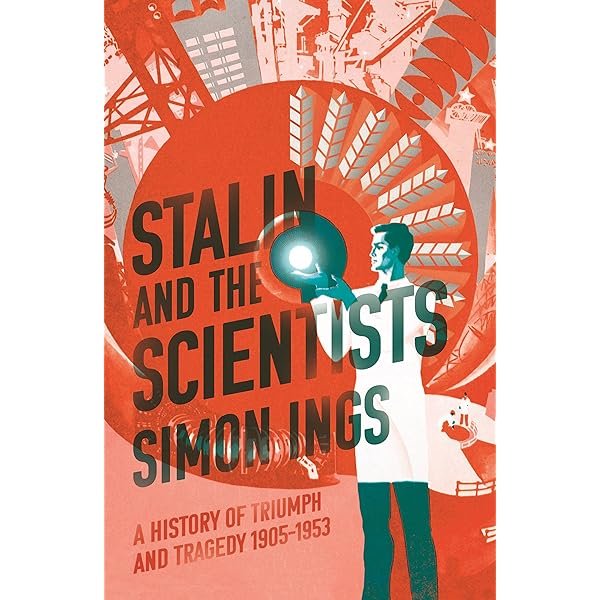
According to Marxist “scientific thought”, man is shaped by his environment; change the environment and you can create a “New Man”. The same belief applies to plants and animals. Thus, it was that while the Soviet Union spent more on scientific research than any other nation, they also managed to produce some of the worse examples of what we would call “junk science”.
Part of the problem was that it was believed that the masses which were held down by the forces of reaction, exploitation, etc., contained within them the seeds of greatness. Thus, it was possible for a poorly educated individual like Trofim Denisovich Lysenko and others of his ilk to make fantastic claims of break throughs in agriculture and dominate the Soviet scientific community. With the right backing (Stalin), Lysenko, who denied the existence of genes, kept many of the older, traditionally educated scientists in a scientific limbo. They were forced to work secretly in small poorly equipped labs while millions of rubles and huge tracks of land were given over to dubious experiments and the results doctored to fit “Marxist scientific” thought. Attempts were made to grow lemon trees above the artic circle, millions of trees were planted in arid waste lands in an attempt to change the environment (the trees all died from lack of water, brutal winters or scorching summers), etc. Foreign species were introduced into areas where the wolves had been killed off with the result that those populations greatly expanded by they passed along their diseases to the local domestic cattle which caused a great death toll and thus shortage of beef in the country. There was even a theory that apes could be used to inseminate women to create a new race.
During World War II, in the face of national disaster, the strict guidelines of adhering to Marxist theory was relaxed with the result that a newly educated generation of scientists were allowed more freedom. The results were staggering as break throughs not only in weapon development, but also in agriculture and genetic research helped to save the State. After the war however, many scientists were forced to adhere more closely to the pre-war scientific theories. This included theory related to such fields as psychoanalysis, social psychology or individual psychology (Pavlov had not ventured into these areas, so research was not considered necessary). The only psychologic theory that seemed to hold any sway was that anyone who did not adhere to Soviet thought must be schizophrenic.
While there was hope for greater freedom after Stalin’s death, the agricultural experiments and failures under Khrushchev were examples of the continuation of the continued life of the theories of Lysenko. To this day, Russian agriculture continues to suffer for the errors of previous times. The amazing thing is that even under the warped science theories of the time, there were positive break throughs which have been beneficial to the scientific and non-scientific worlds.
This book is one great story of political correctness in the scientific world at that time and should serve as a warning to all of us, both scientist and non-scientist of the dangers of the concept of “settled science”, a frightening term if ever one existed.






Leave a Comment