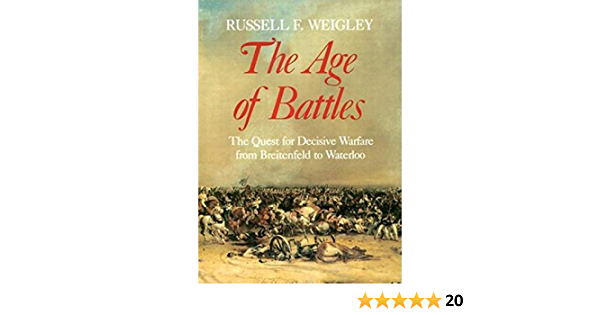
Victor Davis Hanson in his The Father of Us All; War & History, Ancient & Modern gives due credit to The Age of Battles as one of the finest examples of military history as indeed it is. Since it was first published in 1991, Weigley gives a continual history of warfare, mostly in Western Europe, from Breitenfeld to Waterloo. Starting with the revolutionary tactics of Gustavus Adolphus and ending with the defeat of Napoleon, the author traces the continual quest for the “decisive battle” as a short cut to victory.
After the terrible bloodbath of the Thirty Years War, which left Germany devastated with millions of dead, it seemed as if Europe had made a conscious decision that warfare had to be restructured. One of the key steps to this process was Hugonis Grotius, the historical rules for the limitation of war were formalized. These rules were loosely going back to the rules of chivalry (which were never terribly effective) covered dealing with civilians, plunder, and more. Many rulers in Europe recognized that while war was not going to disappear, they could at least try to limit the overall damage. It was amazing that with the rise of nation states and greater concentration of power and wealth, those who ruled suddenly realized that they had a personal stake in limiting wars which could be dangerous to their position and existence.
The military revolution went hand in hand with the greater solidification of centralized power. Gustavus Adolphus the leader of a small and poor European state (Sweden) realized that he had to take his disadvantage and turn it into a positive. The result was a small, highly trained, well disciplined, well fed and amazingly for the time, one that was paid on time. The result was an outstanding force of cavalry (changed and trained on Sweden’s wartime experiences in Poland) backed by a solid infantry trained on shock tactics. For example, the traditional cavalry tactic with the introduction of pistols was for the cavalry to charge the enemy, then stop and fire a volley and retreat. The effect as normally poor, as attempting to accurately wield a primitive pistol which was not only inaccurate but of small penetrating power hardly seemed worth the effort. Adolphus remembering the shock impact of the heavy Polish cavalry trained his cavalry to smash into the enemy formations, break then and then allow the infantry to finish the battle. For a while, he was the terror of Europe, but he ran into problems which he had not foreseen, such as the rise of the centralized state (or other kingdoms) which were larger and wealthier.
Therein lay the rub; how could a general win a war by scoring a decisive battle when the enemy was able how to tap into its own military advantages, such as manpower and wealth. Famously, Louis XIV restructured his system of taxation, developed a competent bureaucracy, and hired some of the best officers in Europe. The result was a dramatic increase in the size of the French military and in the professionalism of the military. Standard uniforms, drills, command structures, etc. all went to create a military that began to move like a machine instead of a mob. In particular, the French army the innovations in artillery made many of the old defensive infantry tactics an invitation to slaughter. Finally, instead of an army numbering ten or fifteen thousand, the French army expanded to number hundreds of thousands. How was a small state like Sweden to compete with power like that?
Unlike many military historians, the author manages to blend the personalities, goals and most importantly, innovations which led to each leader or generals’ temporary success on the battlefield. He also shows how the development of a professional military sped up the development of the industries necessary for it’s being.
He ends the book with the battle of Waterloo, where Napoleon, short of cavalry, surrounded by generals who were past their prime (as was he), head of an army from a nation which had already suffered a million dead from his reign was defeated by an polyglot army made up of, for the most part, traditionally second rate infantry but held together by Wellington who had nothing but distain for the average soldier. Although future generals and admirals would dream of a “decisive battle,” the time for any chance of such a battle has long passed. The modern state is too diverse with too many resources to disappear due to one loss, no matter how great. We have seen during the twentieth century how far the state will go and how much of its population it will sacrifice to survive.
This is the third time I have read the book and each time I have found the book stimulating and a reminder of the skills needed by successful leaders not only in the military, but in business or any endeavor where much is at stake. The ability to adapt and innovate is the one constant lesson to be learned from this work.