

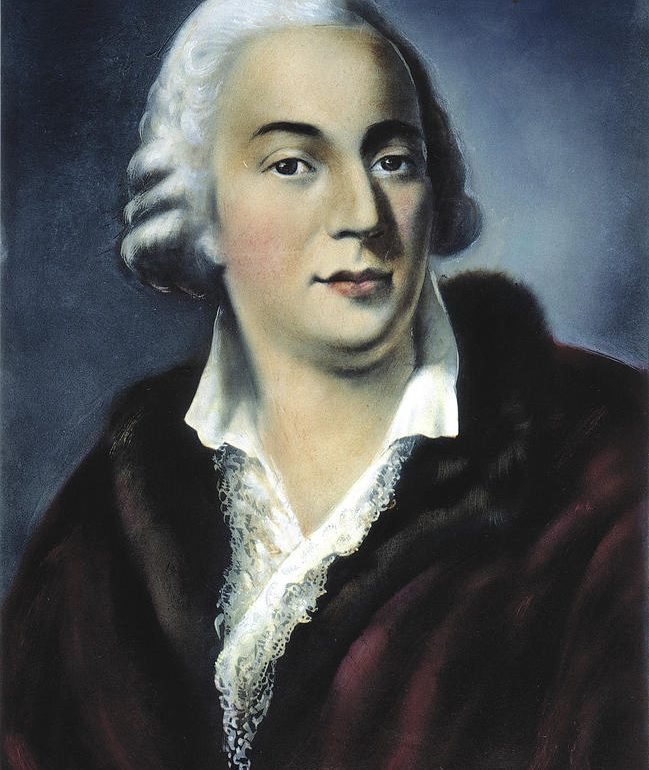
As depicted by Hollywood and popular culture, Casanova was a noted womanizer who had no conscience, made a habit of fleeing from irate husbands through second story bedroom windows and was always one step from receiving his just desserts. Casanova was a major womanizer (although the number of his “conquests” pale in comparison with today’s rock, sport and Hollywood celebrities) but he was also much more, having successfully lived in the courts of Spain, France and even Russia; he conversed with Voltaire and assisted Mozart and his librettist Lorenzo Da Ponte on the composition of Don Giovanni. Moving from country to country (he had been exiled from his native Venice), he lived by his wits, by gambling and late in life, by his writing.
Some of his most amazing adventures (with and without women) occurred in Venice before his exile. Venice at the time was still ruled by a clique of powerful families who were slowly dying out. They controlled the morals, politics and fortunes of the city and despite their lessening physical strength, kept the Republic under a tight control by means of spies and strict moral guidelines. The nobility, both men and women, when in public wore rigid white masks (often too in private) and Venetian laws specified severe punishments for those who violated the code. Women’s masks were held in place with a button held between the front teeth (it was therefore called the “silent mask”). In order to protect the “honor” of the younger women, they were placed in convents, but the girls found ways to slip away from the convents and cavort with their lovers such as Casanova even in the city. They were able to do this as the guild which controlled the gondolas insured that all members were sworn to secrecy; that secrecy provided them a sure stream of passengers who had their trysts in the enclosed areas of the gondolas. In fact, according to a French visitor, the “nuns (in the convents) are the most attractive among all the women in Venice…(and) their costume enhanced their good looks”.
Viewing the French Revolution, he realized that his world was being destroyed and in the last few years of his life he worked for eighteen hours a day on his biography which consisted of millions of words. He wanted to be remembered but he provided an outstanding view of his world and the circles in which he moved. While living on the good graces of the Prince de Ligne, he died in 1798. Yet his biography and writings lived on, first being published in 1822 in German, then in 1826 in French although those were poor versions. In 1943 his manuscript survived a direct bomb hit by an Allied bomb and in 1945 was saved by Allied forces. In 2010, the Bibliotheque national de France purchased the manuscript for over $9,000,000, the institution’s most expensive acquisition to date. In death, Casanova gained the fame and honor he sought all his life.






Leave a Comment