On The Other Hand -
Book Reviews
Lifestyle, Cigars & More
Musings
About
On The Other Hand -
  • Book Reviews
  • Lifestyle, Cigars & More
  • Musings
  • About
Book Reviews

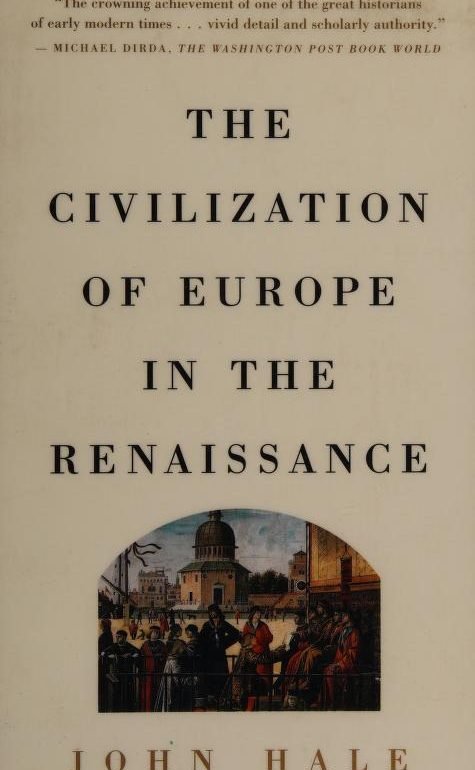
The Civilization of Europe in the Renaissance by John Hale

March 14, 2024 by Barry J. Klazura No Comments

Covering the period between 1450-1620, Hale brings into play all the forces around which everyday life evolved in Europe.  He traces the slow development of the roads, art, economics, religion, how the old warrior class took on new leadership roles and the slow gradual realization of national identities.  The concept of national identities could not have been achieved without the constant warfare of the age so while the time was often bloody for a small percentage of the overall population, the development of industries necessary for the wars themselves create economic opportunities and the build up of wider areas of cross trade.

Aside from the usual topics one would expect in a book like this, he also spends time looking at the daily lives of ordinary people and how they lived.   How did they dress, where did they shop, how were rules of civility created and enforced? What and how did a common language develop in any geographical area and how did that common language unite the people in becoming what we know as France or Germany, etc.  How were the average people able to live during the upheavals in Christianity which were driven not only by religious differences, but also by the various local rulers who saw the time as an opportunity to enrich themselves by pillaging monasteries, churches, etc. 

The book is not an especially easy read; not because it is not well written, for it is, but the amount of information available is extraordinary.  This is due not only to the usual method of using a wide brush, but also because he delves into the ordinary and discusses how movements, ideas, etc. could impact the people of Europe down to the poorest peasant.  It falls into the category of books that if one were ever asked to read one book on a subject, would the one recommended. 

Share:
Reading time: 1 min
Book Reviews

Considerations on the Causes of the Greatness of the Romans and their Decline by Montesquieu

March 4, 2024 by Barry J. Klazura No Comments

Charles Louis de Secondat, Baron de La Brede et de Montesquieu was from the middle of the 18th century through the founding of the United States, widely considered to be the preeminent political thinker of his time. His categorization of what constitutes a tyranny, an empire and a republic influenced our Founding Fathers in their debates and in the writing of the Federalist Papers. He was the principal architect of the theory of separation of powers and his main work, The Spirit of Law (1748) was well received throughout Europe and the thirteen colonies.

This work is considered a minor work, but I would like to suggest that no politician be allowed to take office until they have read and passed a test based on what he writes in this gem of a book.

Rome, like any organism or organization, had a period of growth followed by a decline. What were the causes of its growth? That is often asked as is, what caused its decline? Historians and others will argue those points for as long as Rome is remembered and everyone who attempts to answer those questions will be both correct and wrong. There were numerous causes but that in the end, as with other empires, the entire system simply imploded from lack of will, moral degeneracy and outside pressures that were simply more than could be managed given the resources available. Over time, the ideals and energy which helped the successful growth were lost and there were not enough good and strong men and women to hold the center together.

 Rome started as a small community, cut off from the sea, surrounded by numerous enemies, many of them larger. It had little natural wealth, barely any art and the citizens realized that the only way to enrich themselves was through pillage. Montesquieu believed that Rome’s power came from several factors, among them a constant drive for war, an unwillingness to accept defeat, an equal sharing of the plunder and a government which only allowed recognition and advancement through military success. Because Rome was always at war and because they adopted the best military practices of their individual neighbors, they simply excelled at war. They easily adopted the best skills of their military foes, such as cavalry, the Spanish short sword, etc. and use each in a way that helped to insure their victories. They developed a mindset which directed all activities of the State to be in the successful furtherance of war. Defeat was simply unacceptable and as was demonstrated during the war against Hannibal, no matter how often Roe’s field armies were defeated, they simply kept going after their nemesis until they achieved final victory. Such a mindset is not possible today as the technology of war simply makes war too expensive both in treasure and lives. So, what can we learn from the Romans? We can learn from them the reasons for their decline.

Continue reading
Share:
Reading time: 4 min
Book Reviews

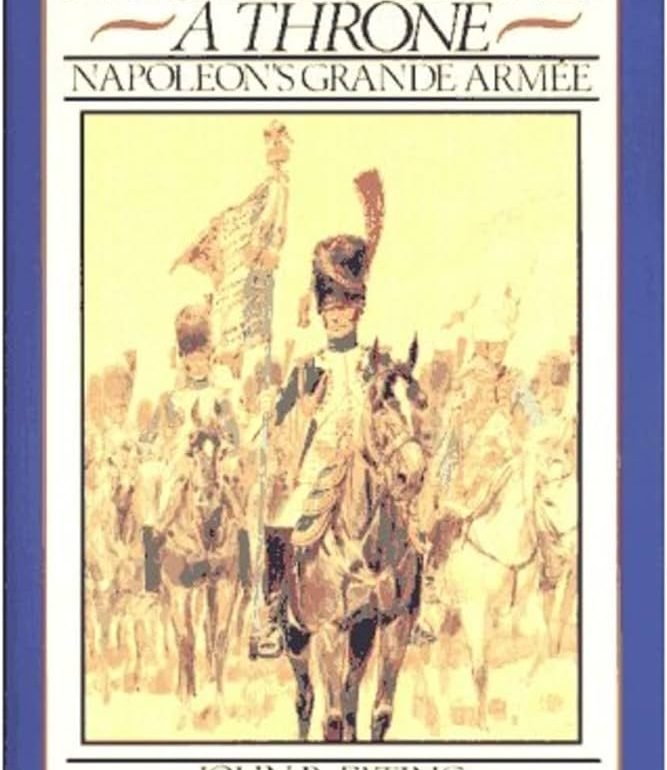
Swords Around A Throne by John R. Elting

February 26, 2024 by Barry J. Klazura No Comments

Elting, a noted historian and lecturer at West Point has put it all together in this 700+ page book.  He starts with a discussion of the decline of the French Army after King Louis XV and its destruction during the French Revolution.  He then proceeds to discuss every aspect of the Army, from the equipment, feeding, transportation, etc. of each branch of the Army, from the infantry to artillery, etc. 

An outstanding one volume history which ends with the new regime of King Louis XVIII, his mistrust of the Imperial army, his lack of skilled advisors, etc., and of course, the Hundred Days of Napoleon.  I would recommend that if you are going to read this book, that you keep handy “Napoleon’s Marshals” which was edited by David Chandler. This book discusses (each Marshal is covered by a different historian) the records of all of Napoleon’s Marshals (25 French, one Polish) including their skills, greed, loyalty (or lack thereof), etc. 

Another wonderful reference book to settle or at least provide fodder for any discussion of the subject (Napoleon’s campaigns, his personal skills, etc.).  The two books total about 1200 pages so don’t think you will finish them in a sitting, but they are well worth the effort.  If nothing else, as with so much of history, you learn a great deal about human nature and management.

Share:
Reading time: 1 min
Book Reviews

The Civilization of Europe in the Renaissance by John Hale

February 20, 2024 by Barry J. Klazura No Comments

Covering the period between 1450-1620, Hale brings into play all the forces around which everyday life evolved in Europe.  He traces the slow development of the roads, art, economics, religion, how the old warrior class took on new leadership roles and the slow gradual realization of national identities.  The concept of national identities could not have been achieved without the constant warfare of the age so while the time was often bloody for a small percentage of the overall population, the development of industries necessary for the wars themselves create economic opportunities and the build up of wider areas of cross trade.

Aside from the usual topics one would expect in a book like this, he also spends time looking at the daily lives of ordinary people and how they lived.   How did they dress, where did they shop, how were rules of civility created and enforced? What and how did a common language develop in any geographical area and how did that common language unite the people in becoming what we know as France or Germany, etc.  How were the average people able to live during the upheavals in Christianity which were driven not only by religious differences, but also by the various local rulers who saw the time as an opportunity to enrich themselves by pillaging monasteries, churches, etc. 

The book is not an especially easy read; not because it is not well written, for it is, but the amount of information available is extraordinary.  This is due not only to the usual method of using a wide brush, but also because he delves into the ordinary and discusses how movements, ideas, etc. could impact the people of Europe down to the poorest peasant.  It falls into the category of books that if one were ever asked to read one book on a subject, would the one recommended. 

Share:
Reading time: 1 min
Book Reviews

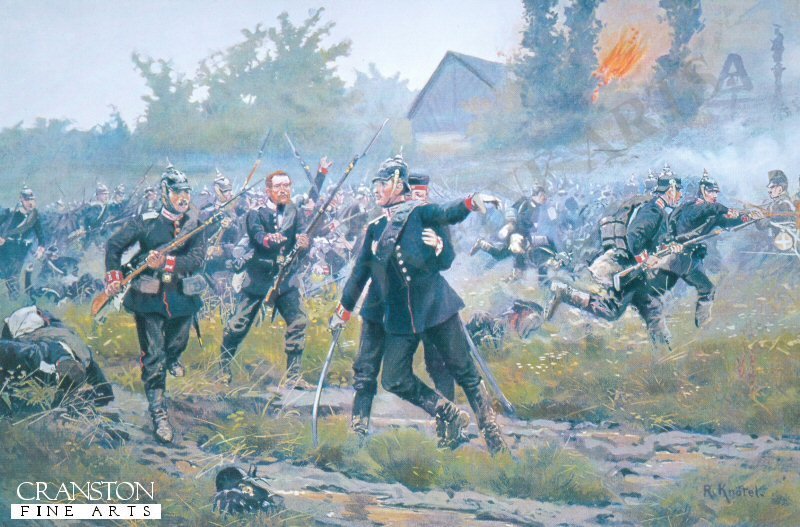
Bismark’s War: The Franco-Prussian War and the Making of Modern Europe

December 3, 2023 by Barry J. Klazura No Comments

A few years ago, my wife and I spent a month in France, starting at the Normandy battlefields and driving eastward towards Verdun.  It was an amazing trip as we covered several different wine making areas and ran across many monuments to battles and wars.  It was clear to us that France was a nation that had suffered from hundreds of years of war.  One special find was just outside of the hedgerows of Normandy on a quiet side country road.  A marker had been placed which outlined a skirmish between a U.S. infantry patrol and a German platoon backed up by an armored vehicle.  A small accidental meeting of two groups of men in which the outnumbered and outgunned Americans were pushed back by the Germans.  Some locals had decided to memorialize the long-forgotten clash so that later generations might realize that that lovely, quiet piece of land was not ruled by a hated enemy as it had been liberated at the cost American liberators.

Later during the month, further east, we ran across a beautiful museum which was dedicated to the battle of Gravelotte, during the Franco-Prussian war of 1870.  It is still vivid in my mind as it featured beautiful paintings of the battle which was the costliest of that war.  The displays were so dignified and in keeping with the spirit of the current time and gave equal time and coverage to both the French and the Prussians. What a gem of a museum!

I bring those instances up because it was with great delight that I read a very positive review of Rachel Chrastil’s new book, Bismark’s War, The Franco-Prussian War and The Making of Modern Europe.  While I was familiar with the war, it was primarily due to two biographies of Bismark, one by Alan Palmer and the other by Jonathan Steinberg, plus earlier books detailing the war.  I was therefore surprised at the direction of this book, and I could not recommend this history to anyone who does not have some background of the war. Why?  A few reasons:

  1. There is little attempt to put the war in context: Most histories would provide the basics of what led up to the war, which in this case could include Bismark’s two previous wars, the downward spiral of Napoleon III government, the tensions between the southern German states and Prussia, etc. The infamous Ems telegram is mentioned but not discussed.  Given this lack of context, an uninformed reader would wonder why the title when it could have been Napoleon’s War.
  2. Military equipment: Why was the Prussian Guards unit so decimated by the French Chassepot rifle and the mitrailleuse and why did the Prussians use the needle gun?  What made the Chassepot such a powerful weapon? Why was the Prussian artillery so superior to the French? How did the confusion at the start of the war on the part of the French impact their strategy? Etc.
  3. Personalities: While the major players are named, the reader is expected to know the experience/personality of each, such as von Moltke, von Roon, Crown Prince Wilhelm, etc.  A bit of background would help the average reader understand the strategy and restraints on these individuals.
  4. Strategy: Early on there is a brief discussion of how military strategy had been changing, based in part on the foreign observers in the American Civil War.  Unfortunately, that discussion was rather short so one is left to wonder why the lessons of that war were not more fully learned by some of the combatants. What was it about the European mind set that allowed it to ignore the terrible impact of modern weapons with their increase in range and rate of fire?  Did the Europeans view the American experience as not applicable to Europe since the Americans were amateurs whereas the Europeans were the masters of war?
  5. Personal detail: Since the war was fought on French soil, it is natural that any discussion on the civilian population would be more French based but there is little discussion regarding the impact on the German population.  How supportive was the average Southern German to the war and did the mobilization of so many men negatively impact those economies?  Nearly all the personal detail was based on the French experience and given the higher literacy rate in Germany, one would expect to find more detail on the attitude of the German civilians from memoirs, news reports, etc.
  6. Lastly, how was Bismark able to string together the German coalition give the general dislike and mistrust of the Prussian power, the religious differences between the northern and southern Germans and the natural inclination of many German states to surrender their sovereignty over international affairs.  That story is amazing and shows the brilliance of Bismark, but you will not find out about it here.

The author has done good research in several areas but seems to assume a general knowledge of the average reader.  I believe that being the case that most readers who possess a modem of curiosity will walk away with more questions than answers. I would like to recommend another book for the first time reader of this war: The Franco-Prussian War by Geoffrey Wawro.

Share:
Reading time: 4 min
American Civil War, Book Reviews

Shrouds of Glory: From Atlanta to Nashville by Winston Groom

August 30, 2023 by Barry J. Klazura No Comments

Winston Groom is best known for his book (and the hugely successful movie), Forrest Gump.  He is the author of six books as well as the co-author of the 1984 Pulitzer Prize nominee, Conversations with the Enemy.  In this excellent book, he focuses on the Confederate General John Bell Hood and his invasion of Tennessee late in the Civil War.

During that campaign, he attempted to distract Union General William Tecumseh Sherman from his famous campaign which burned out the very heart of the Confederacy during his march from Atlanta to the sea.  Hood was unsuccessful in deterring Sherman and managed at the same time to destroy his army in futile attacks against Union forces.

His failure was not preordained, for his record prior to the Battle of Atlanta had been one of a brave and ferocious fighter.  Although not the brightest of the Confederate generals (he graduated 44th out of a class of 52), he had served well in several campaigns and was until the Battle of Atlanta, considered a dashing and rising Confederate star.

Although Hood was criticized for his failure to hold Atlanta, one must remember that he entered the campaign late in the game as his predecessor General Joseph E. Johnston had failed to stop Sherman as he advanced on Atlanta.  Yet, despite Hood’s experiences with the power of defensive firepower, Hood threw his army at Sherman in an effort to sweep him from the field.  The attack resulted in thousands of Confederate casualties at a point in the war where they could not be easily replaced.  Hood had to leave Atlanta and some of his glory was lost.

The invasion of Tennessee was a prime example of “what might have been”, as within a short span of forty-eight hours, Hood lost not one, not two, but six opportunities to destroy the Union army that would later turn and destroy his army.  The battle of Franklin decided the campaign but there would be one more defeat at Nashville and with it, the fate of the South was sealed.

Groom provides excellent cameo descriptions of many Union and Confederate leaders throughout the book and his descriptions of the battles will keep the reader going back to read passages for their excitement and detail.  He also goes into the politics and schemes of various senior officers as they attempt to enhance their reputations and positions through a variety of nasty and dubious tricks.

I have often wondered why, aside from an attempt to sooth Southern feelings, a major military based was named after a General who after years of war, did not understand the days of massed Napoleonic charges were over.  He, like General Lee, seemed to have a blind spot to the realities of not having a numeric advantage and the deadliness of “modern” weapons.  Perhaps it is well that the name of Fort Hood has been changed.  Hopefully it is to the name of a more realistic General.

Share:
Reading time: 2 min
Book Reviews

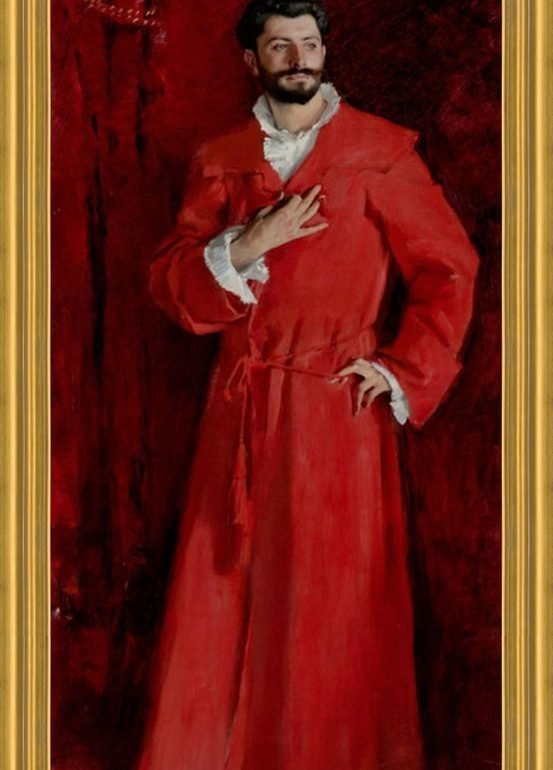
The Man in the Red Coat by Julian Barnes

July 27, 2023 by Barry J. Klazura No Comments

It is the time of the Belle Epoque in France and during the summer of 1885, Samuel Pozzi, the Comte De Montesquiou and Edmond de Polignac decided to visit London for a few days of intellectual shopping.  These three men represent the best and the worse of that time in France; they moved in the same circles; they were very friends but not rivals.

Of the three, Pozzi, Dr. Samuel Pozzi is the lead character in this book and is the man in the red coat.  In that famous painting by John Singer Sargent, he captures the mindset and Pozzi’s vision of his place in the world.  Pozzi unlike the other two individuals central to the book was a “productive” man, known for being a society doctor, a man of science, the doctor who brought French medicine into the nineteenth century. Brilliant, handsome, and cultured, he moved effortlessly through French and English society.  Married but a lover of women who found him all but irresistible, he was welcomed at the finest houses. Pozzi introduced modern gynecology to France and was feted in England for his break throughs in medical hygiene and surgery which led to shorter and higher recovery rates.  When he took over the Lourcine-Pascal Hospital in 1883, it was almost entirely occupied by those infected with venereal disease which was very common in the poor population.  He restructured the hospital, added wings, and went on to create the first gynecological clinic and chair at a university in France.

As we move through the book, we are brought into the society and world of the upper class, mostly in France, somewhat in England.  If one is broke but with a great name, such as Montesquiou and Polignac, one will move smoothly though the houses of the rich and those who play the part.  The parties, affairs, marriages made for financial and name considerations allow men and women to live a life far beyond the lives of the average.  Snobbery is taken to be a fine art, and it continues until the Great War of 1914.

I believe the author enjoyed writing this book as he has felt free to insert his own witticisms and caustic remarks from time to time; they help to keep the reader engaged and draw attention to a detail that might have otherwise been overlooked.  Although not for everyone, the book gives an excellent glance into a world that is long gone, taking its abuses, but also unfortunately, its finest moments with it. It was a time when a man (or woman) could make their mark in the world by combining their talents and interests to create their own unique image.

Share:
Reading time: 2 min
Book Reviews

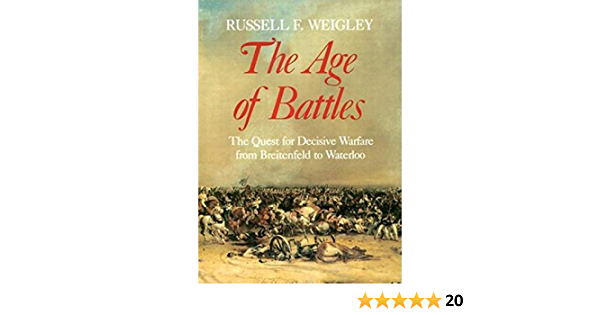
The Age of Battles by Russell Weigley

May 14, 2023 by Barry J. Klazura No Comments

Victor Davis Hanson in his The Father of Us All; War & History, Ancient & Modern gives due credit to The Age of Battles as one of the finest examples of military history as indeed it is. Since it was first published in 1991, Weigley gives a continual history of warfare, mostly in Western Europe, from Breitenfeld to Waterloo. Starting with the revolutionary tactics of Gustavus Adolphus and ending with the defeat of Napoleon, the author traces the continual quest for the “decisive battle” as a short cut to victory.

After the terrible bloodbath of the Thirty Years War, which left Germany devastated with millions of dead, it seemed as if Europe had made a conscious decision that warfare had to be restructured. One of the key steps to this process was Hugonis Grotius, the historical rules for the limitation of war were formalized. These rules were loosely going back to the rules of chivalry (which were never terribly effective) covered dealing with civilians, plunder, and more. Many rulers in Europe recognized that while war was not going to disappear, they could at least try to limit the overall damage. It was amazing that with the rise of nation states and greater concentration of power and wealth, those who ruled suddenly realized that they had a personal stake in limiting wars which could be dangerous to their position and existence.

The military revolution went hand in hand with the greater solidification of centralized power. Gustavus Adolphus the leader of a small and poor European state (Sweden) realized that he had to take his disadvantage and turn it into a positive. The result was a small, highly trained, well disciplined, well fed and amazingly for the time, one that was paid on time. The result was an outstanding force of cavalry (changed and trained on Sweden’s wartime experiences in Poland) backed by a solid infantry trained on shock tactics. For example, the traditional cavalry tactic with the introduction of pistols was for the cavalry to charge the enemy, then stop and fire a volley and retreat. The effect as normally poor, as attempting to accurately wield a primitive pistol which was not only inaccurate but of small penetrating power hardly seemed worth the effort. Adolphus remembering the shock impact of the heavy Polish cavalry trained his cavalry to smash into the enemy formations, break then and then allow the infantry to finish the battle. For a while, he was the terror of Europe, but he ran into problems which he had not foreseen, such as the rise of the centralized state (or other kingdoms) which were larger and wealthier.

Therein lay the rub; how could a general win a war by scoring a decisive battle when the enemy was able how to tap into its own military advantages, such as manpower and wealth. Famously, Louis XIV restructured his system of taxation, developed a competent bureaucracy, and hired some of the best officers in Europe. The result was a dramatic increase in the size of the French military and in the professionalism of the military. Standard uniforms, drills, command structures, etc. all went to create a military that began to move like a machine instead of a mob. In particular, the French army the innovations in artillery made many of the old defensive infantry tactics an invitation to slaughter. Finally, instead of an army numbering ten or fifteen thousand, the French army expanded to number hundreds of thousands. How was a small state like Sweden to compete with power like that?

Unlike many military historians, the author manages to blend the personalities, goals and most importantly, innovations which led to each leader or generals’ temporary success on the battlefield. He also shows how the development of a professional military sped up the development of the industries necessary for it’s being.

He ends the book with the battle of Waterloo, where Napoleon, short of cavalry, surrounded by generals who were past their prime (as was he), head of an army from a nation which had already suffered a million dead from his reign was defeated by an polyglot army made up of, for the most part, traditionally second rate infantry but held together by Wellington who had nothing but distain for the average soldier. Although future generals and admirals would dream of a “decisive battle,” the time for any chance of such a battle has long passed. The modern state is too diverse with too many resources to disappear due to one loss, no matter how great. We have seen during the twentieth century how far the state will go and how much of its population it will sacrifice to survive.

This is the third time I have read the book and each time I have found the book stimulating and a reminder of the skills needed by successful leaders not only in the military, but in business or any endeavor where much is at stake. The ability to adapt and innovate is the one constant lesson to be learned from this work.


Share:
Reading time: 4 min
Book Reviews

The House of the Dead; Siberian Exile Under the Tsars by Daniel Beer

April 21, 2023 by Barry J. Klazura No Comments

Siberia after it was conquered by the Russian Empire, was consider a land of huge wealth, from the priceless furs (a single Ermine pelt was enough to buy a good farm in Russia) to timber and gold, it was also known as the world’s largest prison without a roof.  A land where landless free peasants to go to in order to escape the tyranny of the Tsars and to build a new life, it also served as a great dumping ground for all manner of criminals, both political and non-political (one could be sent to Siberia for life long exile for being a vagrant).  As the population of Russia grew, and the central government could not provide the services for the population, Siberia became a way for lazy local officials to get rid of those they considered problematic.

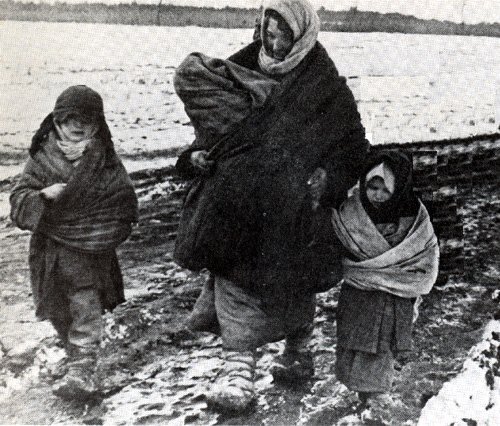
The journey to Siberia until the advent of the Trans-Siberian railway was most on foot.  Imagine walking, 6 days out of 7, week in, week out, in the Siberian summer and winter for one to two years just to reach your place of exile.  And, your term of punishment did not begin until you completed that journey.  During that journey you were, unless supported by your family who could provide you funds, at the mercy and budget of the prison system which provided a minimum of food and clothing both during the trek and at your place of exile.  The system was so terrible, that some male prisoners would often write their wives telling them to sell everything and come to Siberia where the government was providing each prisoner with land, a cow, horse, house and funds.  In reality, nothing was provided and when the wife arrived with children in hand, their husbands would sell them all into prostitution in order to get enough money to live.

After the term of punishment was completed, as the theory went, the ex-prisoners who had been taught discipline and hard work, would stay in Siberia and begin new farms which would colonize the vast land.  In reality, the prisoners had been so brutalized by the guards, other prisoners and hard labor, that they turned to the only things they had really learned in exile; stealing, forgery, murder, etc.  The large numbers of former prisoners would often wander in bands, laying siege to individual farms and even smaller villages and towns.

Continue reading
Share:
Reading time: 3 min
American Civil War, Book Reviews

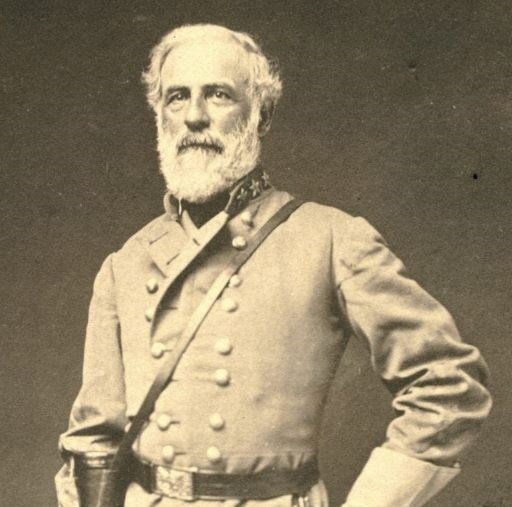
Lee Considered: General Robert E. Lee and Civil War History by Alan T. Nolan

April 11, 2023 by Barry J. Klazura No Comments

If there is one consistent image that has come out of the Civil War, it has been of Robert E. Lee, the calm, brilliant strategist who fought for the Confederacy out of a sense of loyalty to his state of Virginia; a soft spoken man, opposed to slavery but believing more in State’s Rights and the honor of the South.

Many of these myths are exploded in this book as Nolan quotes from Lee’s pre-war letters regarding the institution of slavery; how the slaves were well looked after, how they were better off in their present condition than when they were in Africa as they had the opportunity, at some undisclosed date, to become better than they were (although they could not be as good as whites).  Yes, Lee admitted that there were abuses, but they were few and sometimes necessary to keep the blacks in check until that golden day in the future where they could move up the human food chain. 

Nolan also criticizes Lee as a general in that he failed to fully understand until too late the overwhelmingly destructive firepower of “modern” rifles and artillery.  A prime example of this could be seen at Gettysburg where Lee ignored the strategy put forth by General Longstreet to hit the U.S. army on its flanks.  Instead, Lee threw the fresh troops of Pickett into an assault on the center of the Union line with no reserves at hand so that even if Pickett’s troops had been successful, they would have been swamped by Meade bringing up reserves from both of his wings.  Lee believed in the power to the spirit and was certainly not the last General to fall prey to the idea; the French army in the beginning of World War I was another force that failed to comprehend the full implications of “modern” technology. 

After the Civil War, Lee held an honored place in the minds of most Southerners, even though he admitted that he realized after Gettysburg that the South could not win the conflict.  He fought on and kept his troop together in a cause that was lost against a foe that was more ruthless than he could be in the conduct of the war.  The hundreds of thousands who died after his realization must be in part, laid at his feet but the myth of Lee will not be laid to rest until sometime in the future.

A good book for the reader who is unfamiliar with revisionist history, but a revisionist history that has much merit.

Share:
Reading time: 2 min
Page 2 of 5«1234»...Last »

Barry J. Klazura

Barry Klazura sipping grappa

With a Masters Degree in Guerrilla Warfare and Totalitarianism, Mr. Klazura was well prepped for a career in Sales and General Management, consulting on corporate startups and turnarounds as well as lecturing on history and politics.  For the past twenty years he has focused on being a financial advisor and consulting.

Delivered To Your Inbox

Sign up to get an email when a new article is published.

Topics

  • American Civil War
  • Biography
  • Book Reviews
  • Cigar Reviews
  • Coronavirus
  • Current Affairs
  • Education
  • Environment
  • Factoids
  • Government
  • Lifestyle, Cigars & More
  • Liquid Refreshments
  • Musings
  • Quips and Historical Facts
  • Society
  • Travel
  • Uncategorized
  • World War I

Subjects

book Books-Russia/Soviet Union Books 21st Century Books 1919-2000 Books Ancient to 1900 Books Asia Books Biography Books Fiction Books Germany 1919-1945 Books Pre-WWI books Viet Nam books world war I Books WW1 Books WWI Books WWII Cigar Friendly Location Amsterdam Cigar Friendly Locations-London Cigar Friendly Locations-New Orleans Cigar Friendly Locations-New York Civil War Coronavirus Environment Korean War World War I World War One

Recent Articles

At Stalin’s Side by Valentin Berezhkov

July 15, 2026
The Price of Victory by N.A.M. Rodger

The Price of Victory by N.A.M. Rodger

June 26, 2026
Frontsoldaten: The German Soldier in World War II by Stephen G. Fritz

Frontsoldaten: The German Soldier in World War II by Stephen G. Fritz

June 5, 2026
Organizer of Victory, 1943-1945, George C. Marshall by Forrest C. Pogue

Organizer of Victory, 1943-1945, George C. Marshall by Forrest C. Pogue

May 26, 2026
Illegals Released & Our Leaders

Illegals Released & Our Leaders

May 10, 2026

Inquiries and Comments

For general inquiries and comments, email AOTOHcomments@gmail.com.

Facebook
© 2020 And On The Other Hand. All rights reserved.