

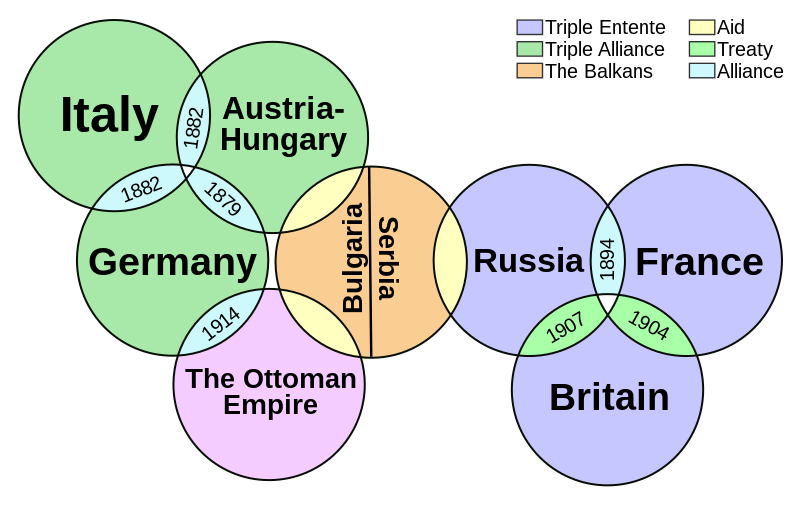
During World War II, an Italian Senator who was forced to resign his post by Mussolini. This was the man who in 1925 published his three-volume work on the causes of the First World War. At 2280 pages, Senator Albertini provides the serious student of history with a detailed, inside glimpse at European power politics reaching back into the mid 19th century. In these volumes he exposes to the light of day the most minute diplomatic dispatches as well as his own personal discussions with many of the diplomats who had key roles in the lead up to the First World War.
Reading diplomatic dispatches, letters and notes is never fascinating in the best of times, and with the distance of time, it is often difficult to remember or place correctly the individual players. German Foreign Ministers of the Kaiser come and go; diplomats of the Czar long forgotten are suddenly brought back to light and the internal wrangling of the Austro-Hungarian Empire between the pro-German factions and the landed Magyars who are at direct logger heads with the Austrian Foreign office can be mind numbing. Added to the pile of information are the even more obscure Italian officials who want so badly to be taken seriously by the “great” European powers and are generally scorned, mistrusted and pushed aside and you have a web of intrigue that is difficult to follow without copious notes or a mind trained to a unusually high level of boredom.
Yet the volumes can also at times read like a great mystery tale, but one in which you know the outcome and which, at times, you want at times to reach back in time to throttle, berate and besiege the players so that the terrible bloody outcome can somehow be avoided. At times you begin to see the engine of history moving forward, picking up speed and moving in what seems to be an unstoppable manner to the conclusion which chewed up the lives, future, and fortune of so many tens of millions of individuals. At times you must put the book down as you shake your head with the knowledge of future events which seem so clear nearly a hundred years later, but which were so shrouded at the time. The book can be infuriating and at times you hope there is a God with a sense of Justice, with a capital “J”. You hope there truly is a day of reckoning for so many individuals, such as:
- Britain’s Secretary of State for Foreign Affairs, Sir Edward Grey who was so lazy and oblivious to the dangers of that July 1914, or,
- The Russian Czar, an autocrat who was too stupid to be an autocrat and who had no idea of what the term “mobilization” meant to the powers around him
- Kaiser Franz Joseph, who was too tired and old and had no idea that his own diplomats had their own agendas which had to lead to war. Specifically Count Berchtold, the Austro-Hungarian Minister for Foreign Affairs who pushed for war, withheld vital information, etc.
- The assassin, Gavrilo Princip who never regretted the fact that he started the Great War but had no idea that his action would help to insure a second, greater war which would consume tens of millions more
- The politicians of the major powers (except for Imperial Germany) who had little understanding of military timetables, mobilization schedules, etc.
- The German Kaiser who early on was full of bluff and bluster but too late tried to stop his ally from going to war and who fell victim to the military that he always viewed as his special domain
The list can go on and on, from the Serbian government officials who worked for a “greater Serbia”, to the Italian Ministers who acted with such bad faith for decades and who had such inferiority complexes that they could not be trusted, to the Imperial German diplomats who openly misled the shallow German Kaiser because they were afraid for their jobs and who in doing so, helped to insure a war. And of course, the
French who were burning with a desire for revenge of their defeat of 1870 that they were willing to spend many millions of francs to insure that the Russians developed railways not for commerce, but for faster mobilization and war.
The amazing thing in slogging through this massive work, is that so many State papers, diaries, interviews and letters were made available to the author. He must have traveled throughout Europe for decades to gather the materials and his filing and sorting systems must have been a marvel to behold. Like all great history, one wants to go to the next step and find if there were interviews with the author regarding his research. But, as he died in 1941 and the volumes were not published until 1942 and 1943, his story will always be incomplete. The dedication that he showed in writing his massive historical work will never be fully realized.
At the end of it all, what does it really tell us about history, about the times we live in and what we see today. Years ago, George Schultz wrote Turmoil and Triumph, a history of his time as Secretary of State for President Reagan. Although only really writing about his tenure from his perspective, and not having the birds eye view of his time that Albertini had, one can still see even in the United States government the many centers of power which affect policy, often distorting reality for their own ends and who operate at cross purposes with the goals as outlined by the President who in theory, was setting the goals and agendas for the foreign policy of the United States.
Perhaps it is fortunate that so many State papers are kept under lock and key for so long. Perhaps the Freedom of Information Act should be repealed as it all too often serves to disillusion the public. Perhaps it is not good for the general public to be able to see the inner workings of the US, or any other government. For the illusion that we have a government which is working for us, that there is an intelligent approach to foreign policy, and that we have some control over the vast bureaucracy of the State Department, CIA, etc., if destroyed can be dangerous. If the average American, or Russian, or citizen of any nation ever understood what is done in their name both by intention and by accident, the individual’s faith in their government would be destroyed forever. We like to think that we are served by the best and brightest, but, our “public servants” can be as base and common as the idiot neighbor we shun in the street. Blessed is our ignorance! Albertini’s history makes one realize that for all our thinking that our government serves us, in reality any government is a great creature that is always growing, expanding, doing battle with itself and struggling in a world where logic is not logic and common sense has little value. A reading of Albertini’s work will make one more cynical, more critical and more worldly. We can take that knowledge for better or worse and that will be the test for each reader. The great shame is that the books are not required reading for government trainees who might just be a little more aware of the impact of their actions.




Excellent review!