

On The Other Hand -
Book Reviews
Lifestyle, Cigars & More
Musings
About
On The Other Hand -
  • Book Reviews
  • Lifestyle, Cigars & More
  • Musings
  • About
Book Reviews

The German War: A Nation Under Arms, 1939-1945 by Nicholas Stargardt

April 15, 2023 by Barry J. Klazura No Comments

There certainly is no shortage of World War II histories, most of which cover the various campaigns around the world.  There are also some excellent histories which cover the logistics of the war, arguing first one way then the other about when the window of opportunity for Germany closed and the tide turned forever against the Axis powers.

While the military side of the war is covered in this book, the main emphasis is rather on the average German and their shifting outlook during the war.  This includes the treatment of Jews and how much the average German knew about the treatment of the Jews in the East, the camps, etc. If they were willing to listen the Sicherheitsdienst (SD) or SS Security Service which was formed in the early 1930s but organized and given new powers when commanded by Reinhard Heydrich provided accurate information on the state of mind of the German people.  That information advised Nazi leaders such as Goebbels when attack the Jews and when to throttle back those attacks and instead focus on some other aspect of the war.  The SD noted the reaction to Goebbels call for Total War which ignited the crowd where he spoke but which was thought to be staged by many listeners.

Throughout the book, the average Germans views on the treatment of the Jews (and other “lesser” peoples), is viewed through the millions of letters, photographs and camera footage shot by the common German soldier and sent home.  The idea that the home front did not have any idea of the mass executions in the East is difficult to sustain given the volume of the information which was provided by the soldiers and freely provided to their families.  Although some letters attempted to shield the civilian (normally a wife or other loved one) from the brutality of the killing by saying that the writer does not want to shock the reader too much, it is clear that mass killings were witnessed. 

No history of the time would not be complete without information on the bombing of the German cities.  Germany, unlike Italy, had a complex and well organized system to maintain production and provide for those who were bombed out of their homes.  In order to maintain morale during the bombing, over fifty-thousand anti-aircraft guns were deployed and those guns devoured about a third of all artillery production at a time when the troops in the field were heavily outgunned.  For those who lost their houses, furniture, clothing, and other household basics were provided by the loot taken from the German Jews. This did lead to instances where the new German owners complained that the loot was either too big, of poor quality or not maintained correctly. As the bombing campaign continued to build, it was not unusual to hear that it is a Jewish payback for how the German Jews had been treated.

One strong aspect of this volume is the use of correspondence between the soldiers and those at home.  They bring an excellent personal touch to the book and when the correspondence from the front stops (such as one correspondence where the writer is at Stalingrad), it brings the pity of war that much closer.

This is an excellent book for anyone to see both sides (campaign and home front) in a single well-written and researched history.

Share:
Reading time: 2 min
Book Reviews

The Origins of the War of 1914 by Luigi Albertini

February 16, 2023 by Barry J. Klazura 1 Comment

During World War II, an Italian Senator who was forced to resign his post by Mussolini. This was the man who in 1925 published his three-volume work on the causes of the First World War.  At 2280 pages, Senator Albertini provides the serious student of history with a detailed, inside glimpse at European power politics reaching back into the mid 19th century.  In these volumes he exposes to the light of day the most minute diplomatic dispatches as well as his own personal discussions with many of the diplomats who had key roles in the lead up to the First World War. 

Reading diplomatic dispatches, letters and notes is never fascinating in the best of times, and with the distance of time, it is often difficult to remember or place correctly the individual players.  German Foreign Ministers of the Kaiser come and go; diplomats of the Czar long forgotten are suddenly brought back to light and the internal wrangling of the Austro-Hungarian Empire between the pro-German factions and the landed Magyars who are at direct logger heads with the Austrian Foreign office can be mind numbing. Added to the pile of information are the even more obscure Italian officials who want so badly to be taken seriously by the “great” European powers and are generally scorned, mistrusted and pushed aside and you have a web of intrigue that is difficult to follow without copious notes or a mind trained to a unusually high level of boredom.

            Yet the volumes can also at times read like a great mystery tale, but one in which you know the outcome and which, at times, you want at times to reach back in time to throttle, berate and besiege the players so that the terrible bloody outcome can somehow be avoided. At times you begin to see the engine of history moving forward, picking up speed and moving in what seems to be an unstoppable manner to the conclusion which chewed up the lives, future, and fortune of so many tens of millions of individuals.  At times you must put the book down as you shake your head with the knowledge of future events which seem so clear nearly a hundred years later, but which were so shrouded at the time.  The book can be infuriating and at times you hope there is a God with a sense of Justice, with a capital “J”.  You hope there truly is a day of reckoning for so many individuals, such as:

Continue reading
Share:
Reading time: 6 min
Book Reviews

Black Earth, The Holocaust as History and Warning by Timothy Snyder

March 31, 2022 by Barry J. Klazura No Comments

Bloodlands, Timothy Snyder’s monumental work has been complimented by Black Earth, The Holocaust as History and Warning. I must admit that I was initially put from this book due to numerous reviews which seemed to focus on one small portion of this work, that of trying to link the lessons of the Holocaust to climate change.  Such a premise held no interest to me as the horrors documented in Bloodlands was the result of conscious decisions by political systems which denied the basic humanity of mankind, whereas the arguments re: climate change are open to sloppy science at the worse as well as subject to hyperbole (we only have twelve years left) which undercut the actual science.

Given the reviews, rather than purchase the book as I would do with any Snyder book, I found it during a cruise in the ship’s library. I was wonderfully surprised that ninety-eight percent of the book was an excellent historical work which consolidated and exposed many forgotten historical facts as well as providing a key analysis between the goals and policies of Hitler’s Germany, Poland and the Soviet Union not only leading up to the Holocaust but also the misconceptions of those three powers and how they impacted the course of history.

For years, Hitler’s Germany attempted to woo Poland into an alliance which would result in a joint German-Polish invasion of the Soviet Union; the goal was the fulfillment of Hitler’s dream of Lebensraum but also (as the Poles realized) making Poland a client state of Germany.  For Stalin, the eliminate of Poland was key, in large part due to the Soviet’s defeat by the Poles in 1921 and Stalin’s part in the defeat, and to create a bigger buffer against Germany.  For the Poles, caught between two more powerful neighbors, the key was to play one off against the other by having non-aggression pacts with both Germany and the Soviet Union.

Continue reading
Share:
Reading time: 4 min
Book Reviews

Allianz and the German Insurance Business, 1933-1945

October 8, 2021 by Barry J. Klazura No Comments

Not exactly the most exciting title for a book, I am sure it would have sold better if it were “The Company Who Insured the Concentration Camps.”  But despite its droll title, the book can be interesting in realizing that even in a totalitarian regime such as Hitler’s, the reality of business must go on.

Dr. Feldman commissioned in 1997 by the Board of Management of Allianz (the world’s largest insurance company) to author the story of Allianz during the war.  He states that he the company was fully co-operative and given his intellectual credentials, I take the book to be accurate and balanced. Allianz, along with a number of other European insurance companies was being charged in a number of class action lawsuits regarding how they discharged their duties to Jewish policy holders. Additionally, there were newspaper stories regarding how Allianz insured various SS-owned factories in concentration camps. Questions were being raised in several quarters regarding how closely Allianz worked with the Nazi regime and how Kurt Schmitt who the general director of Allianz between was 1921-33 became Hitler’s second Reich Economics Minister between 1933-34.

Before accepting the commission, Dr. Feldman (a distinguished professor at Berkeley) insisted that he have access to all records, individuals, etc., and Allianz to its credit provided free access to any materials which had survived the war. But the task was huge as man companies which did business with the Nazi regime tried to paint themselves as victims of the regime and as being held hostage to the rules and polices of that time. Indeed, the same questions which were asked of individuals who lived under such a regime (the degree of collaboration or resistance too) were being asked of companies throughout occupied Europe.

Finally, the life and times of an insurance company is not the most exciting topic for the average historian, even one interested in economic history. Yet, Dr. Feldman does an admirable job of taking the reader through Board meetings, national conferences with the major Nazi players, the fights for business, how claims for Kristallnacht Nacht were handled (the Party did not want the Jews compensated and wanted to seize the funds which would have been compensation, the insurance companies were reluctant to pay claims as the action was “political” and thus outside of the policies borders,  the economists were upset that replacing the broken glass which largely came from Belgium put a drain on foreign currency reserves which impacted the build-up of the military), etc. Meetings between the insurance companies, Goring, Goebbels, etc. were lengthy and often heated until a compromise was hammered out.

We also see the problem of the Jewish employees of Allianz; the regime put increased pressure on Allianz to fire Jewish salesmen, clerks, etc. Then when Allianz continued to pay the fired agents for the commissions on their business, the regime began to take aim at Allianz for not in effect, boycotting Jewish business. Again, lengthy meetings at several governmental levels with numerous agencies.

As the war went on and new territories were occupied, Allianz and other German insurance firms raced to buy up the insurance firms in Poland, France, etc. Indeed, as late as April 1945, just one month from the collapse of Nazi Germany, some insurance companies were trying to expand in territories about to be occupied by the Soviets! As many of the employees of Allianz were military age, most were called up to serve in the armed services. Should drafted salesmen continue to be paid their commissions when someone else must service their accounts? How were clerical personnel to be replaced and trained when most of the replacements were retired or disabled and not up to the physical demands of the job (the company continued to operate from its various offices throughout the bombing raids).

In the end, the book is an interesting business book as the demands of a war and regime that was not exactly business savvy gives us a glimpse into the everyday problems of a company like Allianz. The reading can be harder as there are so many individuals of whom the reader will never again run across so who reports to who in which department can be difficult.

So, the question is: did Allianz co-operate with the Nazi regime during that period and did they in fact insure various facilities at the concentration camps. Yes, and yes with caveats; they co-operated to continue as did hundreds of other companies and millions of individuals. There is no indication that. y financed the Party (unlike Krupp and others) nor did the management participate in the racial or other political goals of the time. They did employ for as long as possible Jewish employees, paid them their commissions, etc., and tried to continue their pre-war drive to create an Allianz set of corporate-employee values.

An interesting book if you have the patience and a score card to keep track of the players.
Share:
Reading time: 4 min
Book Reviews

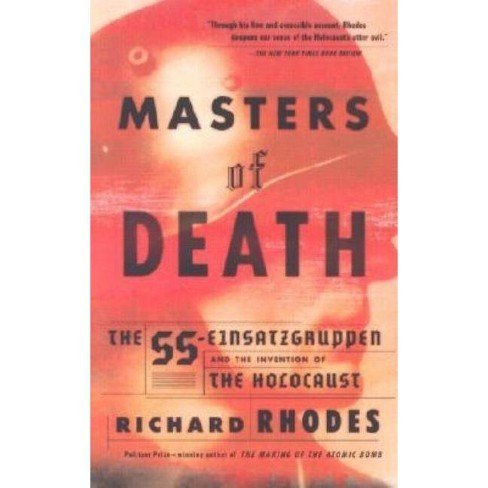
Masters of Death: The SS-Einsatzgruppen and the Invention of the Holocause by Richard Rhodes

May 14, 2021 by Barry J. Klazura 1 Comment

Richard Rhodes is a winner of the Pulitzer Prize and has written both fiction and non-fiction, on topics as diverse as the Donner Party, the invention of the Atom Bomb and the Audubon Society.  In this work, he traces how the Einsatzgruppen were organized, their scope of activity, their relationship with the Wehrmacht and the impact of mass killings on the individuals within the units.

Originally deployed in Poland at the start of the war, their primary directive was the murder of the leaders of Polish society; lawyers, doctors, educators, political leaders, etc. as the conqueror Poles were destined to be a source of ignorant slave laborers who did not need to count much above 100 in their future live.  The “special action groups” also targeted any Poles who offered any resistance either real or imagined.  At the same time, they went after suspected communists and finally, the Jews of Poland.  As the original plan was to move the Jews out of Europe, the concept of committing mass murder of the Jews was not in their primary list of objectives.  Yet once the killing began, and they were under the protection of SS-Reichsfuehrer Himmler, their murderous campaign quickly expanded.

Continue reading
Share:
Reading time: 2 min
Book Reviews

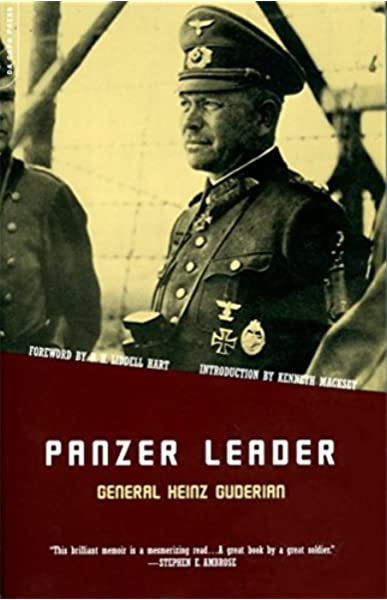
Panzer Leader by General Heinz Guderian

December 15, 2020 by Barry J. Klazura No Comments

Considered by many to be the founding father of the Panzer concept in pre-war Germany, Guderian was forceful, stubborn, opinionated and driven; all the virtues that would put him at odds with most traditional militaries around the world.  Fortunately for him, he caught the eye of Hitler and Guderian’s concepts represented exactly the type of bold thinking that Hitler sought to enable him to carry out his military goals. From that point, it was a love/hate relationship between the two, with Guderian being cast aside, brought back, ignored by Hitler, apologized to by Hitler and finally once again sent into the wilderness.

Continue reading
Share:
Reading time: 1 min
Book Reviews

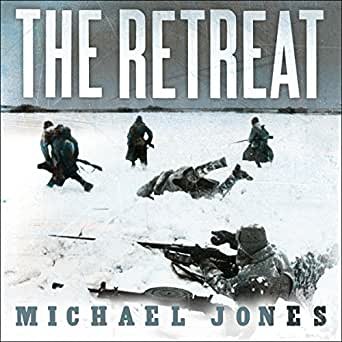
The Retreat; Hitler’s First Defeat by Michael Jones

November 20, 2020 by Barry J. Klazura No Comments

For years, Albert Seaton’s “Battle for Moscow” has been the gold standard for reviews of that famous and brutal battle. This work is a welcome addition to any library on the subject as it is lighter and raises several points which are worth examining. Michael Jones uses eyewitness accounts of actions to bring a personal touch which was missing from Seaton’s and thus the reader is drawn not so much by the technical aspect of the battle as by the personal.

Continue reading
Share:
Reading time: 2 min
Book Reviews

Justice at Nuremberg by Robert E. Conot

October 21, 2020 by Barry J. Klazura No Comments

Originally written in 1947, this was the first comprehensive account to the trial of the major Nazi leaders after World War II.  The desire to create some type of trial (there was no international precedent) in a speedy manner (the beginning of the Cold War and the normal desire of the average citizen to get on with life) were two of the major challenges facing the judges and attorneys who had their own motives and goals.  Although the Nazi regime kept efficient records, the sheer volume of those records and the seemingly complex relationships between departments and organizations made errors unavoidable.  No one even within the Nazi regime could always explain the power differentials between the State and Party organizations, for example, responsible for the administration of any given area (the SD was a party organization while the Reich Foreign Ministry was a State organ but they each had administrative duties in some of the occupied territories).  Add in the duties of the Wehrmacht, the SS, the Todt labor organization, etc., and the judge’s confusion is understandable.

Continue reading
Share:
Reading time: 2 min
Book Reviews

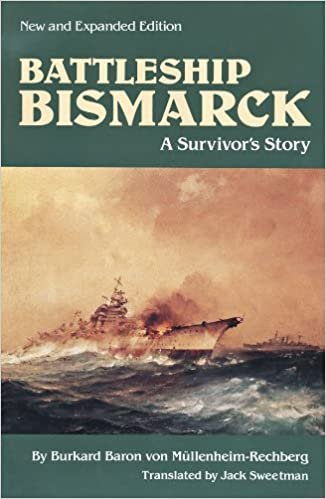
Battleship Bismarck, a Survivor’s Story by Burkard Baron von Mullenheim-Rechberg

July 10, 2020 by Barry J. Klazura No Comments

For a week in late May 1941, the eyes and attention of the British Admiralty and the German Kriegsmarine were focused on the North Sea as the German battleship Bismarck, was attempting to break out on a raiding mission in the Atlantic.  After sinking the pride of the British nave, HMS Hood, Bismarck turned its attention of the Prince of Wales and swiftly caused such damage that the British ship had to run for its life.  Unfortunately for the Bismarck, she was also hit and was badly leaking oil and taking on water.  What followed for the next three days has been the subject of books and movies for over fifty years.  The author was a gunnery officer on the Bismarck and was one of 115 survivors (out of a crew of 2,200).  His story is a firsthand description from “the other side” about a battle that was almost preordained-in my opinion- to failure.

Continue reading
Share:
Reading time: 3 min
Book Reviews

Murderous Science: Elimination by Scientific Selection of Jews, Gypsies & Others, Germany 1933-45 by Benno Miller-Hill

April 23, 2020 by Barry J. Klazura No Comments

The belief that certain people(s) are inherently superior to others and that “lesser” peoples need to be controlled did not begin with the Nazis.  Margaret Sanger, Woodrow Wilson and other Americans joined together with others in Europe decades before the Nazis to argue that birth control would help to control the “lesser” peoples, that blacks could not learn mechanical skills and that somehow the “superior” white race which had created Western Civilization needed to control the animalistic reproductive urges of the “lesser” peoples before they swamped the civilized world.

Continue reading
Share:
Reading time: 3 min
Page 3 of 4«1234»

Barry J. Klazura

Barry Klazura sipping grappa

With a Masters Degree in Guerrilla Warfare and Totalitarianism, Mr. Klazura was well prepped for a career in Sales and General Management, consulting on corporate startups and turnarounds as well as lecturing on history and politics.  For the past twenty years he has focused on being a financial advisor and consulting.

Delivered To Your Inbox

Sign up to get an email when a new article is published.

Topics

  • American Civil War
  • Biography
  • Book Reviews
  • Cigar Reviews
  • Coronavirus
  • Current Affairs
  • Education
  • Environment
  • Factoids
  • Government
  • Lifestyle, Cigars & More
  • Liquid Refreshments
  • Musings
  • Quips and Historical Facts
  • Society
  • Travel
  • Uncategorized
  • World War I

Subjects

book Books-Russia/Soviet Union Books 21st Century Books 1919-2000 Books Ancient to 1900 Books Asia Books Biography Books Fiction Books Germany 1919-1945 Books Pre-WWI books Viet Nam books world war I Books WW1 Books WWI Books WWII Cigar Friendly Location Amsterdam Cigar Friendly Locations-London Cigar Friendly Locations-New Orleans Cigar Friendly Locations-New York Civil War Coronavirus Environment Korean War World War I World War One

Recent Articles

At Stalin’s Side by Valentin Berezhkov

July 15, 2026
The Price of Victory by N.A.M. Rodger

The Price of Victory by N.A.M. Rodger

June 26, 2026
Frontsoldaten: The German Soldier in World War II by Stephen G. Fritz

Frontsoldaten: The German Soldier in World War II by Stephen G. Fritz

June 5, 2026
Organizer of Victory, 1943-1945, George C. Marshall by Forrest C. Pogue

Organizer of Victory, 1943-1945, George C. Marshall by Forrest C. Pogue

May 26, 2026
Illegals Released & Our Leaders

Illegals Released & Our Leaders

May 10, 2026

Inquiries and Comments

For general inquiries and comments, email AOTOHcomments@gmail.com.

Facebook
© 2020 And On The Other Hand. All rights reserved.