

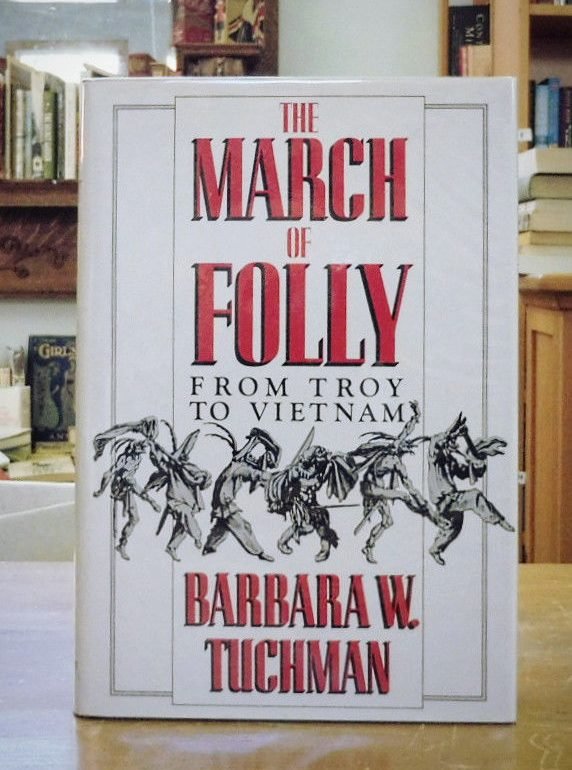
Re-reading Barbara Tuchman’s The March of Folly from Troy to Vietnam (originally published in 1984) and reviewing the foolish foreign policy decisions around the world since then, seems to give proof to the statement by John Adams that government, “is little better practiced now than three or four thousand years ago.” Policy makers seem to delight in flying in the face of common sense, logic, and facts in pursuit of their policies. A wiser man than most, Jordan Peterson once said that when he makes a major decision, he does not look at the best possible outcome, but the downside cost if he is wrong. Too bad that statement is not hammered onto the desktop of every government policy wonk as a warning against their hopes and dreams.
In her book, Tuchman studies the times, forces and choices made by the Greeks who were given a horse, the Renaissance Popes, the British lost of the colonies and American leaders regarding our experience in Viet Nam. Of course, trying to separate fact from fable in the story of Troy is the most difficult, in part because the very ideas that a hollow wooden horse filled with one’s enemies willingly being brought into the city of Troy defies logic. Yet Tuchman does an excellent job of examining the tales from several sides and trying to understand how the leaders of Troy ignored legends, omens, and warnings. The result is well known and should serve as a warning against acting on the basis on ego and hubris.
Her discussion of the Renaissance Popes covers three Popes who through their personal greed and existence in a system had become so corrupt and detached from the basic tenants of their creed, they all but insured the Reformation. Given the slow rise of the nation states, the draining of revenue from the Princes, Kings and Emperors domains to Rome and the corruptness and ignorance of the local clergy, the very foundations of the Roman Church were ready to fail. While the Popes left us with wonderful art treasures, they totally ignored the warning voices within the Church regarding the foolishness of their ways. Instead of tending to their flock, the Popes sought earthly power and wealth which even the lowest peasant in Germany or elsewhere recognized as against the Will of God.
Her section on how the British lost the colonies is excellent and enlightening. She reveals the dynamic forces within Britain and the support by many for the colonies. British politicians, taken mostly from the top two hundred families of the land, possessing enormous wealth, were arrogant and ignorant of the colonies and the mind set of the inhabitants who were building a new society by hand, day by day. British leaders passed tax laws which destroyed trade and the expected windfall of revenue from the taxes were never realized (we still see this today). In many ways, the British were so split on using force on the colonies that numerous British generals and officers refused to fight in a war that they said could not be won. The result was the hiring of German mercenaries which only insured more resistance by the colonists.
Then of course, there is Viet Nam. From the very beginning, a series of political and military errors seemed to multiply as time marched on. From supporting the return of the French to Indochina on, our policy makers were ignorant of the terrain, mindset, and limitations of involvement. There is no need to list the errors made by several U.S. administrations or the tactical errors of our military, nor is there any reason to go over the lost propaganda war by those very same administrations. The result was only compounded by the breaking of our treaty with the South Vietnamese government. It was a shame that still haunts us.
Today, if she were alive, Tuchman could write a second volume on other follies, including Afghanistan, our dealings with Iran, Putin’s war in Ukraine, etc. From JFKs believe that his team was the “best and the brightest,” to a government currently staffed by academics and professional policy wonks who have little if any experience outside of government, policy makers live in a world sealed off from reality. It seems the further from everyday life of the common man, the greater the danger of policy folly. The Founding Fathers were wary of a professional political class as they had seen the result in Europe of their time; we ignore their concern at our own peril.



Leave a Comment