

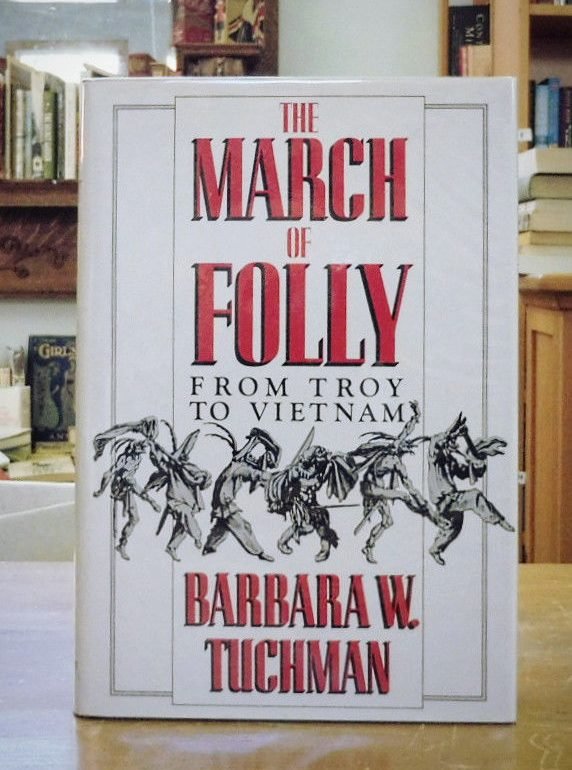
Re-reading Barbara Tuchman’s The March of Folly from Troy to Vietnam (originally published in 1984) and reviewing the foolish foreign policy decisions around the world since then, seems to give proof to the statement by John Adams that government, “is little better practiced now than three or four thousand years ago.” Policy makers seem to delight in flying in the face of common sense, logic, and facts in pursuit of their policies. A wiser man than most, Jordan Peterson once said that when he makes a major decision, he does not look at the best possible outcome, but the downside cost if he is wrong. Too bad that statement is not hammered onto the desktop of every government policy wonk as a warning against their hopes and dreams.
In her book, Tuchman studies the times, forces and choices made by the Greeks who were given a horse, the Renaissance Popes, the British lost of the colonies and American leaders regarding our experience in Viet Nam. Of course, trying to separate fact from fable in the story of Troy is the most difficult, in part because the very ideas that a hollow wooden horse filled with one’s enemies willingly being brought into the city of Troy defies logic. Yet Tuchman does an excellent job of examining the tales from several sides and trying to understand how the leaders of Troy ignored legends, omens, and warnings. The result is well known and should serve as a warning against acting on the basis on ego and hubris.