

Imagine that it is about 1850 in the United States and the British, who have the finest army in the world, invade the U.S. through the East Coast. The citizens of the area who have not been threatened by any enemies since the war of 1812 are more interested in trade and welcome the invaders who promise more states rights and low taxes. Additionally, the great slave holder families of the South provide monetary and physical support to the British invaders. Meanwhile, in the West, the small U.S. army faces an uprising of all the Indian tribes but this time they are united and number two hundred thousand. Additionally, the Mexican army joins the Indians and begin a campaign of pillage and murder across the southwest U.S. Only small groups of soldiers remain faithful to the central government, but they form the basis for a national renewal that eventually drives the British out and pushes back and punishes the Indian and Mexican forces. Large parts of the nation are desolated with farms destroyed and hundreds of towns and villages burned to the ground. Now switch this scenario to the Polish Commonwealth in the mid-eighteenth century.
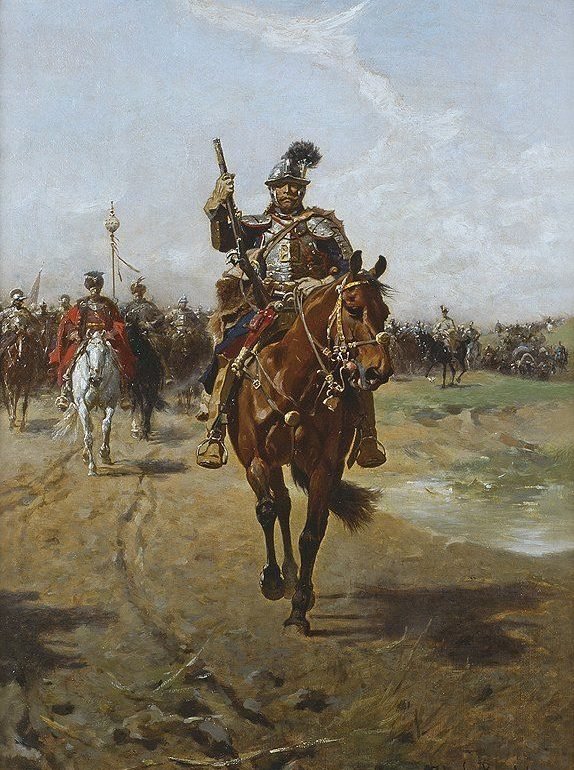
Instead of the British invading, you have the Swedish army, the finest in Europe and victors during the terrible Thirty Years War. Instead of the Indians, you have the Cossacks, and the Mexicans are really the Tartars who are invited in by the Cossacks. Tens of thousands are killed as Ukrainian peasants join the Cossacks, attack the Poles, and slaughter the Jews who are seen as oppressive minions of the Polish overlords (in fact, until the Holocaust of 1939-45, this time was remembered in Jewish history as the greatest Jewish tragedy since Biblical times). Meanwhile, the Tartars capture a hundred thousand Ukrainian peasants and march them off to the Crimea where they were sold as slaves in the vast slave markets. To make matters worse, the most powerful Lithuanian prince helps the Swedes while the Russians stand on the border, ready to invade when the Poles are finally defeated.
The above is the basis of The Deluge by Henryk Sienkiewicz, a huge novel (about 1600 pages), based on the six-year invasion which decimated towns, farms, churches and villages and left much of present-day Ukraine, Moldavia, Belarus, Poland and Lithuania burned, depopulated and barren. It also provided for a short termed national rebirth, heavily influenced, and supported by the Catholic Church which started with the successful defense of a Catholic fortified church at Czestochowa which is still considered a national shrine. In the novel, the author focuses on a number of key characters, all based on actual individuals, weaving humor, romantic love, chivalry, excellent battle descriptions, and politics which give the reader an excellent insight into that terrible time which was a time of national testing.
The book covers numerous battles during the six years of the war during which armies, bands of tartars, Cossacks, Swedes, and the Poles themselves marched back and forth across the nation. The Swedes were able to capture the capital, Warsaw, and the resulting siege to recapture the city destroyed much of the city. In the end, the capital lost 90% of its population during the war.
With the defeat of the Swedes, Poland brought Royal Prussia back as a fiefdom until 1772 and for a moment, the King was allowed more powers. Yet within a few years, a revolt led by a number of powerful families almost destroyed the Commonwealth and decreased the power of the Polish King. As a result of that revolt, Poland was a divided nation, its politics subject to bribery by other rising powers until it suffered its first partition between Russia, Prussia, and the Hapsburg Empire in 1772, followed by another in 1893 and the final in 1795. Poland did not arise again for another 123 years until 1918. This book is an important part of the Polish consciousness and reflects the burning desire for a people’s desire for nationhood.




Leave a Comment