

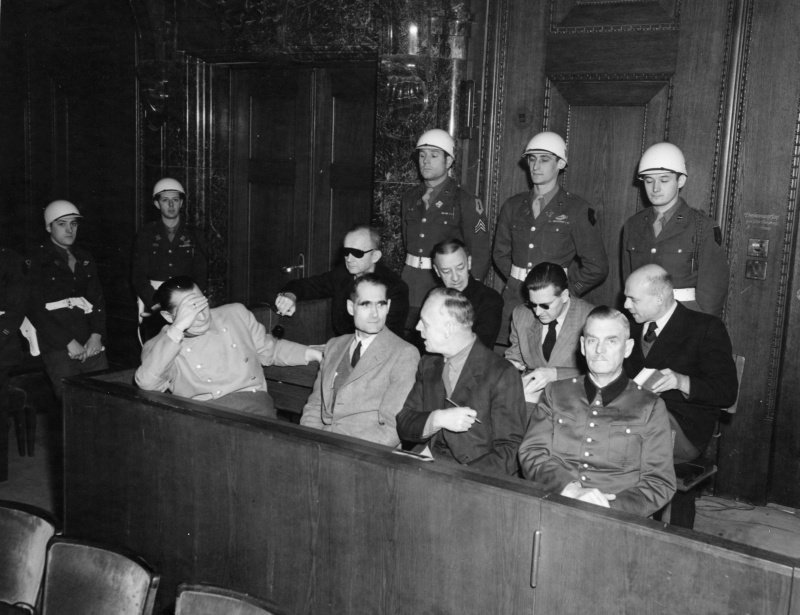
The recent movie, Nuremberg, centers around two characters; Dr. Douglas Kelley, who spent many hours interviewing and interacting with the twenty-two defendants during the first Nuremberg trial and Reichsmarschall Hermann Goring.
Dr. Kelley in 1945 was 35 years old at the time of his work at Nuremberg, upon which the movie is based. He was a U.S. Army psychiatrist with an excellent reputation. His goal was to understand the mind set of the defendants in terms of how they viewed the war crimes they faced and how they could participate in the conducting of those terrible crimes. He interacted with those individuals for only one month, but that month changed his life forever. After those interviews, he gradually became more introverted, subject to flare ups of anger, and more argumentative. His career which held so much promise became short-circuited as he disagreed with fellow doctors and administrators; he was no longer invited for interviews; his scholarly papers were ignored and not published and he became a pariah. In 1958, he died by suicide.
What was it that changed the course of Kelley’s life? It was that month when he spoke with the twenty-two defendants and found a secret that he believed was totally opposed to the image that most people had of those defendants. It is a secret that has haunted generations as they studied the horrors of the Third Reich.
Dr. Kelley concluded, contrary to popular opinion, that the defendants were ordinary individuals; some brighter than others, some more vain, but all profoundly human. They were not devils or demons, they were not mad; in most cases they could be your next store neighbors until the right conditions were created. Dr. Kelley believed that it was not madness that enabled those men to participate in such crimes, but rather from a moral decay disguised as duty. We must remember that numerous commanders of the Nazi killing squads (the Einsatzgruppen) were medical and legal doctors and others possessing the finest intellectual educations in their fields. In their minds, their “work” was noble and ridding the earth of unhealthy and deadly enemies of their race.
In this book, 22 Cells, he saw that the “gradual process of moral desensitization, in which obedience and ambition eroded empathy” enabled those men (and so many others), to commit war crimes on a scale previously unknown. His belief in that process led him to believe that in any society, if the conditions were right, those actions could be repeated and that knowing that society had to take steps to safeguard such a recurrence. Naturally, such a view was not very popular in the victor nations who saw themselves as being not only the physical but also the moral victors of the war.
Long before Hannah Arendt went public with the phrase, the banality of evil, Dr. Kelley had spoken that way of what he had learned in Nuremberg. Like Kelley, Arendt paid a price using that phrase, yet there has never been any evidence to the truth of those words. They paid the price for staring into the darkest portion of the human mind. Will we learn from what they found? Try asking the average teenager of today who fought who in World War II. Ask them who fought in our Civil War. Some may say that Nazi Germany was an aberration, a fluke of history. If that is to be believed, what about the Armenian genocide, the Ukraine famine of the 1930’s, the intentional famine in China under Mao, the muti-year war in the Congo, the slaughter in Rwanda. Need I go on? Their ignorance is not their fault, but someone will have to pay the price for that ignorance. Perhaps not in this decade, perhaps not in the next, but there is always a price to pay for such ignorance.
There can be no finer example of the banality of evil than the book written by the commandant of Auschwitz and one of the greatest mass murders in history, Rudolph Hoss. Written while awaiting trial, he does not attempt to deflect blame or plead some sort of extraordinary circumstances for his actions. Instead, he paints a picture of a very bland, ordinary man simply doing his duty as he was ordered. A good family man, loving father, his main concern was to please his superiors everyday. He was the perfect face of the banality of evil.
For further reading, please consider The Nazi Conscience by Claudia Koonz, The Nuremberg Interviews by Leon Goldensohn, The Mind Doctor of Nuremberg by Kendrick D. Erasmus, and Marriage & Fatherhood in the Nazi SS by Amy Carney, Death Dealer by Rudolph Hoss.






Leave a Comment