

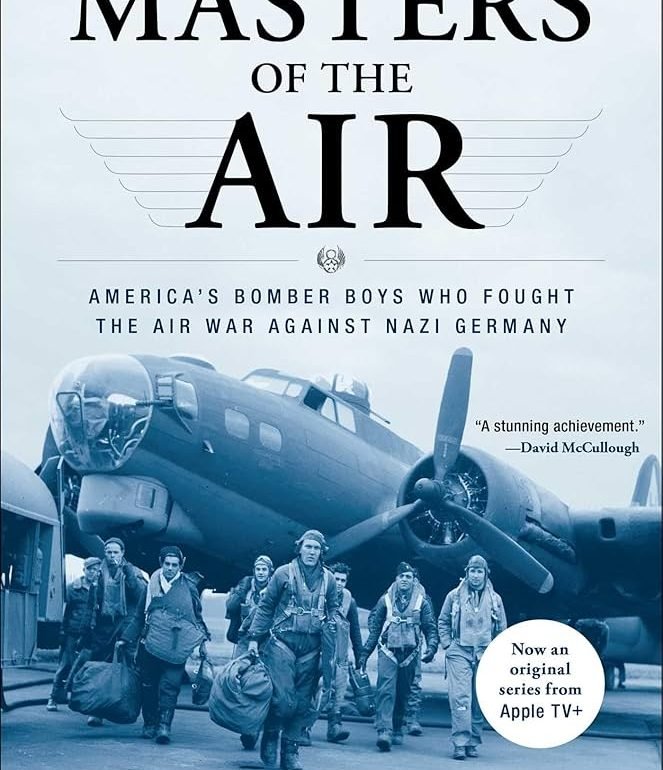
I must admit that I failed (twice) to “get into” the series “Masters of the Air,” in fact I only watched two or three episodes before turning it off. The main problem was that compared to “Band of Brothers” and “The Pacific,” the characters seemed shallow and there was too much time spend on the drinking and almost childish actions between missions. After reading this book, I shall make it a point to watch the television series through to the end.
The book, “Masters of the Air” is a brilliant, gripping history of the American air effort against the Luftwaffe from 1942 though to final victory in 1945. The author takes us on a step by step path as the American air effort is slowly built up, as theories of air warfare are tested and as the initial aircrews in the struggle are sacrificed time and time again on raids that often serve no tactical or strategic purpose.
Prior to the arrival of the Americans, the British had gone through a long and painful campaign of attempting to bomb key targets in German occupied Europe. The Brits had suffered serious losses during the initial campaign against the German invasion of France and wanted to strike back at Germany as the Luftwaffe began their bombing of British cities. The Germans and the British both learned that daylight bombing was too expensive. Despite the pre-war theory of Italian air commander General Giulio Douhet that the bomber will always get through, the cost of such a policy was too heavy, and the results were too meager. The British thus moved to night bombing which produced its’ own problems, one being faulty navigation. Originally the British bombers tried to follow the lights from rail lines and highways which only got them to the British coast, then after that many bombers were fortunate to find the European continent let alone their primary military objective. Thanks to a technological breakthrough, the British were finally able to at least get to the vicinity of their target but under the direction of Arthur Harris the concept of area bombing was developed. Under this theory, Harris hoped to “un-house” German workers and civilians and break the back of German morale. Why the Germans should break when the British civilian morale did not must not have been asked.
The Americans with their heavily gunned B-17s and B-24 bombers and their precision Norden bombsight set out to confirm Douhets’ theory while at the same time destroy the key German war industries. Thus, began around the clock bombing, the British by night, the Americans by day. The only problem was that while the ten-thousand dollar bombsite worked in perfect conditions, in reality with clear days over much of the continent limited to one day out of three, flak jarring the planes, and German fighters closing on the bombers at a combined speed of five-hundred-miles-per-hour, only one bomb in ten landed within five-hundred feet of the target. Added to this was the severe loss rate of raids in which ten, twenty, even forty percent of the bombers were destroy or badly damaged.
Through trial and error for over a year the Americans took heavy casualties, and Miller provides a fascinating section on how the medial teams approached battle fatigue, shell shock and morale problems which threatened to destroy the American effort. One great problem was that with the hostile elements, the randomness of the flak and the determination of the German defenders, many crews felt an extreme sense of helplessness regarding their lives. Rest homes, special meals, more breaks in the early days helped to keep the bombing effort on track despite the dispersal of bombing effort. Miller does a wonderful job of making the reader understand the strain of flying a mission; hours in the air where the temperature can be -60 degrees, where taking off a glove for even a minute can lead to first bite, the jarring of the plane as it flies through hundreds of miles of flak, each shell capable of destroying a bomber, of being wounded during the flight and the slim chance of survival in the terrible cold and then the return to the base which so many empty beds stare at the survivors, knowing that the next day the same drama will be presented to the survivors. In fact, during the early days until the back of the Luftwaffe was broken, the chance of surviving twenty-five missions (at which point a crew member would be rotated back to the U.S.), stood at 1 in 4. As late as the three months leading up to D-Day, the Eighth Air Force lost fifty percent of their bombers, as the Germans had concentrated over 13,000 heavy anti-aircraft guns along the bombing routes. While it took about 8,500 rounds from the newest German guns to bring down a bomber, flak still accounted to over 40 percent of the wounds suffered during the air campaign and flak took down more planes than the Luftwaffe.
The book is filled with descriptions of bravery of young men, often twenty-one years old, who stepped into manhood by feats of bravery equal to the brave young men in the infantry, armor, navy, etc. There was no glory in this war; it was a battle of attrition between two industrial powers who fed machines and bodies into its’ maw until one or the other bled to death. Fortunately for us, it was the German’s who bled faster.
Despite its’ size (over 500 pages before footnotes), it is a fast read; beautifully written and providing insight into the questions the intelligent reader will be mentally asking. Well done and I look forward to giving another chance for the series; I hope it lives up to this excellent work.





Leave a Comment