

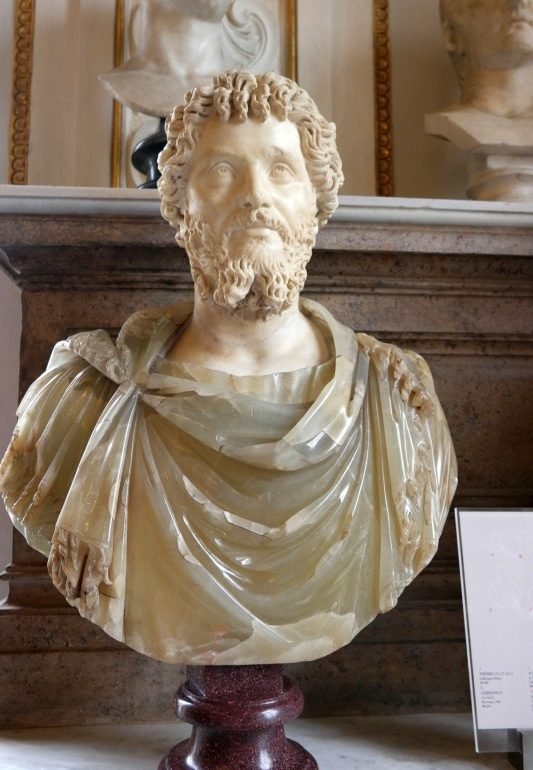
Severus is sometimes called the last of the “Good Emperors” for his ability to bring stability and success to the mid-Roman empire (he was emperor A.D. 193-211). Born in Tripolitania in North Africa (no, he was not black), he was of that stock from which sprang Carthage and Hannibal. He has also been called a typical cosmopolitan Roman bureaucrat, the destroyer of the existing social order and (by Gibbon), the principal author of Rome’s decline. Take your pick. But he did represent the ability of the empire to pull on its subjects to infuse new blood and energy into its body from time to time and this kept the empire from fading away for an extra hundred years.
A restless man, he traveled across the empire and early on, name one of his sons and trained him to succeed him. Unfortunately, that son, later know as Caracalla also known by historians as “the enemy of mankind”. But Severus coming after Commodus and Pertinax brought a period of peace, often by simply scaring the corrupt Senate and the power of his personality.
This book is a bit heavy for the casual reader interested in this period and unless you are familiar with the period, may not be a good read. Yet there are excellent passages, and the author feels free to criticize other historians, arguing that they have misrepresented or misunderstood various facts.
There are a couple of interesting side notes about Severus. As he lay on his death bed, his sons asked him what they should do; his words in this book were “Do not disagree between yourselves, give money to the soldiers and despise everyone else”, although other translations quote him in a more “earthy” manner.
Another tidbit I have often thought that F. Scott Fitzgerald plagiarized when he had his main character in The Great Gatsby say: “I have been everywhere and seen everything, god oh god am I sophisticated”. Although this author disputes the accuracy of Severus’ quote, I remember reading it when I was in my early 20’s and feeling a bit depressed, for he said, “I have been everywhere and seen everything and it is not really much”. If a Roman emperor could say that what hope was there for me! But Birley says the quote (again, disputed) was that “I have been everything and what has it profited me”.





Leave a Comment