

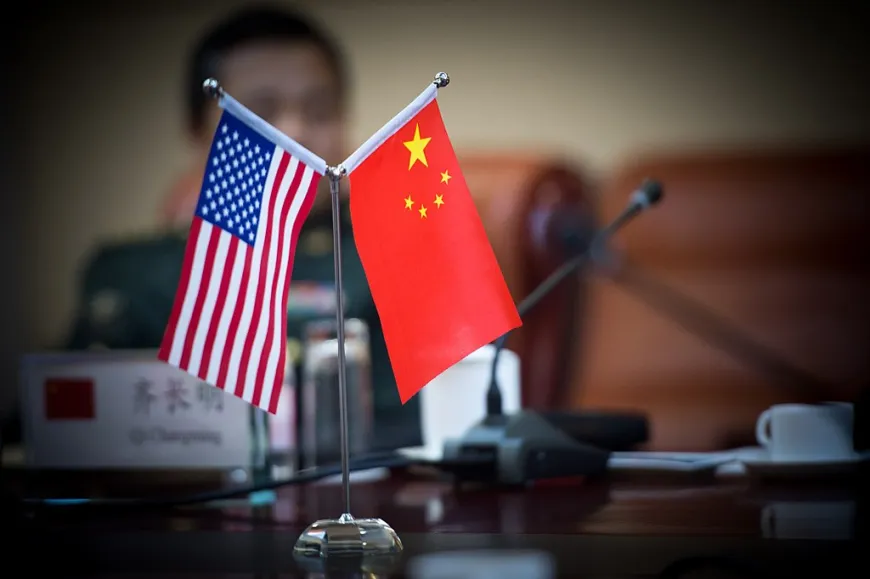
The Thucydides’s Trap is when a rising poser threatens to displace an existing one. This phenomenon began during the Peloponnesian War which lasted for decades and lead to the victory of a weakened Sparta over the devastated Athens.
Since that time, there have been sixteen cases of the same type since then and in twelve cases the result has been war. Some of the cases are easy to recognize, such as Japan vs. the U.S. in the Pacific, or the rise of Germany vs. the U.K. after 1900, while others are more distant such as the Dutch Republic vs. Great Britain during the mid- to late 17th century. The three most recent cases when no war was the result was between the U.K./France vs. Germany for political influence in Europe, the Cold War and surprisingly, the rise of the U.S. and the perceived threat to the U.K. during the early 20th Century.
The first third of the book is a devastating review of the rise of modern China; it’s huge growth in GDP, the strength of its economy, the expansion of its military, etc. as compared to the sluggish performance of the U.S. Despite the “pivot” in American foreign policy under President Obama, little of concrete value has been achieved; the North Koreans have more arms, the Chinese have claim more of the sea and built numerous “island” which contrary to their promise, they have militarized, and our “allies” have been forced to bend to Chinese demands through the use of their great economic power in the region.
Other components of the challenge are the desire of the U.S. to see a problem and fix it while China views it’s 5000-year history as proof that the same problem can be addressed later when it is more advantageous to China to provide a fix. Additionally, while the U.S. has a belief that every nation wants to live in peace and harmony, to respect individual rights, the rule of law, etc. in the eyes of China is arrogance on the part of the U.S. and a sign of the way the U.S. maintains its power. China believes that the natural superiority of their system which has enable them to survive for 5000 years will be seen and appreciated by other powers who will then pay homage to China.
In short, there is a huge gap between the two nations in outlook, goals and methods.
Finally, we come to the answer to the primary question and in this the author seems to fall short. His primary answers seem to center of the retreat of the U.S. in making many accommodations with China, all of which leave the U.S. with less power and influence in several areas. The author does not address the huge debt problem in China (it is growing at 2.5x the growth of their economy), the corruption within the highest levels of the Party, nor their minorities problems. Can those and other stresses make China more “reasonable” (in our eyes) in the future, or will they merely be factors which can push the Chinese leadership to some form of outright adventurism? In short, the future relations between the two powers will be one filled with mistrust, misinterpretation, and danger. There are several scenarios where these factors can lead to military confrontation between the two powers and the result, even for a short period, would be a disaster for the world. Unless and until both parties can deal with the other in a manner which bridges the huge difference in mind sets, we shall be living in a very difficult and trying world, filled with the dangers of the smallest misstep.






Leave a Comment