

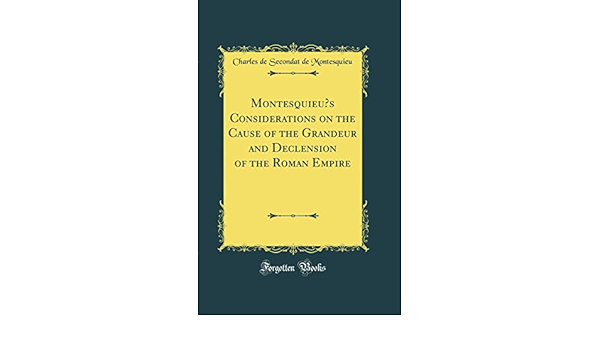
Charles Louis de Secondat, Baron de La Brede et de Montesquieu was from the middle of the 18th century through the founding of the United States, widely considered to be the preeminent political thinker of his time. His categorization of what constitutes a tyranny, an empire and a republic influenced our Founding Fathers in their debates and in the writing of the Federalist Papers. He was the principal architect of the theory of separation of powers and his main work, The Spirit of Law (1748) was well received throughout Europe and the thirteen colonies.
This work is considered a minor work, but I would like to suggest that no politician be allowed to take office until they have read and passed a test based on what he writes in this gem of a book.
Rome, like any organism or organization, had a period of growth followed by a decline. What were the causes of its growth? That is often asked as is, what caused its decline? Historians and others will argue those points for as long as Rome is remembered and everyone who attempts to answer those questions will be both correct and wrong. There were numerous causes but that in the end, as with other empires, the entire system simply imploded from lack of will, moral degeneracy and outside pressures that were simply more than could be managed given the resources available. Over time, the ideals and energy which helped the successful growth were lost and there were not enough good and strong men and women to hold the center together.
Rome started as a small community, cut off from the sea, surrounded by numerous enemies, many of them larger. It had little natural wealth, barely any art and the citizens realized that the only way to enrich themselves was through pillage. Montesquieu believed that Rome’s power came from several factors, among them a constant drive for war, an unwillingness to accept defeat, an equal sharing of the plunder and a government which only allowed recognition and advancement through military success. Because Rome was always at war and because they adopted the best military practices of their individual neighbors, they simply excelled at war. They easily adopted the best skills of their military foes, such as cavalry, the Spanish short sword, etc. and use each in a way that helped to insure their victories. They developed a mindset which directed all activities of the State to be in the successful furtherance of war. Defeat was simply unacceptable and as was demonstrated during the war against Hannibal, no matter how often Roe’s field armies were defeated, they simply kept going after their nemesis until they achieved final victory. Such a mindset is not possible today as the technology of war simply makes war too expensive both in treasure and lives. So, what can we learn from the Romans? We can learn from them the reasons for their decline.
The virtues that built Rome were, over time, discarded in many ways. The original Roman armies were paid in land taken from their defeated enemies. Later this concept was altered to one where the conquered land was taken by the wealthy and by the state while the armies were paid by their generals. Thus, the soldiers no longer had a direct interest in the state but rather looked to their generals for greater financial gain.
That change was possible because the concept of Roman citizenship changed. Whereas citizenship was possible only by being from Rome, it was later given to conquered peoples. With that change, the value of citizenship became diluted and with it, a lack of interest in the life of the State. Gone was the nobility of citizenship, the value of one’s vote as the voices bought and paid for by vested interest replaced the old values and virtues of service to the State.
With the loss of the Republic to the generals and wealthy, the mass of the population was driven into virtual servitude by those same generals and wealthy who became tyrants. Placed on the same level as conquered peoples, and housed by a bureaucracy that placated the unemployed masses with free grain and games, the virtues which created Rome were buried and forgotten.
Being pressed on all sides, Rome began to follow policies of appeasement, as was witnessed prior to World War II and the recent policies towards an implacable foe such as Iran. Appeasement is never based on strength; it is viewed as weakness and can only be of value if a rededication to strength can be rekindled by the leaders of the State. Unfortunately, while some of the emperors worked to consolidate and stay Rome’s degeneration, there were just too many enemies and not enough resources to hold back the waves of warlike tribes and waves of migrant nations. Additionally, those invading tribes learned more about the art of war and began to fight Roman armies on a more equal footing.
It is amazing that reading this book, which was published over three hundred years ago, talks about an empire destroyed fifteen hundred years ago and that the lesson can be so clear as we face the problems of our own age. We can see that the same forces, both good and bad, have been part of human nature and have driven humanity in one endless cycle after another. The only question is whether we will realize that we are not terrible unique and that we cannot change our basic nature, both good and bad.





Leave a Comment