

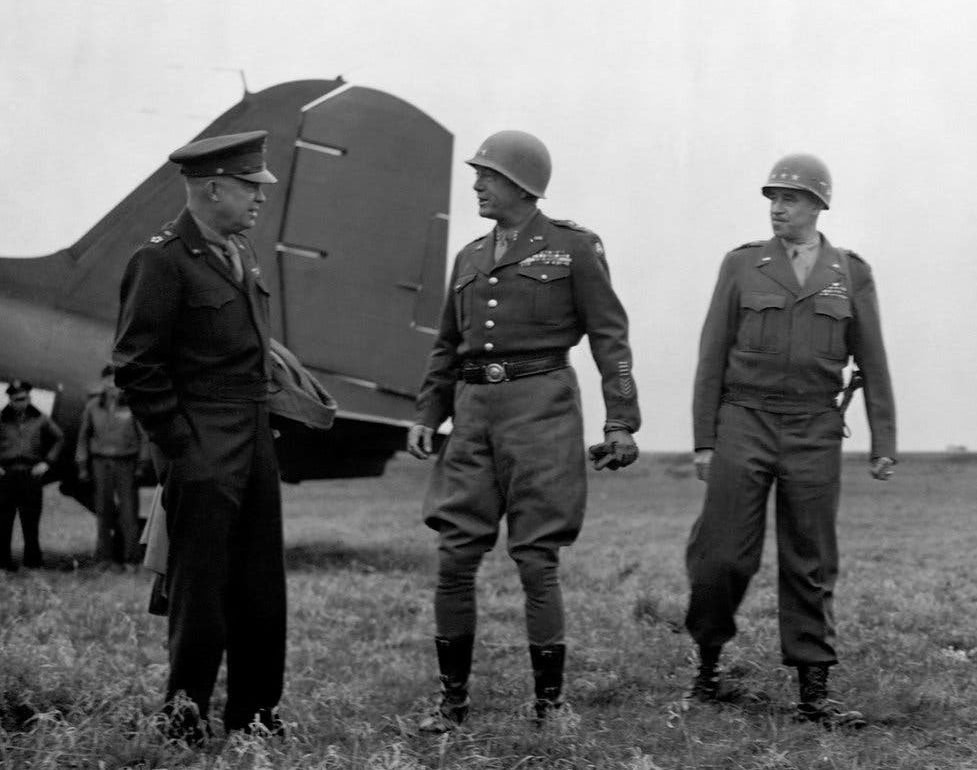
Eisenhower, Bradley, and Patton are names which will stand for the Allied victory in Western Europe during World War II. But who were these men, what were their backgrounds, how were they picked to hold their commands and finally, how secure were they in those commands. Mr. Jordan does an excellent job in answering these and other questions in a concise and excellent manner. These men did not suddenly appear with stars on their shoulders with full knowledge of their craft; they served decades in backwater posts, seemingly forgotten, grinding out their lives (and the lives of their families) believing that they might never practice what they were learning.
Then came World War II, but more importantly, a man by the name of Marshall, George C. Marshall. He was charged with creating from a puny, ill equipped army a force that could fight around the world, something that no one and no country had ever done. Breaking the careers of several hundred generals, Marshall had the ability to reach into corners of the military and find individuals who had spent up to twenty years in obscure posts due to tight budgets, their thinking outside of the military “box”, etc.
Each of the three men covered in this excellent book were professionals, but each of the three also carried within them their own personal demons which come through very clearly.
For Eisenhower, the commander, the stress of the political side in building and managing a coalition was a terrible burden. He was often viewed as a paper pusher (he had had no combat experience) and balancing the demands of the British (who had their own cliques), Marshall, Roosevelt, the various armed services, generals, politicians, etc. had him smoking up to four packs of cigarettes a day. Combined with a poor diet and the realization that failure would land on his head while his control of all the aspects of the operations were so often beyond his direct control, wore him to a thin edge. The picture we have of a smiling, easy Eisenhower contrasts with the reality of a man who could swear as much as Patton and who had a temper that could be devastating.
Patton on the other hand, while we think of him as a loud, profane bull in a china shop, could and often did go meekly to stay in the war. Recognized as the best tank man in the army (and that recognition was shared by the Germans), his verbal gaffs nearly cost him his chance to prove his ultimate worth. Several times Eisenhower was ready to ship him back home, but Patton’s sheer skill at his profession stayed Eisenhower’s hand. His death shortly after the war while tragic was probably in the long run a blessing for Patton was not cut out for a future without war.
Finally, we come to Bradley; this book confirms other works on him including his own autobiography that he could be petty and vindictive. Coming from a poor background and having served as Patton’s subordinate, when he became Patton’s superior, he was able to repay Patton for the slights and shadow Bradley felt he had experienced. Careful and unglamorous, Bradley was the opposite of Patton and this gave him a feeling of superiority as a shield against Patton’s high public image. Bradley was aware that there had been a close personal relationship between Eisenhower and Patton so perhaps he was insecure and felt a need to fire at Patton when he could, but as a sheer mechanic in the art of war, Bradley certainly passed with high marks.
This is an excellent single resource for any interested in these three interesting men.


Leave a Comment