

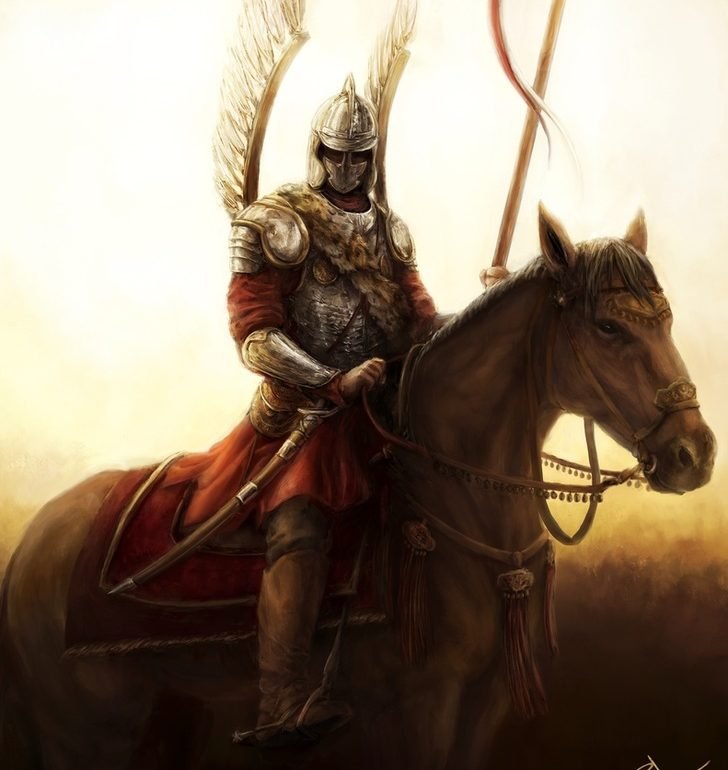
When I was a little boy, my Grandmother will tell me stories of when she was a young woman in Warsaw Poland; how the young girls would flirt with the Russian soldiers who occupied the city, how she hesitated to go out at night as the Cossacks made it a habit to ride down the street, striking anyone with their nagaikas unless they were really drunk in which case they used their swords on anyone in their way, etc. One thing she especially remembered, was that a chapter of Sienkiewicz’s epic novel, With Fire and Sword was serialized in the Warsaw newspapers and there was always a rush to purchase a copy; it was the Netflix of its day.
Sienkiewicz would win the Nobel Prize for literature in 1905 for his novel which took place in seventeenth century Poland, when Poland was the largest country in Europe. Sweeping across the steppes, it is an adventure story centered on the Cossack revolt which was led by Bohdan Hmyelnitzki (also spelled Khmelnytsky). The Cossacks aligned themselves with the Tartars and Great Khan of the Crimea and the revolt which lasted off and on for several years, was only one of numerous wars fought in what is today the Ukraine, Byelorussia, and what was prior to World War II, eastern Poland. It was the bloodiest of the revolts and was responsible for the largest number of Jewish deaths until the Holocaust. The Cossacks encouraged the native Ukrainian population to join the revolt and Poles and Jews alike were hunted down and killed in their tens of thousands. While the Ukrainians were used as cannon fodder by the Cossacks, who looked down on the Ukrainians, the Tartars were given free rein to capture as many Ukrainians as possible who were then forced to walk to the slave markets in the Crimea and beyond.
One reason for the book’s success in Poland was that it harkened back to a time of bravery and glory for the Polish soul. Poland at the time of the writing, was divided between the Russians, Prussians, and Austrians, and both the Russians and Prussians were doing all they could to eliminate any form of Polish identity. Classes could not be taught in Polish, baptisms had to be recorded in Cyrillic (as was one of my grandfather’s although the Church made a second, secret copy in Polish), the Roman Catholic church was restricted, etc. All the actions we decry today as ethnic cleansing were practiced at that time.
Another reason for the success of the book, was that the author knew he could not make the Russians the villains of his novel (as they occupied much of the country), so the Cossacks were an easy to identify substitute. He knew he was being watched by the authorities and one mistake could result in serious punishments, so he wrote as he traveled across the country, always with one eye open for the Czarist secret police.
Finally, the novel (the first of a trilogy), was an enormous success because it is a classic tale of war, bravery, love, and devotion, loaded with traitors and scoundrels. It is a central European version of cowboys and Indians, sweeping across a land untamed, beautiful, and cruel. Warriors who prayed for the hand of their favorite maiden easily impaled their enemies without a second thought.
The trilogy is falls into my “ten-year rule,” by which I read the trilogy every ten years. It is easy to be swept away by the magnitude of the novel and I was happy to see that it was made into a movie in 1999 and nominated for Best Foreign Film in that year. If you don’t have the patience for the novel (all eleven hundred pages in the first book), try catching the movie available on YouTube. It will certainly make you forget your cares.





Leave a Comment