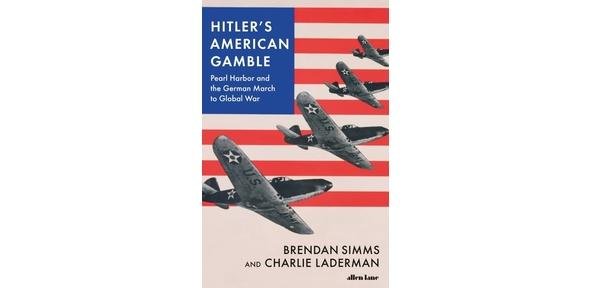
History is full of “what ifs”, “near things”, and “almost”. In Hitler’s American Gamble by Brendan Simms and Charlie Laderman, the authors discuss the various scenarios had Hitler not declared war on the United States after the Japanese attack on Pearl Harbor.
What makes this book more interesting than one would expect is that the authors follow the fears, thoughts, actions and discussions of the Roosevelt, Hitler, Stalin, Mussolini, Churchill, and various Japanese officials on a day-to-day basis from December 7th until the German declaration of war on December 11th. They point out that serious questions were raised during that four-day period and that contrary to popular history, it was an agonizing time for Churchill. While he may have been buoyant to those around him, he had numerous concerns about the actions the Americans might take and how it would impact the British.
For four days, Axis, Soviet and British leaders held their breath and pondered the American course. Concerns included:
- Would the U.S. begin to scale back Lend Lease support to the U.K. and the Soviets to rearm themselves against the Japanese?
- If they did, by how much and would that help the Germans at a time when the U.K. especially were just handing on in the Battle of the Atlantic, North Africa, etc.?
- As Roosevelt only called for a declaration of war against Japan, and with a seriously damaged U.S. navy, would support in the Battle of the Atlantic be scaled back?
- For the Japanese, their concern was whether Hitler would honor his pledge to declare war on the U.S. and thus force the U.S. to divert some of its immense industrial strength away from Japan and towards Germany.
- With the sinking of the British warships Repulse and Prince of Wales, not only Singapore but also Australia was in grave danger and the British were fearful of a Japanese thrust into the Indian Ocean towards India.
- Roosevelt believed Germany to be the greater threat but how to enter the war against Germany when most Americans were either isolationist or calling for revenge against Japan?
- Aware of the industrial might of the U.S., Hitler knew that sooner or later Germany and the U.S. would fight one another directly, so was it better to declare war now when Japan could divert some of the U.S. strength or stay out of the war and force Roosevelt to zero in on Japan?
- For the Soviets, who had a non-aggression pact with Japan, would the U.S. cut back on the munitions, supplies, trucks, food, etc., that was vital to keeping the Soviets in the war and would Japan break its pact with the Soviets and attack, creating a two-front war for Stalin?
- Churchill knew that without increased U.S. aid, he would have to cut back military aid to Stalin to stay in the battle with Germany. If the U.S. did not declare war on Germany, the future for the Empire was bleak at best.
Fortunately for the world, on December 11th, Hitler honored his pact and declared war on the United States. Now Churchill fully believed that the war was won as the U.S. was fully committed to a world war. Hitler still believed that he had the time build from his European conquests the industrial might to counter the eventual direct struggle with the U.S. and that it was better to begin the fight now rather than wait until the fully industrial might of the U.S. could be brought to bare on Germany. For Japan, who managed to seriously underestimate the potential might of the U.S., they believed that they could create the defensive zones and exploit the areas they had so easily conquered. And, for Stalin, he had proof that Japan would focus on the U.S. and the danger of a second front was avoided.
In some ways, this book reads like a novel in that the day-to-day questions, routines, discussions, etc. of various leaders takes the reader into the mindset of leaders on a day-to-day basis. It is an excellent history both for someone who seeks to capture the days and for more advanced amateur historians as a fine reference point.



Leave a Comment