

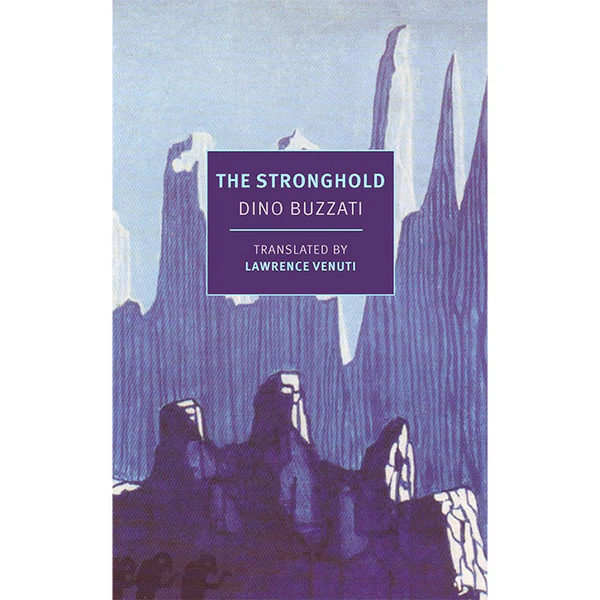
The review of this book from the back cover states that, “Buzzati is one of the great Italian writers of the twentieth century, renowned for his fantastical imagination and for a touch that is as lyrical as it is light. The Stronghold, previously translated as The Tartar Steppe, is his most celebrated work, a book that has been seen as a veiled attack on Mussolini’s militarism, a prophetic allegory of the Cold War and an existentialist fable.” Considering it was originally published in 1940, claiming it is an “allegory of the Cold War” is quite a claim, but I digress.
I personally was not impressed with this novel; I found it slow moving, dull and pointless. It tells the story of a young Lieutenant who is transferred to the remote fortress of Bastiani, there to stand guard along with an aging garrison against an anticipated invasion by some terrible enemy. Aside from the normal duties of manning a garrison in a remote area, there is little to do and despite the best attempts to fulfill his duties, the Lieutenant like all the other officers and enlisted men gradually fall into a lethargic existence. Then the enemy appears, and life suddenly has meaning! On the various mountain tops two or three of the enemy are spotted so action must take place! Then a message appears, and that brief flame of action is destroyed as the “higher ups” state that the newly seen opponents are in fact on a peaceful mission and garrison life returns to normal.
That is about it. Fini! Oh, there is more as we watch our Lieutenant live out the rest of his life and those who he holds dear die or disappear. Nothing more.
Now I admit, I may expect more from a novel, I may be a bit too shallow (one reviewer wrote that the Lieutenant confronting, “the desperate need to affirm oneself as an autonomous entity against the forces of solitude and persecution”) to understand such depth. On the other hand, some reviewers may have gotten into a bit of group-think and must enjoy a bit of mental, shall I politely say, exercise. Unfortunately, this novel reminds me of Hunger by Knut Hamsum (see my review, 3/14/2020), a western European attempt at authoring a short Russian novel; one which allows a willing reader to find much more than there actually is.





Leave a Comment