

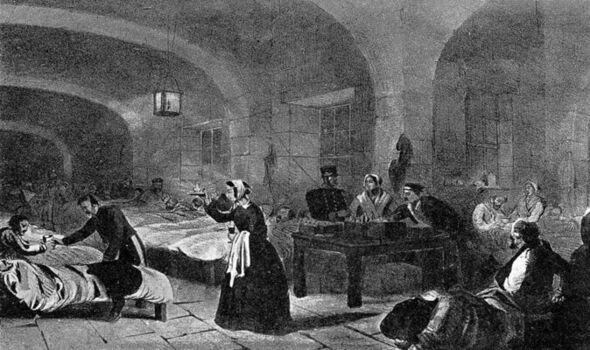
I am re-reading Orlando Figes’ (for the third time) excellent The Crimean War and I was struck by the plight of all the soldiers (particularity the British, Russian and Ottoman). The daily trials of poor food, lack of medical facilities, diseases, abuse from officers including whipping enlisted men can make the horrors of actual battle seem less terrible.
In this reading, I have come to realize that alone among armies in the West, the Russian army seems to have consistently been the worse abuser of its own men. From the time of Peter the Great, through the list of Czars, into the First World War, to today, the average Russian soldier has been seen as truly expendable and faceless. With that mindset, we have seen repeatedly the failure of the Russian Empire and today, the ability to field a successful fighting force against a lengthy list of enemies. Yes, the military was effective in WWII, but in face of the brutality of the German opponents and given the total ruthlessness of Stalin and his generals, the average Russian soldier had nothing to lose by throwing himself into the cauldron of war. Throughout history, the Russian soldier has been poorly led, poorly equipped, lacking in logistical support and abused by his own officers. Indeed, such a luxury as a graves unit was virtually unknown. During Czarist times, until WWI, returning soldiers were often not allowed to return to their own villages (to disguise the human losses). When peasants were drafted for the military, their send off was an actual funeral procession while in WWII, when a high Soviet officer was asked about the lack of care for the dead, he is reported to have said that if a man does not return home, it will be assumed he was killed in the war.
The following from Figes’ book captures the pity those soldiers at the time of the Crimean War earned. As Figes writes,
“A lone Russian woman, Daria Mikhailova, cared for the wounded with a cart and supplies purchased at her own expense. Daria was the 18-year-old daughter of a Sevastopol killed at the battle of Sinope. At the time of the invasion, she was working as a laundress in the Sevastopol naval garrison. According to popular legend, she sold everything she had inherited from her father, bought a horse and cart from a Jewish trader, cut her hair and dressed up as a sailor, and went with the army to the Alma where she distributed water, food and wine to the wounded soldiers, ever tearing her own clothes to make dressing for their wounds, which she cleaned with vinegar. The soldiers saw through Daria’s disguise, but she was allowed to carry on with her heroic work in the dressing stating at Kacha and then as a nurse in the hospitals of Sevastopol during the siege. Legends spread about the ‘heroine of Sevastopol.’ She came to symbolize the patriotic spirit of the common people as well as the Russian female ‘spirit of sacrifice’ that poets such as Alexander Pushkin had romanticized. Not knowing her family name, the soldiers in the hospitals of Sevastopol called her Dash Sevastopol-skaia, and that is how she has gone down in history. In December 1854 she was awarded the Gold Medal for Zeal by the Tsar, becoming the only Russian woman of non-noble origin ever to receive that honour; the Empress gave he a silver cross with the inscription ‘Sevastopol’. In 1855, Daria married a retired wounded soldier and open a tavern in Sevastopol where she lived until her death in 1892.” (H. Rappaport, No Place of Ladies: The Untold Story of Women in the Crimean War, London, 2007, p,2007.
I do question the idea of national patriotic feeling in Russia for that war as in the army, only 0.2% of the non-officers were literate and I wonder if like today’s war in the Ukraine, the average Russian soldier did not really know where he was or why he was fighting.





Leave a Comment