

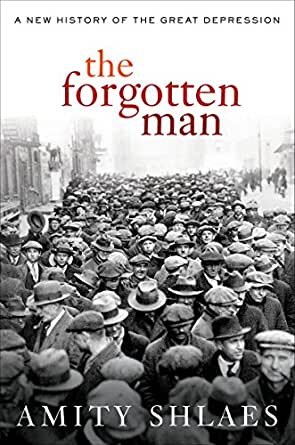
“As soon as A observes something which seems to him to be wrong, from which X is suffering, A talks it over with B, and A and B then propose to get a law passed to remedy the evil and help X. Their law always proposes to determine what C shall do for X, or in the better case, what A, B and C shall do for X…What I want to do is to look up C. I want to show you what manner of man he is. I call him the Forgotten Man. Perhaps the appellation is not strictly correct. The is the man who never is thought of… He works, he votes, generally he pays-but he always pays… William Graham Sumner, Yale University, 1883
Shales excellent book covers the period of the late Coolidge Presidency, through that of Hoover into the Roosevelt terms up to his defeat of Wilke. We see these personalities but also many others who attempted to find solutions to the Great Depression while receiving conflicting messages and directives from President Roosevelt. Roosevelt was a crafty politician who kept everyone guessing as to which direction to go and which was the best policy to achieve his unclear goals. This led to duplication of effort and mixed signals to those with whom he was attempting to achieve an agreement. It was not unusual for Roosevelt to send out two sets of negotiators with conflicting instructions and then even if an agreement were reached, he might reject it as it did not agree with some new idea of his. This led, in the real world, to a hesitancy on the part of business to commit to long term planning as they were unsure of the next set of taxes, regulations, etc. and how they would impact them. This of course, let to reduced hiring and an extension of the Depression. Internationally, it led to a mistrust of U.S. policy.
The book provides an excellent overview of the battle the President had with the Supreme Court and they with his various new laws and governmental agencies. To put those agencies and the growth of the Federal government in context and why the SC was viewed by FDR as obstructionist, within a few months of FDR’s first term, his new agencies had written more regulations than the entire U.S. government had written since the founding of the Republic. The SC, struck down many of his rules and agencies. At his second inauguration, FDR stated that his goal was “unimagined power” which set him on a collision course with the SC. FDR suffered a major defeat when he attempted to “pack” the SC in a political effort to control it (as we hear today from various politicians) yet in the end, due to retirements (the “four old men” on the Court were in their mid-seventies) and FDR was able to place Justices more in line with his political thinking.
FDR is remembered as a great President I believe for a couple of reasons;
- His “We have nothing to fear, but fear itself” speech when he gave the American public hope for the future
- His constant activity which made it appear that something constructive was being done for the American people (even though for example, he and his advisors realized that programs such as Social Security were unsustainable and would saddle future Presidents with a huge burden)
- His realization, earlier than the American people of the dangers of Nazi Germany and the fact that he had to begin to gradually bring the American people and Congress out of their isolationist mindset
- His real leadership during World War II
If the Second World War had not happened, Roosevelt would have likely been remembered as an experimenter who failed to solve the problem of the Great Depression. Until the Second World War, the policies of the New Deal by and large could be tactical victories but strategic failures. While 1932 saw industrial production rise in New Zealand, Japan, Greece, Romania, Chile, Denmark, Finland, and Sweden, it was stagnant in the U.S. The official end to the Depression in the U.S. is considered to be 1942. While FDR claimed to practice Keynesian economics, after a meeting with FDR and his economic advisors, Keynes was heard to mutter that he was the only Keynesian in the conference. In fact, the stock market did not return to pre-depression levels until a couple of years after the end of World War II.
Shlaes provides an excellent analysis of the Roosevelt efforts to overcome the Depression and provides an early insight into the mindset of FDR, a man who later, when Churchill offered to advise FDR for his first meeting with Stalin, told Churchill that he would simply talk to Stalin man to man and FDR would win him over with his personal charm. In the end, it was the forgotten man of the Depression who paid the price for policies which extended or at the very least, did not improve the challenges of that time. Whenever A and B decide on a policy to help X, you can be sure that C will always pay the bill, whether he agrees or not. And C is normally the Middle Class, the average taxpayer who plays by the rules and keeps too quiet for his own good.



Leave a Comment