

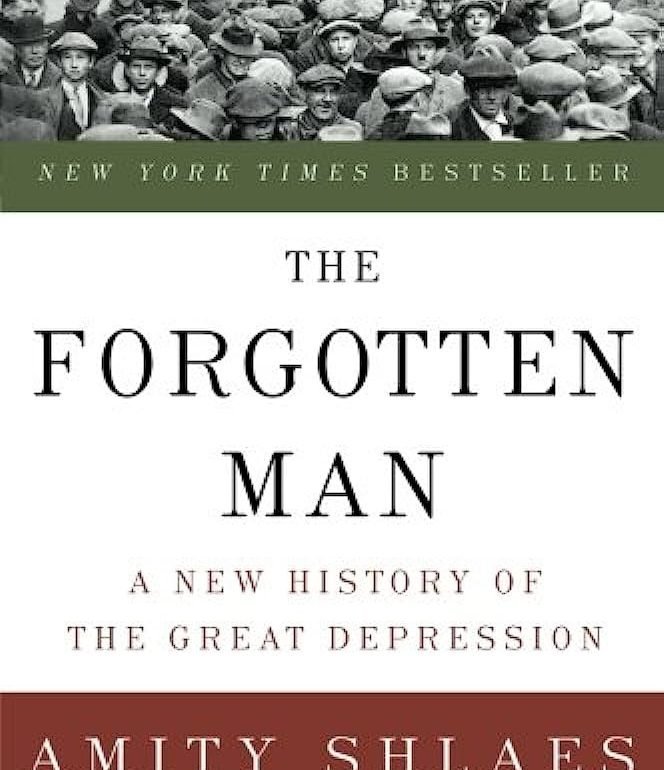
“As soon as A observes something which seems to him to be wrong, from which X is suffering, A talks it over with B, and A and B then propose to get a law passed to remedy the evil and help X. Their law always proposes to determine what C shall do for X, or in the better case, what A, B and C shall do for X…What I want to do is to look up C. I want to show you what manner of man he is. I call him the Forgotten Man. Perhaps the appellation is not strictly correct. The is the man who never is thought of… He works, he votes, generally he pays-but he always pays… William Graham Sumner, Yale University, 1883
Shales excellent book covers the period of the late Coolidge Presidency, through that of Hoover into the Roosevelt terms up to his defeat of Wilke. We see these personalities but also many others who attempted to find solutions to the Great Depression while receiving conflicting messages and directives from President Roosevelt. Roosevelt was a crafty politician who kept everyone guessing as to which direction to go and which was the best policy to achieve his unclear goals. This led to duplication of effort and mixed signals to those with whom he was attempting to achieve an agreement. It was not unusual for Roosevelt to sent out two sets of negotiators with conflicting instructions and then even if an agreement were reached, he might reject it as it did not agree with some new idea of his. This led, in the real world, to a hesitancy on the part of business to commit to long term planning as they were unsure of the next set of taxes, regulations, etc. and how they would impact them. This of course, let to reduced hiring and an extension of the Depression. Internationally, it led to a mistrust of U.S. policy.
The book provides an excellent overview of the battle the President had with the Supreme Court and they with his various new laws and governmental agencies. To put those agencies and the growth of the Federal government in context and why the SC was viewed by FDR as obstructionist, within a few months of FDR’s first term, his new agencies had written more regulations than the entire U.S. government had written since the founding of the Republic. The SC, struck down many of his rules and agencies. At his second inauguration, FDR stated that his goal was “unimagined power” which set him on a collision course with the SC. FDR suffered a major defeat when he attempted to “pack” the SC in a political effort to control it (as we hear today from various politicians) yet in the end, due to retirements (the “four old men” on the Court were in their mid-seventies) and FDR was able to place Justices more in line with his political thinking.
FDR is remembered as a great President I believe for a couple of reasons;
- His “We have nothing to fear, but fear itself” speech when he gave the American public hope for the future
- His constant activity which made it appear that something constructive was being done for the American people (even though for example, he and his advisors realized that programs such as Social Security were unsustainable and would saddle future Presidents with a huge burden)


Leave a Comment