

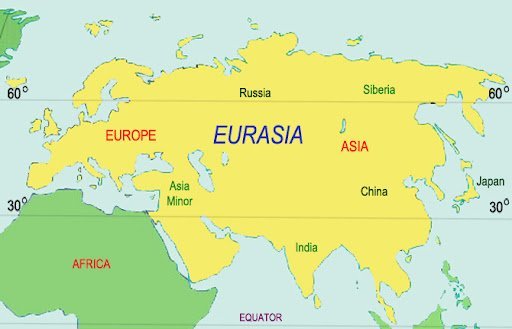
A friend of mine recently lent this book to me and it brought to mind various debates I had during graduate school many moons ago regarding the premise of the book; whomever controls the Eurasian continent controls the world.
This theory was originally formulated in 1904 by Halford MacKinder, a British geographer. It shortly followed the work by Captain Alfred Thayer Mahan’s extremely influential book, The Influence of Sea Power upon History, 1660-1783. In that book Mahan put forth the theory that as the oceans are the fastest routes for trade, control of the oceans will decide which powers will succeed and which will die. MacKinder put forth the idea because of the population, central position, and mineral wealth of the Eurasian land mass, that it will determine which nations live and die. Going further, Karl Haushofer, a German geopolitician continued MacKinder’s theory and he was influential to the Nazi view of the world as MacKinder was influential with Kaiser Wilhelm prior to the first World War.
Britain and the United States are both sea faring nations, outside of the Eurasian sphere, yet both have played vital parrs in controlling and shaping the Eurasian sphere. Brands goes through several examples of how the United States has dealt with the area, including World Wars I and II, the creation of NATO, our actions in the Middle East and so forth. In one way, this is a weakness in the book as the involvement of the U.S. was not due to an acceptance of MacKinder’s theory, but rather at least until the Cold War, a natural case of self-defense. The U.S. actions in the Middle East, plus Afghanistan are more suspect in that they went far beyond actions that were previously acceptable to the average American.
The last part of his book looks at the current players who seek to control if not all, at least sizable chunks of the Eurasian land mass, namely China. China with it ever increasing military power and sizable economic power, is the greatest player. It pushes until seriously pushed back as the nations such as Viet Nam, the Philippines, and others are finding out today. Their Belt and Road programs has reached even into Europe and has been successful in spreading China’s influence through most of Africa. Can China, with help from Russia, seize control of the Eurasian area thus locking out England and the United States out of such a vital area.? Can anyone accomplish that goal?
That has always been the key question to me, for the land mass is so great, the populations so diverse and in so many levels of development that how could any power do anything but bleed to death attempting to gain a level of control that would be worth such a great effort. In the early twentieth century, thinkers like MacKinder and Haushofer might have believed it was possible, even though there were already small struggles for independence in India and parts of Asia and Africa. Today, we must add in the religious extremism of the Middle East (and parts of Indonesia) and the task would become even harder. Finally, we have seen failures in the Belt and Road project which show the Chinese model may have feet of clay.
I would recommend this book as it is objective (I only found a couple of examples of personal political bias) and provides an excellent overview of various nations causes for action. If one or more nations cannot control the Eurasian area, is it possible to be done by a group of nations? It is doubtful, for if we think of the problems in Europe which has tried to tamper down the differences between the various members of the E.U., we find that despite hundreds of years of cross border trade and wars, the differences in languages, customs, views of history, even food make for a challenge on so many fronts.
The Eurasian area is huge and the hundreds of millions of people who live there share little in common beyond a desire to live, have enough food and at best, provide for a better life for their children. Help yes, control and direction, no.





Leave a Comment