
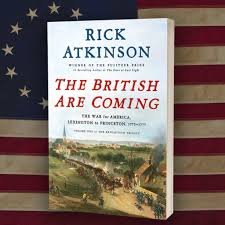
I have always found it interesting that some of the very best histories are written not by professors, but rather by individuals who have not spent their entire lives studying a specific field or discipline. Journalists can very often write fine histories, perhaps because they are used to looking at everyday people earlier in their careers. Rick Atkinson, a former staff writer and editor at The Washington Post has won Pulitzer Prizes for history and journalism and his trilogy on the U.S. war effort in World War II is an example of research and writing at it’s finest. In this book, the first of a trilogy on the American Revolution, Mr. Atkinson has again created a work that is unusually fine in the quality of the research, evenhandedness and writing. In fact, he has created a history that reads more like an adventure novel, filled with tension, humanity, pain and relief. I believe that even a well-read historian of the period will find much that is new and well balanced in this book.
This first book of the trilogy deals primarily with the military aspect of the war, centering on George Washington and the men around him, King George III and his politicians and the men at the sharp end of the spear, those who do the marching, fighting and dying. Many individuals are brought into the story, some to flit in and out throughout the book, others to step onto the stage for only a short while before they are swept away by the tides of war. The book offers well balanced insights into the personalities of the main players and puts their decisions in an historical context that can make one think again about previous views on a battle, policy or individual. The detail to the requirements of the men and their campaigns will impress on the reader the depth and majesty of men and governments to supply armies and navies during a war. A simple example will suffice; a single British man-of-war, the equivalent of a battleship, was made from over two thousand mature trees and required over twenty miles of rope; the British navy had one hundred of these ships alone, not to mention hundreds of other ships around the world. Given that it could take up to six years to construct such a ship and that it took two to three years to season the timber, one’s mind can begin to appreciate the complexity that war had become over two hundred years ago.
The chapters give excellent credit to both sides as one tries to determine what would be the next step, the next course of action. It was by the narrowest of chance that the Revolution survived the first two years, and it would be more years before the war would end. Although it is not taught, the war was full of barbarism, as prisoners of the British suffered a seventy-five percent death rate, where arson, looting, rape and the murder of innocents by the British and Hessians were commonplace. It was both a civil war, where fathers and sons, or brothers could face each other as well as a revolution, or as the British Crown saw it, a traitorous act against their lawful king.
It was almost a relief to finish this fine book as the writing is lively, fast, informative and exciting. I found myself making numerous notes from the details that spilled from each page. And, near the end, the comment from Adam Smith seemed to fit the volume perfectly, when he wrote: “The Americans fee in themselves at this moment a degree of importance which, perhaps the greatest subjects in Europe scarce feel..(They) are employed in contriving a new form of government for an extensive empire, which, they flatter themselves will become, and which indeed seems very likely to become, one of the greatest and most formidable that ever was in the world.” For anyone who believes that America was never, great, they should read this book and re-examine that belief.