

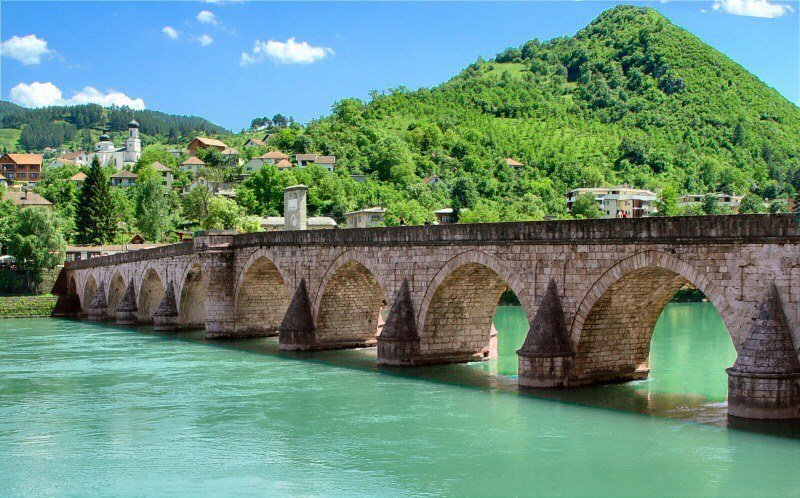
Over three hundred years ago, a Grand Vizier of the Ottoman Empire built a bridge at the small village of Visegrad in modern day Bosnia. At the time, the Ottoman Empire was near its peak and the bridge was s symbol of the power of the Empire. Ivo Andric, a Serbo-Croat, grew up in the area; he learned the tales and history of the bridge, how it was built, how it was a meeting place for not only the Ottomans, but also the Christians and Jewish leaders of the area. He traces its history through a series of stories spanning the centuries, capturing the mindset, problems and changes over the three hundred years.
Although not a Muslim, Andric captures quite well the mindset of the Muslims as they see the power of their Empire gradually slip away over the ages. As the Empire recedes, some Muslim leave, some resist the new nationalistic power of their Christian neighbors and some sit and wait, not knowing where to go and believing that all will turn out for the best. Each vignette is interesting, covers a short period and is remembered only by the elders as the years roll on. One story is of a local rebel who is impaled, another of a beautiful woman who ends her life rather than submit to an arranged marriage, while others tell of a gambler or a young soldier who pays with his life for forgetting his duty over a woman. They are all real because they all could occur in any country at any time over the course of history.
Andric won the Nobel Prize for literature in 1961 for this novel as well as Yugoslavia’s highest literary award. A non-political man, he led a quiet life, always in love with his native land. Unlike some of the Northern European novels I have read which seem to herald the decline of Western European culture, this one left me with a desire to read some of his other works as this one provided a positive break with our everyday world. A fine novel, well written and historically informative.






Leave a Comment