

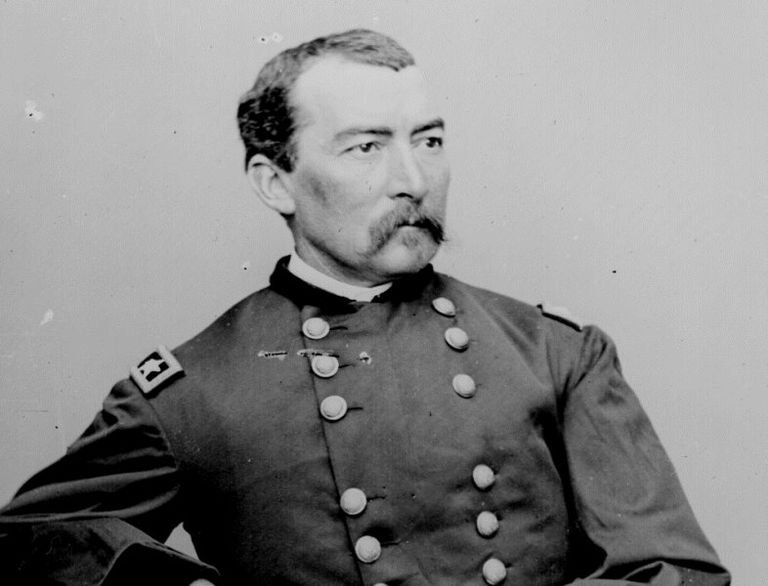
The North won the Civil War for many reasons: more manpower, greater industrial strength, tremendous capital, a better idea. They also won because they had three generals who believed in total war. It was not enough to defeat an enemy in the field; no, one had to tear the insides out of the enemy. Bring war with its flames and cruelty to the very hearths of the enemy to make them realize what war really was and is to this day. Those three generals are Ulysses S. Grant, William Tecumseh Sherman, and Philip H. Sheridan. These men knew that with the material, industrial and manpower strength of the Union, they could win and were determined to ensure that there could be no future Civil War.
Grant had his Battle of the Wilderness and Cold Harbor, where his army took huge losses, but he kept pushing ahead. Lee knew he had met his match. Sherman had the burning of Atlanta and his march to the sea, leaving a swath sixty miles wide devoid of crops, buildings, livestock, etc. while destroying every Confederate force thrown at him. Sheridan is best known for his campaign of destruction in the Shenandoah Valley, that graveyard of Union armies and generals. He was successful, in part because he carefully planned his campaign recognizing the unique character of the topography of the valley and destroyed the break basket that sustained the Confederate forces in Northern Virginia. Even today, the names of Sherman and Sheridan are muttered insultingly in the South.
Sheridan like the others went onto other things; after the Civil War, he was charged with protecting the rights of the Blacks in the South and threw out of office or locked up dozens of Southern politicians, former Confederate offices who fought to keep the Blacks from practicing their right to vote, hold office, etc. Back by then President Grant, Sheridan earned new hatred from Southerners for his hard and swift actions. Then, given responsibility for much of the West, he encouraged the slaughter of millions of buffalo as part of a campaign to destroy the Southern Plains Indians to him, it was more effective and less costly in lives that to continue a war with so few troops. When the great herds were decimated, and the Indians defeated through starvation and year-round campaigning which he was told could not succeed as the winters were too brutal. He fought the corrupt Indian Bureau which neglected to deliver the promised food, blankets, etc. to the reservations. He also fought powerful business interests who wanted to exploit such unique areas such as the Black Hills by building rail roads into the area to bring tourists. The Northern Plains Indians, starving on their reservations went to war again and once again in a brilliant campaign, Sheridan defeated them after their victory over George Armstrong Custer. Defeated and scattered, Sheridan managed to minimize the commercial intrusion into the Black Lands and insured their natural preservation.
Sheridan, like Sherman, was the Patton of his time. His legacy of strategic and tactical aggressiveness lives on in U.S. military doctrine. Add the airplane to their actions and you have the blitzkrieg of World War II. Sheridan was a man of his time, but also a man of the future. He could be ruthless in war, believing that war is terrible and to try to dress it up only made for longer and more wars. Yet, he was fair to the defeated and hated injustice, corruption, and greed. Today, generals at a certain rank take dance classes and lessons in how to speak to politicians. I know which general I would want to serve under.




Leave a Comment