

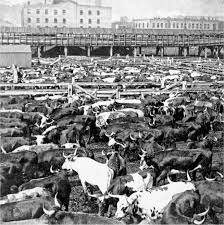
It has been said that Henry Ford was a genius who expanded the horizons of the average American. In “Slaughterhouse”, Dr. Pacyga tells the story of the Chicago stock yard and the world that it made. In fact, the stock yards of Chicago did much more than industrialize the slaughter of cattle, sheep and hogs, they were responsible for increasing the diet of Americans and Europeans by providing meat products in a timely, cost effective manner. They also were instrumental in the invention and improvements in rail transportation including refrigerated cars, smoother rides, etc.
The Chicago stock yards were in operation for about 100 years and business was done on a hand shake and the giving of a man’s word. On a hand shake, thousands of head of cattle could be sold and a price honored. Growing up in Chicago, I know that a man’s word and hand shake were considered almost holy and I am sure it is in part due to the system of the stock yards.
The book tells of how it would take 3 men on a farm days to dress a hog, but in the stock yards, it could be done in about 30 minutes. The industrialization of the process was on part with the assembly lines of Henry Ford.
Dr. Pacyga briefly discussed “The Jungle” by Sinclair Lewis but seems to almost brush it aside as an exaggeration of the yellow press. But there is no doubt that the work conditions were hard and the workers and owners were often at odds with one another.
This is a very good book, a bit dry in places, but it makes you appreciate the inventiveness and genius of the American spirit, as business leaders as well as political leaders from around the world visited Chicago to see how it was done; yet no one else in the world was able to replicate what those Americans created for the world.





Leave a Comment