

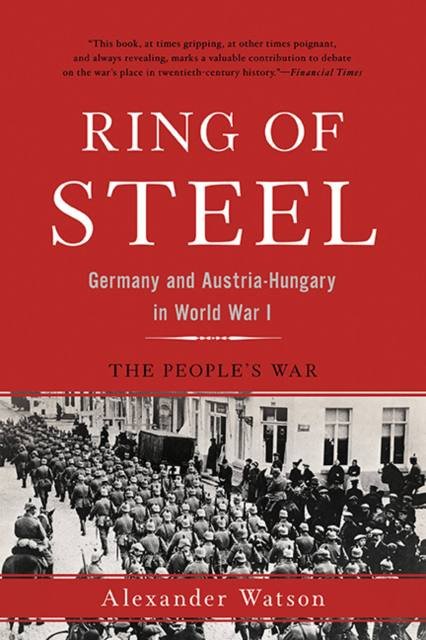
Prior to this volume, Holger Herwig’s book, The First World War, Germany and Austria-Hungary 1914-1918 was in my opinion, the finest book which not only dealt with the military aspects of the war but focused more on the civilian cost of the war. Watson’s book goes beyond Herwig’s work in detailing the almost immediate impact of the war on the citizens of the two powers.
Surrounded by hostile states, with the rapid rearmament of Czarist Russia after its defeat in its war with Japan, a French paranoia and demand for revenge for its defeat in 1870, a weak and untrusted ally in Italy which demanded lands held by the Austrian’s and an self-important Serbia which sought a “Greater Serbia” at the expense of Austria-Hungary, time did not appear to be on the side of the Central Powers. A mistaken belief of the Austrian military command that a short, sharp war could both eliminate the troublesome Serbs and be localized entirely ignored the expansionist plans of Russia as well as Russia’s desire to appear strong after its military defeat and its humiliation by Austria over Bosnia a decade before. The result was a domino effect as one nation after another seemed to stumble into war based on military time tables and a lack especially by the Czar of what “mobilization” really meant.
From the beginning, the Central Powers were faced with food shortages which they tried to make up by a ruthless exploitation of areas their armies won on the battlefield. It could never be enough however, to counter the internationally illegal tight British blockade of even neutral shipping. Additionally, it seemed that Austria and Hungary, the two halves of the Empire were fighting different wars, with disputes over goals, command and most importantly, shipments of Hungarian grains and fats to Austria, especially after the rich province of Galicia was overrun and laid to waste by the Russian army. Rationing was imposed but poorly administered but the concept of all for the front held the people together until even their patience was exhausted by the inflated promises of victory as the casualty lists become ever greater.
The running of the war by Ludendorff in Germany and his concept of total command of the economy was a failure. The one shortcoming I found in the book was a claim that arms production actually decreased under Ludendorff but there were no statistics to demonstrate the point.
This volume (about 750 pages) provides an excellent examination of a civilian world under huge stress. The inability of the Central Powers to provide basic living needs for its population led to purely physical exhaustion for millions of citizens. It is no wonder that later, Hitler would proclaim the need for Lebensraum which was partially responsible for his drive to the East.
A highly detailed book, well written and of value to anyone interested in the often-forgotten civilians who face so much in so many wars.






Leave a Comment