

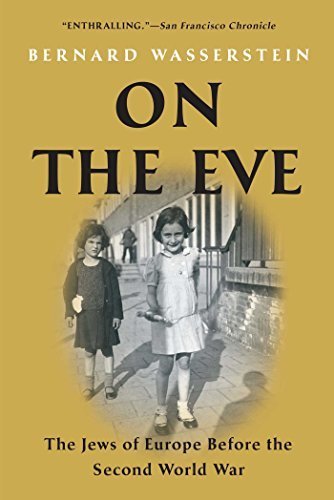
There was a time when the question of the future of Jews in Europe did not depend on government sanctions, actions or anti-Semitism. The real question was if within a few generations the Hebrew race and religion would simply die out through a low birth rate and assimilation. As terrible as it is to believe, the Final Solution of Hitler and the Third Reich led to a rebirth of the Jews as they were able for the first time in 2,000 years to have and create, after WWII, a state of their own.
Prior to World War II, the Jewish world was split between the various factions, such as the Ashkenazim, the Sephardim, Litviks, Galitsyaner, Hasidim and misnagdim, etc. Each group looked down on another as either uneducated or as not really Jewish, some viewed others as foreign as whirling Dervishes, while others viewed another’s religious practices as strange. Added to this mix was the fact that in parts of Europe, intermarriage with non-Jews reached over 30% and many women were marrying later (as late as 27) which lead to a lower natural birthrate.
The question of intermarriage came about because of the widespread movement of bringing the Jewish community into the modern State as a full-fledged participating member. Yes, there were still ghettos in Central-Eastern Europe, but many of these were self-imposed while the shtetls in the old Czarist were all but rural ghettos (poorer and dirtier than the urban ghettos). However, especially in France, Germany, Poland and Italy, the Jewish population from the French Revolution until the end of World War I made amazing progress in higher education and the professions such as medicine, music, teaching, etc. Their success was so amazing and huge, that they were later seen as predators who captured all of the best positions even though, for example, in Germany they only amounted to about 0.75% of the population. In Poland, Warsaw contained more Jews than any city in the world (about 33% of the population) and they extremely successful in the professions. With the rise of successful penetration of various professions, the old barriers against intermarriage began to fall and the children were often raised outside of the Jewish religion, especially as it was the Jewish male who married outside of the race.
Perhaps it was in the Soviet Union that the greatest strides were found. After the Revolution (the one in March, not the later Soviet revolution), Jews were finally free to live anywhere (prior they had for the most part been restricted to the “Pale”). The young Jews flocked to Leningrad, Moscow, and other cities to attend Universities and to absorb with the fire of youth the doctrine of Communism. It was unfortunate in one sense that they were so successful, for when the great purges swept the Soviet Union, many were destroyed as they had moved quickly into the positions of upper management. And, as the Soviet Union invaded Poland and the Baltic states at the begging of World War I, those Jews (who ranked highly in the Soviet Secret Police) came to be seen as the tyrants who executed and exiled millions to Siberia.
Yet for all of the problems, Jewish intellectual life in Europe was very successful with many noted Jewish authors, newspaper editor, Jewish self-help societies, hospitals, etc. The book goes into the histories and ideas these Jewish intellectuals created and debated and it is a glimpse into a world long gone. Their debates were both lively and courteous, covering all aspects of human life, from government to religion. Additionally, there was a strong movement for the liberation of Jewish women in all fields; these movements were on the whole, stronger in the Jewish world than in the non-Jewish world in Europe but this is due to fact that Jewish women had traditionally been more confined to the home so there was further to go.
This is a full and rich book, full of little remembered names, a book which both celebrates the Jews of that time and is sad for what they had and how it was lost. Often seen as passive, ignorant victims of the Nazis, the book paints a community split but full of life and hope.





Leave a Comment