
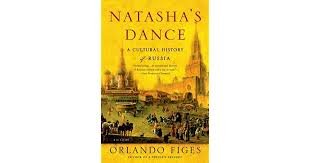
There is one great question that courses through this amazing book and that is, “Is there such a thing as Russian Culture?”. In just under 700 pages, Figes, one of my favorite historians, traces Russia from its roots through the collapse of the Soviet Union, reviewing art, music, literature and culture in general. To say the least, Russians (let’s exclude the peasant class for now) have been torn between their experience with Asia (Mongols, etc.) and their disillusionment with the West. They have moved first one way then the other, all the time denying the worse of their history while attempting to create a new world for themselves.
The efforts by Peter the Great to move the base of Russia towards the West led to the creation of St. Petersburg; it was a window to the West. It was also an alien city cut off from the rest of Russia. In Peter’s new capital, Western art was introduced to Russia (previously the only art produced were icons), Western music, styles, manners, etc. were imported. For the vast majority of Russia, these things were alien concepts and it was decades before such changes reached as far as Moscow. During the next one hundred twenty years or so, the aristocracy gradually came to look on the West as a model to follow, but while clothing could be changed and manners adopted, how far below the surface did the ideas of the West penetrate?
With the invasion of Napoleon, suddenly the Russian aristocracy became disillusioned with the West. When they went to defend their nation, they found that in most cases they could not communicate with the peasants in the army as the officers who were aristocrats, could not speak Russian! After the war, there grew a movement which idolized the peasants (based on their strength in battle) and suddenly the upper class decided that they should all speak Russian. There were problems however, for in trying to write novels or poetry in Russian, it was found that the Russian language did not have the vocabulary of the French so new words had to be invented.
As time wore on, the brutality and ignorance of the peasants shocked those Russian elites who traveled to the villages and the gulf between the elite and peasants grew greater. Attempts to develop “native” industries were tried (the “traditional” Russian nesting doll did not come about until the late 19th century and then only because someone wanted a Russian copy of the Japanese nesting doll) but were few and far between. With the advent of the Russian revolution, a third way was proclaimed, the Soviet New Man who could be molded from the lumpen proletariat.
Figes (his The People’s Tragedy is in my estimation, the best history of the Russian revolutionary movement) has done an outstanding job of tracing the numerous waves that have propelled the attempts of the Russians to create their identity. In the end, I was left with the impression that Russia is still attempting to find itself; the closest it came was World War II with a cherished belief that the common suffering would lead to a new age of openness and opportunity. The end of the war, however, did just the opposite and since that time there has been one blow after another to the Russian psyche. Today, the split between Moscow and St. Petersburg is as great as ever, Russia is trying to project an image of power while attempting to create an alliance with a country which harbors hard feelings against her. Will Russia ever develop a true image that all can accept? That is a question which bears watching.