
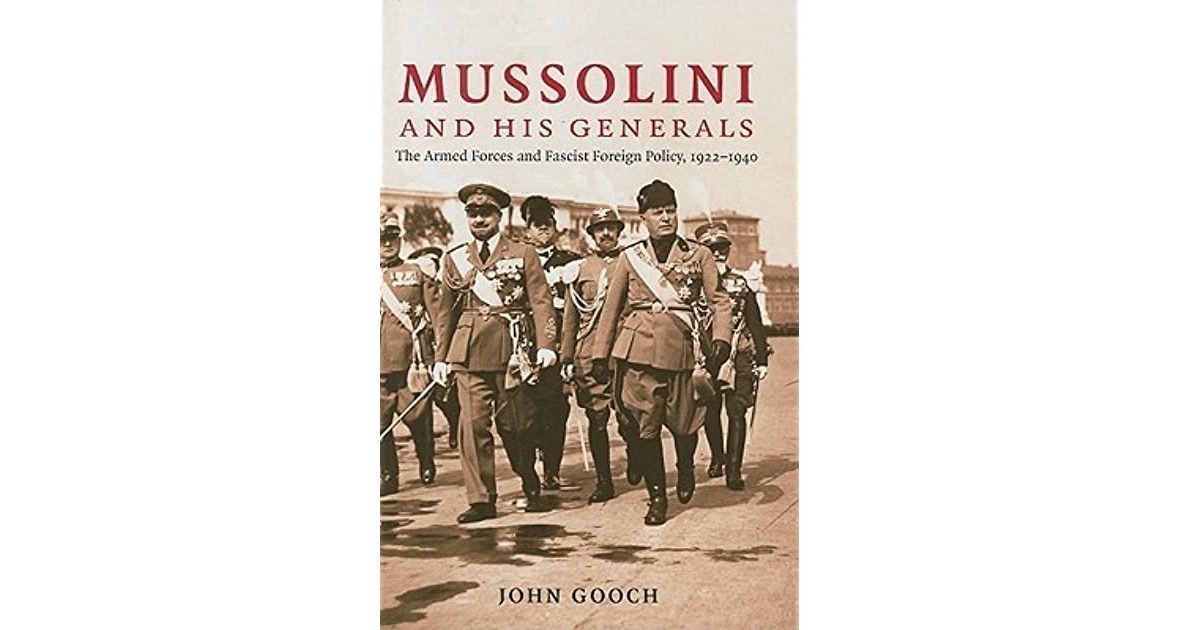
I have read biographies of Mussolini and military books, trying in vain to find out why Mussolini was so adored by his I have people. Hitler, Stalin, Mao, I could understand as they tapped into the needs of the people, promised them what they desired and delivered on many of the promises (although at a huge, terrible price). Mussolini, aside from killing off (or their fleeing to the US) the Mafia and making the trains run on time, seemed to stagger from one disaster to another. It must have been the pomp and uniforms that kept many people enthralled and we need to remember that FDR and Churchill both had favorable opinions of the Italian dictator for quite a while.
This book is not an easy read for the author provides what seems to be an almost day to day running explanation of the relationship between Mussolini and his generals from 1922-1940. Unlike Hitler who had an understanding of economics and strategy, Mussolini and the generals seemed to have absolutely no understanding of economics, manufacturing, balance of trade, economic forecasting, etc. Plans were made which were totally beyond the capacity of the Italian economy, but which were believed to enhance the standing of the State and Fascism in particular. While trying to build up the military, equipment was sold to gain hard currency which was then used to pay for basic food stuffs which Italy could not produce. New designs for weapons-Italy entered the war with a largely outdated air force, poorly designed tanks, and a poorly trained and motivated officer corps- were delayed due to a lack of raw materials. One is tempted to shake one’s head as one reads of the discussions totally detached from the economic realities of the government.
The adventure into Ethiopia, a desire for revenge after the humiliation of Adwa in 1896 and a scramble as a late comer to the race for colonies, might not have been won except for the use of mustard and other gases. The result of the “victory” was that Italy had a costly colony which contributed nothing to the motherland and could exist as long as the British allowed it to exist. Then the participation in the Spanish Civil war all but bankrupted Italy with little gain and much condemnation by potential enemies, France and the U.K. Believing his own propaganda, Mussolini was embarrassed when in 1940, 36,000 British soldiers defeated 150,000 Italians at a cost of less than 2,000 casualties. Humiliated in Greece and Albania, the Italian generals exhibited their lack of expertise in modern warfare and inability to command respect from their own troops.
This is a heavy read, but one which dissects the problems of both Mussolini and his generals. A veneer of gloss could not long hide the emptiness of a regime that brought ruin and pain to its population.