

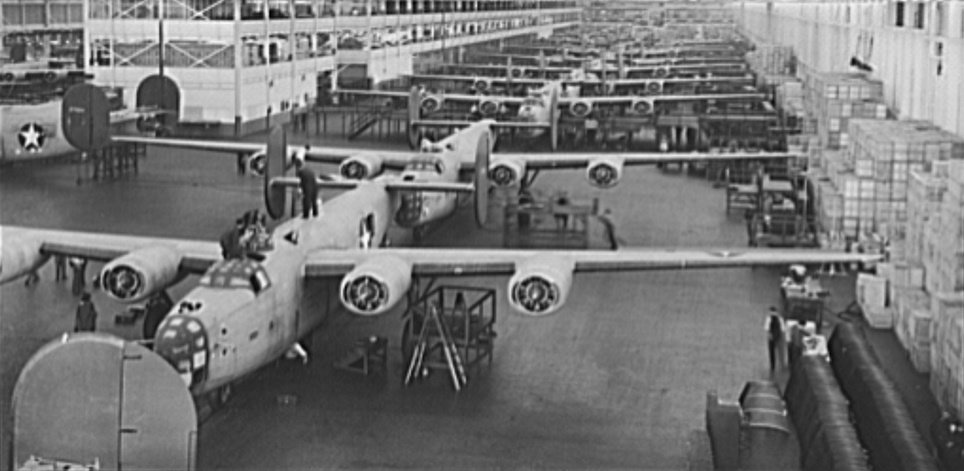
This is the story of how American business, which is the American people came together to produce the best equipped military in the history of the world. The book has two key players; not FDR, not Eisenhower, not even Marshall, but two Americans, one a first generation American, the second, an immigrant who helped to focus and force American industry at a time of national peril.
The first was Henry Kaiser, first generation American who through his drive and skills was the driving force behind such pre-war projects as Boulder and Grand Coulee dams, as well as thousands of miles of paved roads as the country was getting behind the wheel of their new cars. His vision of what he could do enabled him to move into ship building, but his skill was not just in being able to successfully move from industry to industry (during the war he would build ships, airplanes, etc.) but in finding ways to mass produce them in record time. An example is his work building the Liberty Ships which helped to defeat Germany in the Battle of the Atlantic. When given a contract to build ships, he also had to build his own shipyards, as well as recruit workers and provide housing for them. The workers came from every facet of American life; they were teachers, hairdressers, farmers, students, housewives, etc. and they all had to be taught how to handle tools, cut sheet metal, maintain equipment, order parts, inventory those parts, supervise production lines, etc. All from scratch. And he did it so successfully that a ship which use to take 200+ days to produce were coming down the waterways at one every 15-20 days.
The other main character in this excellent book is William Knudsen, a Danish immigrant (he landed in the U.S. before his teens) who not only revolutionized the production facilities of Henry Ford, but also was the driving force behind General Motors which he managed to be built to a point where it surpassed the production of his old boss, Henry Ford. Knudsen was the type of production man who could look at a production problem and, in his mind, reconfigure the entire process to speed up production and better quality. In recognition of his skills, he was the only civilian in the history of the U.S. to be made a Lieutenant General in the military.
But this is also the story of the average Americans who not only worked at the huge war plants but created tens of thousands of businesses to support the war effort. An excellent example is Ma and Pa Harrington in Rockford Illinois. Their specialty was making machine tools for turning artillery shells and tank turrets. When they realized that a new lathe would cost four thousand dollars, they made their own out of a junked lather, an old washing machine motor, and oil pump from a 1926 Chevrolet and an old washtub that caught the oil that leaked from the bottom of the home-made tool, all in their living room! This is an example of American ingenuity which was not found anywhere else in the world and which contributed so much to the war effort.
In the days before the internet, social media, faxes, computers, even a reliable nationwide telephone system, we would able to design, order, produce, ship, inventory and assemble the 55,000 parts for a bomber, all in record numbers. That ability won the war as surely as the men on the front line, and despite the best efforts of the New Dealers in Washington who wanted to direct all production centrally, as occurred in Nazi Germany.
This is an inspiration book, of interest to anyone interested in production, or wishing to read a book about what the country was capable of during those dark hours. Is the country, are our people still able to pull together in such a desperate time? That is for you to determine.






Leave a Comment