

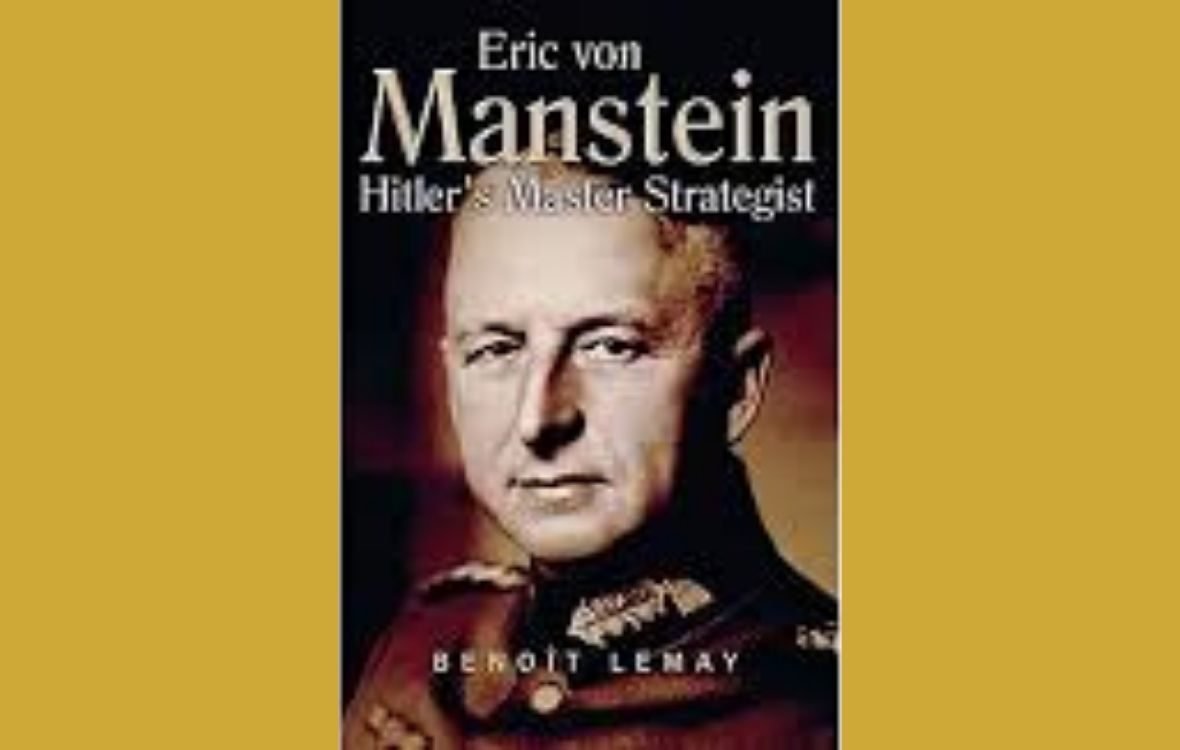
It has been claimed that Field Marshall Erich von Manstein was the best strategic general to come out of World War II. His development of the “Sickle Plan” which was adapted by Hitler led to the defeat of France in 1940, actions in the attempt to rescue the Sixth Army at Stalingrad while at the same time foreseeing the Soviet attempt to destroy Army Group South, his counter offensive which recaptured Kharkov and other actions, all fought while out numbered in men, tanks and aircraft, point to a military mind which was superior to many of his contemporaries. While his excellence was acknowledged by many in the Wehrmacht, his arrogance and drive were also resented by many and those factors were key reasons why he never attained his goal, shaping the total military direction of the Germany war effort on the Eastern Front. The final decision maker, Hitler himself, while acknowledging the brilliance of von Manstein, did not want so strong a personality around him and trying to influence him.
After the war, von Manstein was convicted for war crimes and served several years imprisonment. His sentence and time served was harshly criticized by such notables as Churchill, Liddell Hart, Konrad Adenauer, Lieutenant General Robertson and many others served to free him early and allowed him to act as a consultant in the formation of the reborn West German Army. He was able to do this as he, and other German Generals managed to create, after the war, the fiction and legend of the “irreproachable” Wehrmacht. According to their post war diaries (as opposed to their actual diaries written at the time), every bad decision was Hitler’s, every good decision was theirs, they never knew about the killing of the Jews by the Einsatgruppen and they always took great care to fight an honorable war. This “legend” was more easily accepted by Allied veterans who had fought in North Africa (President Eisenhower agreed to a joint declaration with West German Chancellor Konrad Adenauer on April 5, 1951 on the honor of the German soldiers in World War II) than by those who faced the Germans in the East (the typical Soviet General referred to von Manstein as “that bastard”). The “legend” managed to overlook the facts that those very same generals were charged with the supply, maintenance and physical support (by normal Wehrmacht troops) on a day to day basis, or that those same generals issued in writing, the need for the harshest methods in dealing with not only the enemy troops, but the civilians in the occupied territories. In fact, the German troops were exempted from judicial penalties on the Eastern Front for any of their actions. The deaths of several million Soviet POWs, the scorched earth policies, 100 to 1 ratios of executions, etc. were all swept under the rug by the generals who greedily took tax free payments and free estates from Hitler to reward them and invest them more heavily in the fate of the war.
Much of the book is an excellent discussion of the actions by von Manstein on the Eastern Front along with other generals and how their actions were fully supportive of the racial war which Hitler proclaimed. In fact, only one German General was vocal in his opposition to the racial policies and the actions of the Einsatgruppen and that General, Johannes Blaskowitz spoke out about crimes in Poland in 1939 and as a result was sidelined for years during the war (he was reinstated for a short period of time and was then one of the major Generals to face a war crime trial). Other generals, such as Guderian, Hadler, Hoth and others were spared a trial. LeMay covers the changing political scene in the late 1940s-early 1950s and how the emergence of the Cold War created a need for the concept of the “irreproachable” Wehrmacht of the Second World War which would a helpful scenario so that the new West German Army could be created.
This is a fine, serious book about a complex man, his goals, what he was willing to do to achieve them and the price paid for his ambition. It should be clear, the price he paid was very small compared to his actions and he was a chief architect to a myth of a “clean” German Army which lasted for several decades. That myth and its destruction are echoing in the structure of the current German Army.


Leave a Comment