

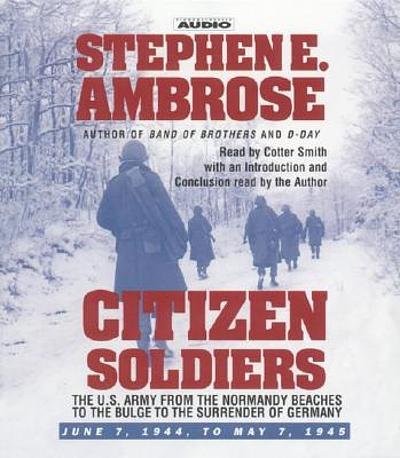
This is Stephen Ambrose at his best; after conducting interviews with over 1000 veterans, on both sides of the line, and reviewing outstanding studies by Russell Weigley, Paul Fussell and other excellent historians, some of who fought in the theater, Ambrose has created a fast-moving history from the ground level. The cold, the thrill of the chase, the shock of retreat, the realization that the war is almost over and the fear of being the last man to die are brought home in a book that is difficult to put down.
Numerous other books have cast doubts on the fighting skills of the average U.S. soldier, especially in the infantry arm, especially in relation to his counterpart on the other side. While Ambrose does not dispute that debate, he does not acknowledge it, instead focusing on the amazing ability of eighteen-year-old teenagers who served as privates and even officers to learn quickly how to survive during the terrible winter of 1944-45. There is no doubt that thousands died due to poor training and an inability to master their weapons (young men trained as infantrymen were suddenly given a two-hour course on how to drive and use a tank with the result that in many instances, they did not last a day against the more professional German army). Yet enough did to stop the German’s time and again and create the conditions for victory.
Ambrose does focus on the infantry as they are the sharp end of the bayonet, yet he also has chapters on the medics and nurses who provided the difference between life and death for literally tens of thousands of G.I.s who were wounded and rescued from the battle field and cared for by over worked nurses at the aid stations. The relationship between the G.Is and those who treated them was one of mutual respect and admiration.
There are dark scenes and he discusses the execution of prisoners by Americans. Some killings are done in the heat of battle, some are done coolie as a soldier is detailed to take prisoners back to battalion but somehow the prisoners never make it back. How much killing of prisoners went on? It is difficult to say, as only one veteran admitted to killing a prisoner, but hundreds “heard” of such actions. Did the veterans condemn such actions? Not to any great degree and the general impression from the book that such actions happen in war and that is that.
Of course, one major factor in the ability of the U.S. Army to win was the absolutely complete control of the air. The story of the airmen is not told in this book but their contribution to the victory is clear. From the inability of the Germans to move to the battlefield in Normandy, to the key attacks which forced the Germans to only be able to move at night, the U.S. air forces provided a sheltering umbrella where the common American infantry man seldom had to look up to the skies whenever he heard any aircraft.
There is no doubt that most soldiers did not want to be in the war, yet, there were clear indications of nobility from individual troops in their letters. One example is from Pvt. Ken Webster who wrote to his mother about how if he did not come back, to not take it too hard. He said that in battle you expect someone to be killed but you have to keep going. His mother wrote back in alarm about his attitude and he responded this way: “Would you prefer somebody else’s son to die in the mud? Somebody has to get in and kill the enemy. Somebody has to be in the infantry and the paratroops. If the country all had your attitude, nobody would fight, everybody would be in the Quartermaster. And what kind of a country would that be?”
Ambrose in the end pays tribute to the soldiers as “American citizen soldiers (who) knew the difference between right and wrong, and they didn’t want to live in a world in which wrong prevailed. So, they fought, and won, and we all of us, living and yet to be born, must be forever profoundly grateful.



Leave a Comment