

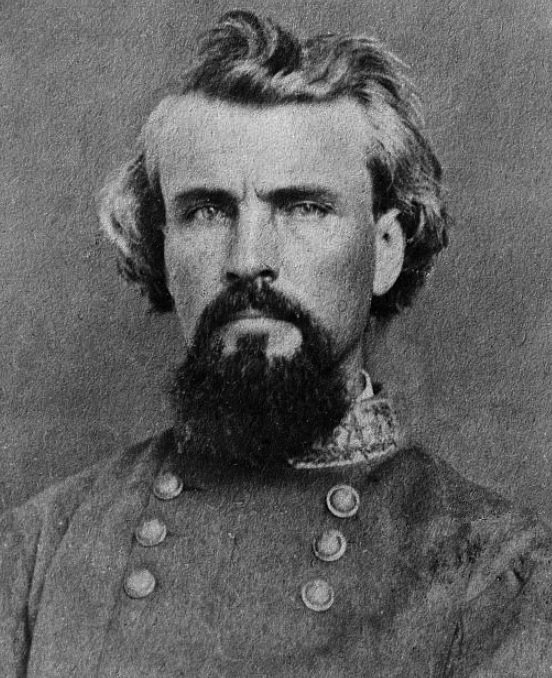
Perhaps no Civil War General is surrounded by more controversy than Nathan Bedford Forrest and yet his life and campaigns are to a large extent ignored or lightly skipped over as they are lost in the large battles of that conflict. This book, written by a man of the South, is pro-Forrest and yet, it is difficult to refute most of the history as told when reviewed against other contemporary and non-contemporary accounts.
There is no doubt he was a hard man; a one time slave trader, successful businessman and self-taught military master, at six feet two inches and two hundred and ten pounds, he was a terrible figure to behold as he led cavalry charges during some of the toughest campaigns of the war. Loved by his men, when he freed his black slaves who were on campaign with him, the majority decided to stay with him and fight against the Union. Ruthless in battle, was his sense of honor at the abuses by the troops at Ft. Pillow on the locals so outrage him that he decided not to stop the massacre of that garrison or could he have stopped it? He cared for the lives of his men and his anger at Generals Hood and Bragg show that he was not a “death and glory” butcher but rather an officer who knew the value of human life. After the war, when he was penniless (he had been worth over $1,000,000 before the war but used much of it to feed and equip his men), what were his true designs for helping to form the KKK and why was he so active after resigning in condemning it’s actions? Why did he work with organizations like the Order of Pole-Bearers Association which was an early civil rights organization make up of blacks in the Memphis area, urging blacks and whites to work together under one national flag? Was he a died in the wool racist? Did he fight to protect slavery (he had given up his slave trade years before) or for States Rights, or did he simply not want someone far away from his home telling him what to do?
Seen from today’s perspective, some would condemn him for his being a slave trader, but then how does that balance against his work with blacks after the war and his support of their rights? Was he responsible for the massacre at Ft. Pillow or was it more an example of a blood lust that some of his troops had against an enemy which in their eyes, had abused the locals? In short, this book while excellent, does not answer these and other questions, but then what good history or biography ever tries to make that claim. Forrest was a complex man, a man with few illusions and one who faced the realities of the world as strongly as he could. At the end of his life, old and poor, he never complained or railed against fate but accepted life as it was and did the best he could.

Leave a Comment