

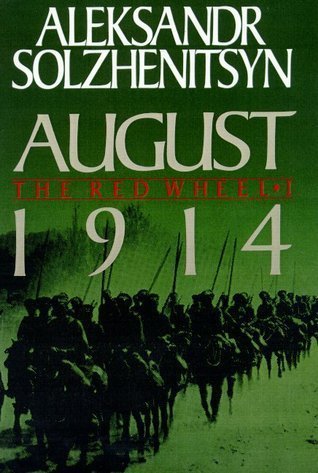
In August 1914, the Imperial German Army won a total victory over the Imperial Russian Army which had invaded East Prussia. Total losses for the Russians were about 250,000 (78,000 killed and wounded) while the Germans suffered only about 15,000. For the Germans, it was a revenge for their defeat 500 years before at the Battle of Grunwald at the hands of the Poles and Lithuanians (a Slav is a Slav) and gave the homeland something to cheer about after the losses in France, while for the Russians, it showed the failure of the reforms within the Russian Army that had been in process for decades. When the French Ambassador to the Tsar offered his condolences for the Russian losses, the Tsar is reported to have said that he was glad to have fulfilled his obligation to this French allies.
Solzhenitsyn provides an interesting look at the battle from the standpoint of several characters including a staff officer who is privy to various headquarters. As such, he sees the inability of the Russian Army to have a united strategy (there were two Russian armies whose generals had not met to create a strategy and whose commander represented the worse stereotype of Russian commander who owed his rank to his favor at the Russian Court). Moving from one HQ to another, we see the lack of maps, poor logistics, almost lack of communications and general stupidity among the officer corps (especially above the field level), condemn the mass of Russian peasant soldiers to futile attacks and brave defensive actions which only led to further confusion and the eventual defeat of the Russian armies.
As with all novels with Russian characters, the names can be confusing and the book is not an easy read, but it does provide the reader with a good feel for the fog of battle. It offers a good overview if the reader is not familiar with the battle and will leave the reader with a feeling of wonder at how the Russian army was able to survive the First World War for so many years.






Leave a Comment