

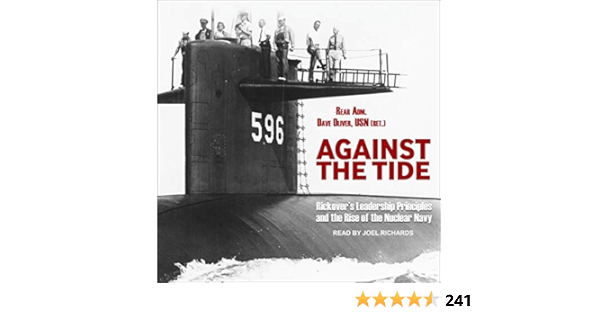
Prior to World War II, the established bureaucracy within the U.S. navy felt that battleships would decide victory or defeat in any ocean-based war. During the war, it was realized that it was not battleships which were the deciding factor, but the aircraft carriers and hence, a new bureaucracy displaced the old. There was another weapon which created its own set of followers and that was the submarine. It was the submarine in the Pacific that accomplished what the U-boats could not achieve in the Atlantic; the destruction of the Japanese to transport the basic materials they needed to conduct a war. The U.S. submarine fleet destroyed the Japanese merchant fleet which carried the oil, wood, coal, foodstuffs and all the other ingredients upon which Japan depended.
The submarine officers were a different breed apart from the officers on carriers and other surface vessels. They were so different in fact, that officers who served in submarines knew they did not have a chance to access the highest ranks in the navy. They were considered mavericks, risk takers and prone to striking out on their own. They readily admitted these characteristics but then their service was entirely different from the rest of the navy. A surface vessel can have engine problems and get towed, but if a submarine has major engine problems, it sinks.
Against this backdrop of two entrenched bureaucracies, each attempting to snare more dollars in the military budget, comes Hyman Rickover, a man of Jewish background, born in Russian occupied Poland in 1900 who has chosen to make engineering as his course in the Navy. Talk about handicapping! As with sub officers, an engineering officer realized that getting a shot at Admiral status was small. Not only those black marks, but he also becomes the driving force behind creating a force of nuclear submarines while disdaining the sub captains who came out of WWII with honors and medals. Yet somehow, despite all odds, he manages to defeat much of the naval bureaucracy, convince powerful Congressional leaders and several President’s to create a nuclear submarine force that although smaller than the Soviet fleet, was technologically far ahead of the Soviets.
While this excellent book provides a fast course on how he was successful despite fearful odds, prejudices and of course, bureaucracies, it is a management manual which lays out certain principles that can help any individual entering into management.. In some ways, there is nothing brilliant or daring, no breakthrough concept that can be considered a wonder pill. In reality, the key to his managerial style is to understand the market, with its strengths and weaknesses, anticipate problems and demand the best from the best people you can collect.
To show how far Rickover took these concepts, there is one story where in the early days of nuclear subs, a problem came up while on boat was at sea. The captain of the boat surfaced and advise Rickover of the problem. Rickover told the captain to solve the problem (such a problem was not in any manual) and over the next hours, several fixes were tried but nothing worked until after a number of approaches were tried. This particular problem was not anticipated and thus had to be fixed ad hoc. After returning to base, the author (who had been on the sub) went to visit Rickover and he asked him about a variation of the problem. Rickover went over to his desk and pulled out a number of envelopes including one that was labeled as the author had described to Rickover. The point was that although no one had anticipated that particular problem, Rickover had and already had a solution. That is called “thinking ahead”.
Rickover had two keys to his success:
- He insisted that very sub commander did not command a sub during the war. This was important as a nuclear sub is totally different in its operation, capabilities, maintenance, etc. than the old “pig boats.” Rickover wanted a new breed of naval officer, one who is a nuclear engineer and a warrior.
- He realized that he carried a heavy responsibility by creating a nuclear sub force. His greatest concern was safety, and he geared all design, training, operations, guidelines and directives with safety in mind. Selling the safety of dozens of nuclear subs sailing the oceans with their self-contained nuclear power plants had to be accepted buy the American public. If the American public did not have confidence in the safety issue, his goal could not be realized.
This is a beautifully written and interesting book and reflects well not only on Rickover but also on the author who was a nuclear sub commander. With men like these, the U.S. was well cared for.






Leave a Comment