

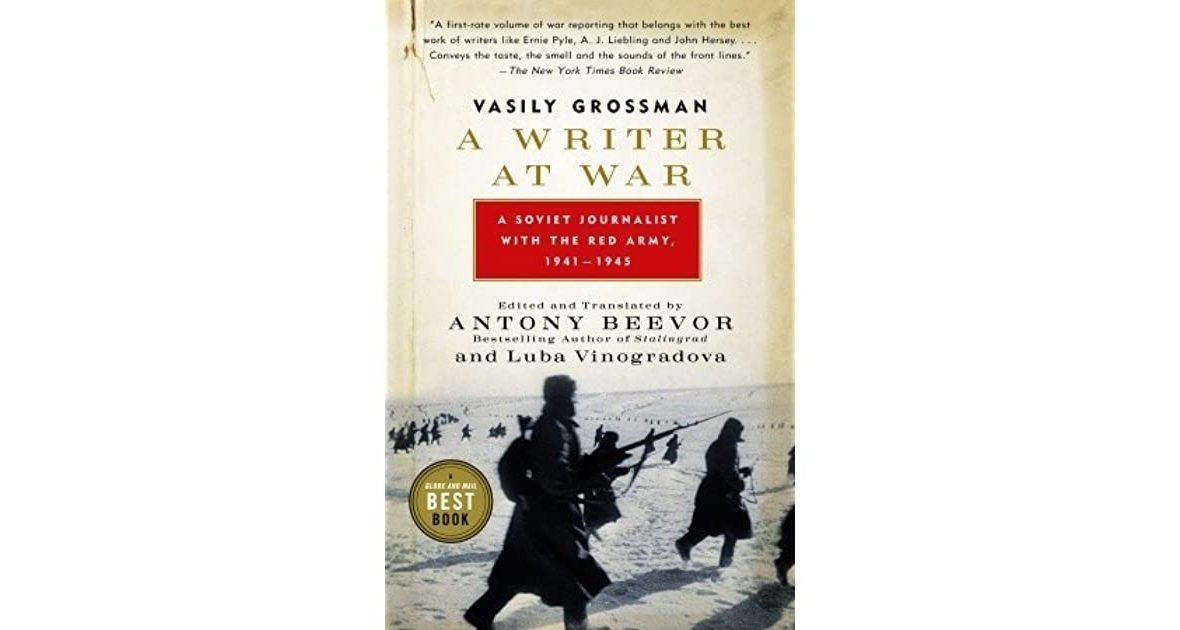
Grossman is best remembered for his novel, Life and Fate which has been described as the greatest Russian novel since War and Peace. When originally shown to the Soviet censors, they agreed that it was a great novel but that it could not be published for at least two hundred years; its descriptions of the men and women fighting in the Great Patriotic War were too real and did not pay any homage to Stalin.
Born of a Jewish family during Czarist times, Grossman was a trained chemist but when the Germans invaded the Soviet Union, Grossman, not exactly the finest physical specimen, managed to be accepted into the military but as a correspondent. For the next four years, he was constantly at the front, sharing experiences with common soldiers, be they infantry, artillery, or tankers. Although he had no military training, he was determined to learn every facet of the military art and was readily accepted by whatever unit he visited. He was in Stalingrad during that great battle but was denied being there when the German 6th Army surrendered. Was it because he was Jewish?
Grossman was aware of the anti-Semitism of the Czarist regime but saw a great opportunity under the Soviet system. As the war went on, he gradually saw that contrary to his hopes, there still existed a deep river of anti-Semitism within the system, starting with Stalin himself. Given that many of the early leaders of the Soviet Union and especially the Cheka (Soviet secret policy) were Jewish, their actions helped to keep anti-Semitism alive, although more under cover.
This book is taken from notes that Grossman made almost everyday while at the front. Many of his character in Life and Fate are based on individuals he knew while at war. If one were to read the novel and this book, one could find entire sections taken from his wartime notes.
The most moving part of this book is his description of what he found when the Soviets liberated the Death Camp of Treblinka. His description of the operations and the sadism of the SS guards should be required reading as an example of what men can do to their fellow man. That experience fully exposed the anti-Semitism of the Soviet system to Grossman as Stalin demanded that no one group of Soviet citizens be shown to have been special victims of the German invaders.
After the war, when his novel could not be published, he watched the emergence of more anti-Semitism, directed by Stalin with his move against “cosmopolitism” which was a code word for “Jewishness”. Although many of the leading Jewish leaders during the war were executed for spying (despite their having received approval for their international charitable activities), Grossman managed to survive. His manuscript was seized by the secret police, but a copy was smuggled out of the country and published in 1964, after his death.
This is a book which gives one an excellent, unvarnished view of a brutal war, worth the read.


Leave a Comment