

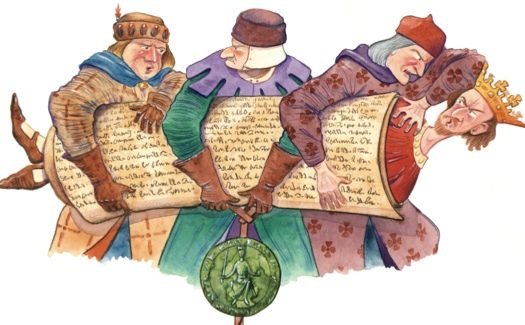
I recently re-read an old article from the WSJ on the Magna Carta, the document which Lord Denning said was “the greatest document of all time, the foundation of the freedom of the individual against the arbitrary authority of the state.” I thought that the following was really inspiration and worthy of remembering:
“Liberty and property; how naturally those words tripped, as a unitary concept, from the tongues of America’s Founders. These were men who had been shaped in the English tradition and they saw parliamentary government not as an expression of majority rule, but as a guarantor of individual freedom. How different was the Continental tradition, born 13 years later with the French Revolution, which saw elected assemblies as the embodiment of what Rousseau called the “general will” of the people.
In that difference, we may discern explanation of why the Anglosphere resisted the chronic bouts of authoritarianism to which most other Western countries were prone. We who speak this language have always seen the defense of freedom as the duty of our representatives and so, by implication, of those who elect them. Liberty and democracy, in our tradition, are not balanced against each other; they are yoked together.
Most other countries have fallen for, or at least fallen to, dictators. Many during the 20th century, had popular communist parties or fascist parties or both. The Anglosphere, unusually, retained a consensus behind liberal capitalism.
This is not because of any special property in our geography or our genes, but because of our constitutional arrangements. They work because, starting with Magna Carta, they have made the defense of freedom everyone’s responsibility. Americans, like Britons, have inherited their freedoms from past generation and should not look to any external agent for their perpetuation. The defense of liberty is your job and mine. It is up to us to keep intact the freedoms we inherited from our parents and to pass them on securely to our children.”
There are those who believe that we need a “living Constitution,” more open to changes based on the moods, whims, and foibles of the lowest common denominator. Let us hope that we do not overthrow our proven vehicle for untried and fashionable experimentation.
I hope you enjoyed the points above. Thank you.





Leave a Comment