

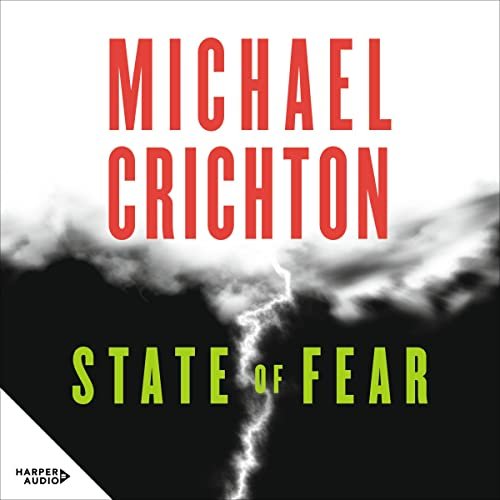
A second read for me (first was in 2006) and even more timely than then. Crichton who wrote numerous excellent novels based on “science” (he was an MD) makes it clear that he was skeptical of the concept of man’s impact on climate change. It would be nice if those who believe in man’s impact were to read this book, but that is asking far too much of those who embrace that religion, I mean theory (sorry, I do not accept it as fact either).
The novel moves quickly and has numerous charts and graphs showing both sides of the debate which makes for an interesting addition to the story. In the novel, a major environmental group works to create huge disasters to prove their point about the environment. One of the problems, however, is that they plan to cash in on each disaster and use them to increase their capitalization. The leaders of the group of lawyers (hard to believe) are merely using others to feather their own nests, manufacturing events and causes.
In the book, several interesting questions and facts are raised, such as:
- Why is it that when a scientist releases a study against man’s impact, and if he is paid by an oil company, etc., his study is bias, but when a counter study is released by a scientist paid by an environmental disaster group is released, it is not viewed in the same way. Does anyone who is paid ever release a study which goes against the hand that feeds them?
- Are the oceans rising? Yes, and they have been for about 10,000 years, so how can it be blamed on humanity?
- When the UN formed the Intergovernmental Panel on Climate Change in the late 1980’s, their statement that there was “a discernable human influence” on climate was generate after the scientist went home and was contrary to the document the scientist had signed during the conference.
- Scientists and others make silly statements such as Paul Ehrlich’s prediction that 50% of all species would be extinct by the year 2000. Yet no one knows the exact number of species; estimates range to from 3,000,000 to 100,000,000 so how can Ehrlich be given any print space with such a silly statement.
- Back in 1998 a court overturned the EPAs findings on second hand smoke as the EPA violated its own guidelines in order to come up with a slanted finding; yet despite that finding which was not disputed by the EPA, laws across the country have been passed and we still hear that 50,000 people a year die from this “problem”.
The book is filled with information that should make most people question the idea that humanity has even a minor impact on global change. As the book points out, “at any moment there are 1500 electrical storms across the planet. Eleven lightning bolts strike the ground each second. A tornado tears across the surface every six hours. And every four days, a giant cyclonic storm, hundreds of miles in diameter spins over the ocean and wreaks havoc on the land.” And, if we look at the disasters we have achieved (such as how Yellow Stone Park has still not recovered from our management during the first years we decided to “save” the area), we have far to go to understand the world we live in.
There is one other interesting theory in the book which he titles the PLM (political-legal-media) powerhouse which has supplanted Eisenhower’s military-industrial complex. The function of the PLM is to create fear; we live in the richest nation in history, with unlimited food, freedom to travel, options and choices, education, etc. and yet people are afraid for the future. If people have fears, it is an opportunity for those who manage the PLM to profit and gain more control and power. An interesting concept.
Given the recent farcial COP28 orgy of food, drink and private jets, this old book is amazingly timely. There is much in this book to get one thinking and I recommend it as a follow-up to your summer reading.





dear sir,
you seem have missed the difference between science and science fiction. State of fear is clearly a work of fiction just like Sphere, Adromeda Strain, Coma, Jurassic Park, Next, Prey. All very entertaining novels just like State of Fear a bit inspired by current state of science but totally fictitious. I’m sure mr Crighton is well aware of that was he still among us.
So don´t spoil the reading experience by reading to much in to it.
It is a work of fiction based on Crighton’s reading of the science. I believe he was skeptical about man’s ability to act on nature in a positive manner and we certainly see governments around the world continue to stumble down the path of climate change despite the results of their actions. Totally fictitious? Only if you ignore this documentation. But thank you for your comment.