

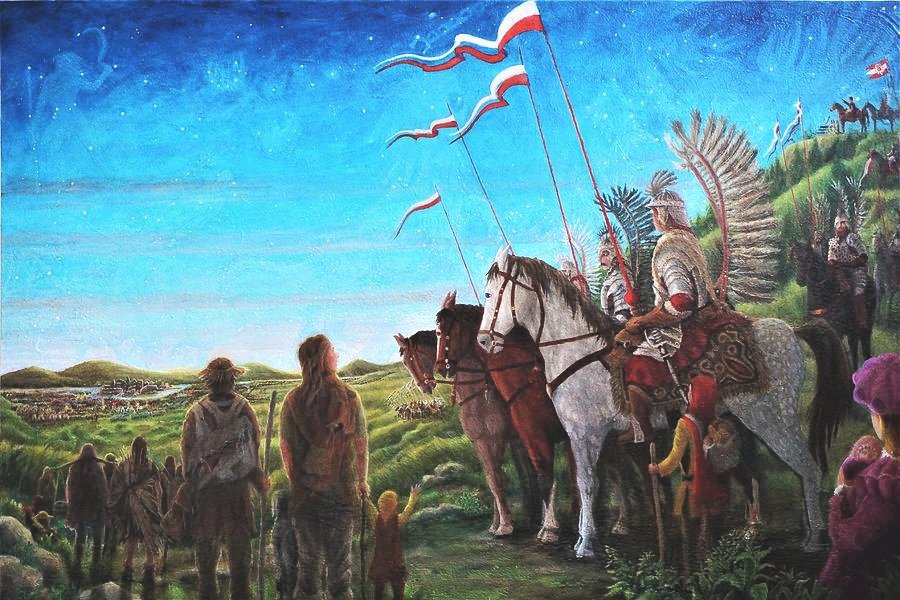
In the year 1683, a vast Ottoman army is laying siege to Vienna, the heart of the Hapsburg Empire. The Ottoman army was subsidized in part by the king of France, who although Catholic, opposes the also Catholic Hapsburg Emperor. Then, from the wooded heights, the famous Polish winged hussars smash into the Ottoman army and from another direction troops from Franconia, northern Italy, Bavaria, and Saxony break the Ottoman flank. Vienna was saved and from that day forward the Ottoman Empire begins to degenerate and weaken until at the end of World War I it finally falls.
What lead to the decline? How could an empire that had been unstoppable and the scourge of the Christian world, which had the wealth and absolute power of life and death over tens of millions slid irreversibly into oblivion? There are several answers, but they center around the fact that if the empire was expanding and plundering those who were weaker, it was able to sustain itself. When denied plunder, the empire began to collapse as it simply did not have the skills necessary to be productive and survive.
There are other reasons, such as the time known as the Rule of the Women, when strong and corrupt women ruled over weak Sultans. During that time court intrigue grew and promotion was not based on merit but on a Viziers ability to please the Sultana. In fact, this time is dated from the before the siege of Vienna when a Suleiman the Magnificent laid the groundwork for the eventual fall of the empire by marrying one of his concubines, the infamous Roxelana. Then there was the problem that without expansion, the tax base of the empire continually shrank and with it came corruption as poorly paid officials had to supplement their pay by bribes, kickbacks, etc., Coupled with a system which did not train future Sultans (brothers of the ruling Sultan, if they were not murdered upon his gaining the thrown, were kept in virtual isolation until called up to become the new Sultan), was the inherent conservative nature of the mullahs who feared a decrease in their power. Numerous times Sultans sought to improve the military, but the mullahs turned the corrupt Janissaries (who were originally Christian boys taken from their families and turned into the core of the Ottoman army) against the new troops and the Sultan. The problem that the Sultan in need of cash forced him to sell economic concessions to the despised Christians thus losing his tax base.
The book does an excellent, basic job of highlighting factors and I would recommend it for anyone who wonders why the Muslim world of today is such an economic basket case. It is often said that history does not repeat itself and it may not in a direct manner, but it is a fool who does not learn from the lessons of history.





Leave a Comment