

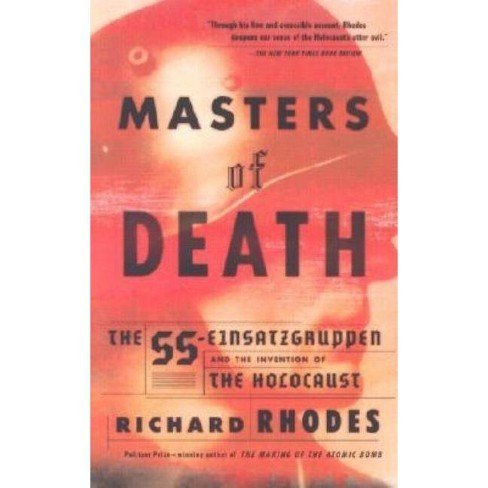
Richard Rhodes is a winner of the Pulitzer Prize and has written both fiction and non-fiction, on topics as diverse as the Donner Party, the invention of the Atom Bomb and the Audubon Society. In this work, he traces how the Einsatzgruppen were organized, their scope of activity, their relationship with the Wehrmacht and the impact of mass killings on the individuals within the units.
Originally deployed in Poland at the start of the war, their primary directive was the murder of the leaders of Polish society; lawyers, doctors, educators, political leaders, etc. as the conqueror Poles were destined to be a source of ignorant slave laborers who did not need to count much above 100 in their future live. The “special action groups” also targeted any Poles who offered any resistance either real or imagined. At the same time, they went after suspected communists and finally, the Jews of Poland. As the original plan was to move the Jews out of Europe, the concept of committing mass murder of the Jews was not in their primary list of objectives. Yet once the killing began, and they were under the protection of SS-Reichsfuehrer Himmler, their murderous campaign quickly expanded.
The invasion of the Soviet Union with it’s additional millions of Jews, present the Nazi leadership with a unique problem, for no longer was transplanting the Jews to an island like Madagascar feasible; there were simply too many Jews. The mission of the Einsatzgruppen quickly changed into one of mass murder, mostly by shooting of the millions of Jews and other enemies of the State. Other methods of murder were tried, including burning, mobile killing vans using carbon monoxide, dynamiting, etc. The other methods, however, were too slow and in many cases, sloppy; in dynamiting, body parts had to be collected, burning was inefficient and too slow, not to mention the stress on the murders as they had to listen to the screams and pleas of the victims. Recruiting local helpers, willing executioners, proved to be easy in some locations which sped up the process. Yet shooting wore on the nerves of the executioners as they were splattered by the blood, brains, etc. of their victims. To ease nerves, extra cigarettes, vodka, sausages, etc. were laid out for the executioners so they could relax from their efforts. Rhodes cites numerous instances of individual executioners suffering nervous break downs, but most returned after a period of rest to continue their work.
In the end, the approximately 3,000 members of the Einsatzgruppen were responsible for about 2,500,00 deaths; Jews, Slavs (Russians, Poles, etc.), “partisans” (often Jews and others who fled into the forests and swamps, etc.), civic leaders, etc. The Einsatzgruppen were aided by locals (especially in Estonia, Latvia and Belorussia), members of the Waffen-SS and Wehrmacht and nationalists in the conquered territories. Just over twenty senior officers were prosecuted after the war at the Nuremberg Trials and less than five hundred were charged by West German courts. In the end, thousands of murderers went back to their homes after the war and faded from history.





It’s hard to find educated people for this topic, but
you seem like you know what you’re talking about! Thanks
my site – Merrill Labonte