

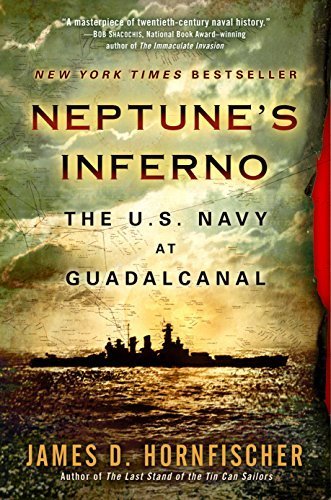
While historians believe that after the victory at Midway Island the course of the war in the Pacific was set, this excellent history of the naval battels around Guadalcanal shows that had the U.S. navy not prevailed, the marines on the island would have been defeated, displayed in captivity and a serious setback handed to the overall strategy. That the U.S. naval forces were not defeated was not due to the brilliance of the naval leadership, but rather due to luck, a technological advantage that was nearly thrown away, sheer luck and the misunderstanding of the Japanese military which was focused on tactics instead of logistics.
Like Hornfischer’s other excellent book, The Last Stand of the Tin Can Sailors, he paints a vivid picture of not only the commanders, but of the common fighting men who had to learn on the job while under a potential sentence of death. If the common fighting man had not responded to the training provided to them by dedicated officers, many more of the ships involved would have been lost and with it, the battles. It was unfortunate that many of the professional officers of the navy could not grasp the advantage of the technology which was provided to them using radar on their ships. Since the Japanese navy was superior in the type of close quarter, night fighting that was the hallmark of those battles, the use of the new radar was the “weapon” which gave the U.S. navy the opportunity to gain an edge on the Japanese navy. Many U.S. ships and men were lost by the poor understanding of radar.
The author provides the reader with an excellent feel for the terrors and pain of naval warfare. The ships could be as small as the length of a football field and less than forty feet wide; on that small bit of steel were less than three hundred men all at the receiving end of enemy shells which could weigh fifteen hundred pounds and cut the ship in half. If the ship were not instantly destroyed, fires would be throughout the ship with electrical circuits and fire fighting equipment blown apart. Along with the fires were the terrible wounds caused by the fires, explosions, and shock waves (in some instances, entire turret crews died without any wounds, but simply by the shock of the exploding shells). If a man was blown overboard, he faced death by drowning, being swept into the blades of the ship’s propellers, concussion caused by nearby exploding shells or by sharks which were in the area in great numbers.
To survive a naval battle, one needs skill but also a great deal of luck. Fortunately, the Japanese used their submarines primarily as scouts, unlike the U.S. navy which used the subs to cut the lifeline of the Japanese logistical system. At Guadalcanal, the few times the Japanese subs were let loose, they did a fine job of sinking several U.S. vessels and the largest, newest U.S. battleships were fortunate in those narrow waters to not run across any of the Japanese subs. The newest U.S. battleships were armored to withstand plunging naval fire at the cost of protection against torpedoes. The U.S. was also fortunate in that the Japanese navy neglected their logistics. Entering the war, Japan was ill equipped to exploit the riches in their new empire due to a lack of tankers and freighters. That shortage tied the sailing options of the combat naval forces and delayed the Japanese response to the battle for the island. The time lost was enough for the U.S. to find a solution, and one that was desperate at that, as to how to defeat the opponent.
This like his other book mentioned is an excellent read for anyone interested in the human and technological aspects of naval warfare at that time. The excellent photos give a three-dimensional feel to the read as you can put a face to many key names and players. I recommend this book if this area is of interest.






https://waterfallmagazine.com
Quality articles or reviews is the main to interest the people to go to see the website, that’s
what this website is providing.
Thank you!
Pretty nice post. I simply stumbled upon your blog and wanted to
mention that I’ve truly enjoyed browsing your blog posts.
After all I’ll be subscribing to your feed and I hope you write once more very soon!
My web site … Letha
Thank you for your kind comments! I hope to keep you amused and interested. Sorry, could not find your website.
of course like your web site but you need to check the spelling on several of your
posts. Several of them are rife with spelling issues and I to find it very bothersome to inform the reality
then again I will surely come back again.
Look at my web site: Leon
Wow! After all I got a webpage from where I be able
to really get valuable facts regarding my study and knowledge.
Here is my web-site Dieter
Thanks,I appreciate your viewing and comments. If you have a special area of interest, please let me know