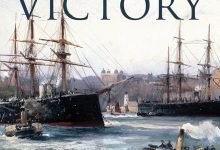


Professor Rodger’s two earlier volumes on the naval history of Britain began in the seventh century and carried the story through to the end of the Napoleonic Wars. This third volume opens with the Royal Navy at the height of its power and traces its decline from around 1840, taking in the difficult transition from sail to hybrid sail-and-steam ships and on into the modern era. The scope of such a work is immense, yet the author goes beyond the expected and creates a history that carries the reader into territory other British naval histories leave untouched.
At times, the work can border on eye-blurring, particularly when he details the personalities and politics of the British naval bureaucracy of the mid-nineteenth century. The individuals, with their foibles and political battles, can be hard to keep straight, and the prime movers of the Royal Navy are by now dusty figures receding into history. Yet those passages bring home a striking point: the politics and decision-making of that distant age were, in reality, no different from the political and economic battles we see today.
On the other hand, the book is a treasure trove of facts and struggles that are at once fascinating and genuinely enriching, giving the reader a wider and deeper understanding of the innovations and sacrifices that shaped the twentieth century.
The Women’s Royal Naval Service (WRNS)
One example, and a tribute, is his writing on the Women’s Royal Naval Service (WRNS). At a time when women were still primarily occupied in the home, the naval establishment not only welcomed the creation of the WRNS but placed its founding and day-to-day running entirely in the hands of women. The first director, Dame Katharine Furse, who had resigned from the Red Cross, was given a free hand, choosing her own staff and building the organization without male supervision. As the First World War wore on, the responsibilities of the WRNS continued to grow, and when the service was disbanded in 1919, its 438 officers and 5,054 ratings, all women, were reluctant to return to civilian life. Many formed the Association of Wrens, which later served as a foundation for the service’s reconstitution. Moving into the Second World War, the WRNS took up the challenge again, performing efficiently and at times heroically, freeing up much-needed manpower for other duties.
Breaking Enigma: The Government Code & Cypher School
Then there is the history of the Government Code & Cypher School (GC&CS), which, having learned much about German signals procedures from the Poles, was able to read a great deal of the traffic from captured Enigma machines. This intelligence played a decisive role in routing convoys around German submarines and in misleading the enemy about sailing routes and dates. Admiral Karl Dönitz never grasped the scale of the intelligence disaster he had suffered,
and as terrible as the losses were in the Battle of the Atlantic, the work of the GC&CS contributed mightily to the eventual victory.
The Small Facts That Change the Picture
Rodger also has a gift for dropping in those wonderful tidbits of history that make the reader stop and reread a passage. While discussing the siege of Malta in the Second World War, for instance, he notes that the total tonnage of German bombs dropped on Malta was greater than that dropped on London during the Blitz. Anyone who has visited Malta will grasp the weight of that single fact at once, and it casts the battle for the island in an entirely new light.
Is It Worth Reading?
I should say that the book is lengthy, more than 600 pages before the numerous appendices, with the footnotes alone running to ninety-one pages, and it can be heavy going in places. That, however, is bound up with its great strength: it is loaded with fascinating facts, presented in a way that keeps the reader reluctant to put it down. I would suggest that any newcomer adjust to the idea that you may read fewer pages per sitting than you expect, but you will come away knowing you have read a treasure of history, and one of the finest single volumes ever written on the naval history of Britain.