
I first read this novel over forty years ago and although I did not recall the exact plot, I remembered that as I finished it, I put it aside vowing to never read another of Mishima’s’ works. My fear was that having read one more, I might have to devour his extensive list of works, a bit like an old friend who refused to purchase on Judy Collins record (that shows how long ago that was), as then he would have to purchase them all.
A very good friend presented me with a copy of this work for my birthday, and it was with a mixture of excitement and trepidation that I began to read it. The story itself seems to be simple; it centers around a widow, a sailor she meets, her young teenage son and the circle of his friends. Filled with a subtle sensuality (as you would expect when you consider the author), it tells a story of how the son, and his friends reflect a form of nihilism that Mishima believed was part of the Japanese post-war character. The “tribe” of boys looked down on society, the family and anyone who was not in their “enlightened” circle. They were superior, above all the bourgeois values and norms and were determined to create their own world. Mashima also rejected Japan’s new materialism, democracy and flirtation with communism.
The book traces the young son’s disillusionment with the sailor who is courting his mother and the betrayal by the sailor when he decides to give up his life at sea and marry the boys’ mother. That action is a betrayal of the boys (not the sailors) sense of superiority, and the group of boys believe they must “punish” the sailor, or they will not be true to their sense of themselves.
As I finished the short novel, I felt the same sense of amazement at the power of Mishima’s writing. I slowly closed the book, put if my lap and let the last two paragraphs sink into my mind. The power that the book projected so many years ago was still there, as strong as ever. It is a book that dares to look at the dark side of disillusioned youth.
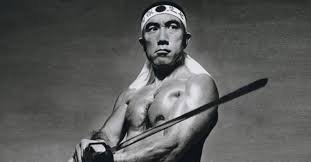
Mashima was one of Japan’s premier authors during the 1960’s. His novels were nominated five times for the Nobel Prize for literature, but he is probably best remembered for his dramatic action at Japan’s West Point in Tokyo in 1970. There, with some of his personal self-defense force, he seized a main building, captured the commandant and harangued the gathering cadets to throw off the new Japanese values of materialism, democracy, etc. and to recapture Japan’s sense of “national essence” including Emperor worship or all of Japan would end up as a “rootless people”. Failing to rally the cadets, he committed seppuku and had his second cut off his head as prescribed in the ceremony. He was forty-five years old.
What place did he hold in the minds of the Japanese youth of that time? In my previous lifetime I worked at Panasonics headquarters in Secaucus New Jersey. One of the photos I kept displayed was of Mishima haranguing the cadets on that day in 1970. None of the older Japanese commented on the photo in my office, but the younger generation were more open in their comments, and I found it interesting that a simple photo could pierce the normal Japanese self-containment and lead to an openness that was so rewarding.
Read this book at your own peri or sense of excitement. The term you use after the reading may tell you something of yourself.