

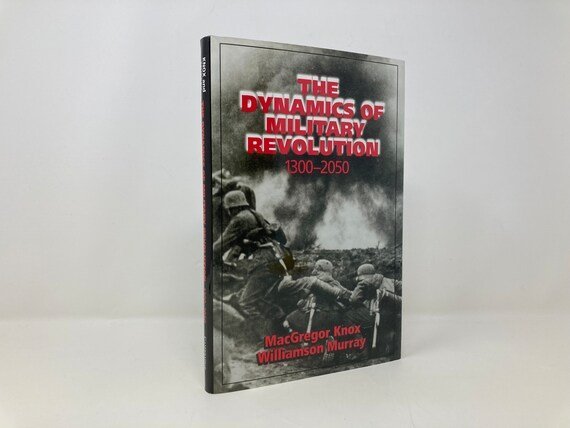
One of the pleasant things about New Orleans is that you can spend hours in used bookstores, shifting through volumes which reflect the mind set of the locals. I have found a number of gems over the years, and this last trip enabled me to find this excellent volume on RMA (revolutions in military affairs). I have to admit that I had never heard of the book (originally published in 2001 while the volume I found was from its seventh printing in 2008. The last printing was in 2015), but it is a find that I shall keep close. The contributors range from professors of history to the Director of Royal Artillery, British Army. This is short (less than two-hundred pages) but serious book.
According to their thesis, there have been five military revolutions in Western history:
- The creation of the modern nation state which brought about the discipline of military power.
- The French Revolution which “merged mass politics and warfare.”
- The Industrial Revolution which made the nation states to pay, feed, cloth, and arm masses of manpower.
- The First World War which merged numbers 2 and 3 while “set(ting) the pattern for twentieth-century war, and
- The Cold War which was cold in the “decisive European and northeast Asian theaters.”
These five RMAs are more important than any momentary tactical advantage (such as the superior use by the Germans of tanks vs. the French use in May 1940). They are more important as they completely change how war is fought across all theaters involved.
Moving into the book, there are separate studies regarding the Western army in seventeenth-century France, the impact of the French Revolution with it dramatic introduction of the mass army, the U.S. Civil war, the Prusso-German RMA of 1840-1871, the Battlefleet revolution of 1885-1914 under the direction of First Sea Lord Jackie Fisher, and of course the First and Second World War.
One might be tempted to ask about the current war in Ukraine and the impact of drones on the battlefield. I believe the authors would not say that drones are a real RMA as they would fall into the category of say, the introduction of the tank in World War I. Yes, they do make an impact, but the initial monopoly by one side was quickly lost and, in many ways, it mirrors the technological battle that was fought during the Battle of the Atlantic.
The writing is decidedly not academic: each section is sharp and well argued with a minimum of excess verbiage. The writing is tight and the average armchair military historian could easily grasp the ideas put forth in each section.