
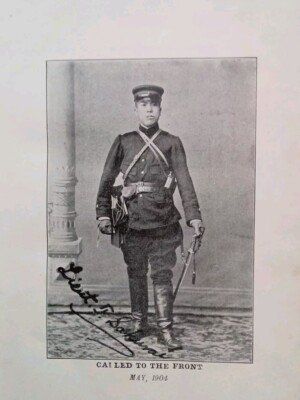
On my posting of September 29, 2025, I reviewed an excellent history of the Russian-Japanese war of 1904-1905. References were made to a tip of the bayonet history by a Japanese Lieutenant who served in that war. Originally published right after the war, it has been out of print for decades, and I have never been able to find a copy. I mentioned that I was interested in that history to a friend of mine and amazingly, he managed to find an excellent facsimile copy of that book reprinted in 2018. Thank you Christian!
The history gives a wonderful insight into the mindset of early Imperial Japan., during the Meiji era (1868-1912). Filled with pride and ego’s that could be easily bruised, Japan had made magnificent advances into a world that prior to 1868, they could little comprehend. Their advances in education, industrialization, the military, not to mention the coming together of a nation that was ruled by power Samurai clans, each having a history to warfare and political intrigue stretching back hundreds of years was amazing.
Like all industrialized nations of that time, they sought to borrow the phrase from Wilhelmian Germany, their “Place in the Sun.” This was done via military actions in Korea and China where the Japanese military showed exactly how far they had progressed as they were easily victorious against much less Westernized nations. Yet they were also humiliated by the demands of the Western powers (Russian, Great Britain and Germany), who at the peace table, reversed most of Japan’s gains. In fact, the success of Japan caught the attention of Great Britain who suddenly found a new and dangerous player in an area where they were dominant.
Japan was forced to give back some of their gains but was to a degree mollified as a chief protagonist, Imperial Russia also agreed to honor a pull back on their part. Unfortunately, the Czar, not being the brightest of men, decided that it was important that he push the boundaries of the agreements. The Russian leasing of Port Arthur and fortification of the Liaodong Peninsula (which Japan had been forced to give up in the peace treaty), made the Japanese feel betrayed. Russia was also seeking to gain influence Korea which was seen as a direct threat to Japan. In the end, Japan felt betrayed and shown little respect and Japan declared war on Russia. And thus starts the history of this book.
Anyone who has studied history, especially the Second World War in the Pacific, understands that the Japanese soldier was a tough, brutal opponent. Drafted, trained, often abused, and indoctrinated to honor the emperor who was a god on earth, they were lead by an officer corps that had no regard for the Geneva Convention which attempted to temper the worse horrors of war. The Japanese military had an almost medieval mind set but twentieth-century weapons. Take that mind set and amplify it and you will start to realize the mindset of the author who was a field grade officer.
The pages of the book are riddled with proclamations before every action that he, or his commanding officer or his men that they will die in battle in order to fulfill the commands of the emperor. If the individual returns from battle, many have an intense sense of shame, as if their death would have made the battle even more glorious. While the Japanese military machine had progressed far, it was still a young force backed by a nation with limited resources. In spite of their limited resources, especially their manpower (as opposed to the ever-increasing manpower of the Russians), the infantry commanders including the commanding General in charge of operations, used Russian human wave tactics in their attacks. In one attack, the Japanese suffered over 6,000 casualties (which would be like the U.S. losing 45,000 in one battle). Such losses are the basis for the title of the book. Many infantry battles were fought at night, when the Russians used search lights to expose and blind the attacking Japanese who were mercilessly cut down by machine gun fire.
Mentally, each battle or probing attacked was viewed as an individual’s final attack; individuals would expose themselves to fire as they hurled insults at the Russians (who no doubt could not understand a single word) and were instantly cut down. Yet the author, was either a fanatical believer or painted a (to the Japanese of that time) picture of a glorious warrior, the modern-day image of the samurai. In fact, the patriotism, the belief in the beauty of death in battle is so loud, that it is like something a child would think of what war is like. Either a child’s mentality or that of a jihadist.
It is a fascinating book, and there are small glimpses of humanity (a shared water bottle with a dying man who has not only been shot, but run over by horse and iron wheels of their own artillery), but on whole, it is a book from a different age, one which fortunately is largely disparaged today.