Although in recent years, more histories of the battles on the Eastern Front during World War II have been published, it is the landings in Normandy that still hold most Western Europeans and Americans attention and interest. Indeed, even the name “Eastern Front” reflects the prejudice of Western historians, for most certainly that name was never used by either the Soviets or those Europeans who fought in that area of Europe and the then Soviet Union. The lack of general knowledge can be considered amazing as the German military suffered ninety percent of its casualties in that theater of operations. It was the Soviet military and more importantly, Stalin who was willing to accept the huge losses throughout the war to insure victory.
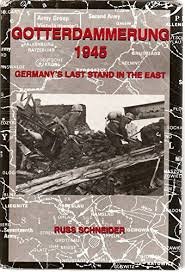
It can be difficult to appreciate the size of the battles in the east, but a comparison does show that no battles in western Europe after the Normandy invasion comes close to the size of the final battles in the east. The invasion of Normandy and the following ten weeks ended costing the Allies about 209,000 casualties vs 276,000 German. The Battle of the Bulge in forty-one days totaled for both sides almost 200,000 men killed, wounded or missing. Market Garden was a small business with losses totaling about 25,000 (to put it in perspective, during the battle for Stalingrad, the Soviets executed about 12,000 of their own men for desertion, cowardice, etc.) The battles covered in this book in the period of January-May 1945 resulted in a million Germans and one and a half million Soviet losses. Two and a half million men killed, wounded or missing. Many of those men were killed when their fuel and ammunition ran out and they stood practically disarmed, often little more than a militarized mob, spent after six years of battle.
In action after action, German troops fought and delayed the Soviets in desperate battles against huge odds. Often outnumbered up to ten to one, the Germans delayed their enemy so civilians could try to reach the zones the American or British occupied. Civilians fled in freezing weather and had to camp in bare fields while being attacked by Soviet war planes. The book covers dozens of actions where officers and men sacrificed themselves in often vain attempts to save their compatriots. The Soviets, urged on by Stalin and their officers, raped, burned, and crucified tens of thousands of German civilians.
Unfortunately, the average reader will not think of the Soviet civilians who fled from the Germans in 1941 and after. Nor will they fully understand the terror of living under German occupation when hundreds of thousands were rounded up for slave labor or mass executions. It was likely that a huge proportion of the Soviet soldiers showing no mercy to the fleeing Germans had family members who had lived and suffered under the German occupation and had lost members of their families. Was the revenge meted out to the Germans fair, or justified? Unfortunately, because of the how the Soviet system worked, few common Soviet soldiers left written records as was the case with the Germans.
In the end, the battles came down to desperate Germans and Soviets, driven on by a sense of duty, fear of capture, the hunt for glory from their officers and tactics which was the only option at a time when everyone wanted the war to stop. Battles create mountains of dead, but when at the very end, one side is out of ammunition and has no opportunity to escape, and the killing continues at an industrial rate, there is nothing but murder.
It is easy to understand how, after the war, many Germans viewed themselves as victims. They were pounded from the air, night after night. Their armies were torn apart and slaughtered at a rate which towered about the four terrible years of the First World War. Their cities were destroyed, hundreds of thousands of their women raped and hundreds of thousands of their soldiers were simply wiped off the face of the Earth. Yet, their terrible experiences were the result of one simple fact; they started the war, their intended victims finished it.