
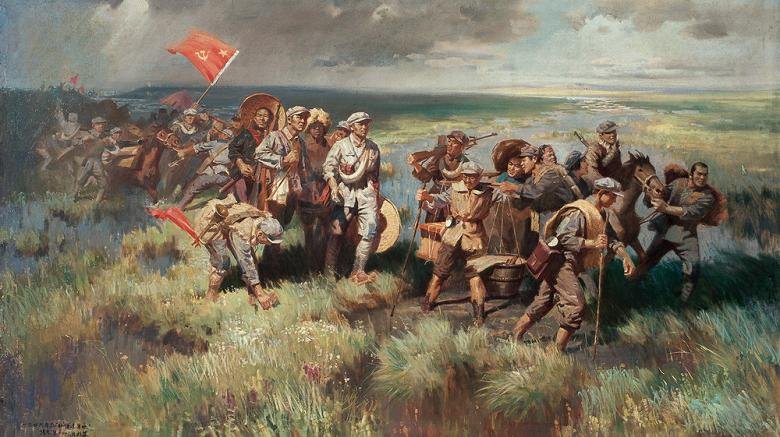
Recorded history is often made up of one part truth, one part perception, one part myth. One of the great human stories of the 20th century was The Long March, when hundreds of thousands of Communist soldiers with their leaders marched thousands of miles of often arid and empty land, pursued by Chiang Kai-shek and his army. In the end, after suffering eighty percent casualties, the Communist army found shelter far from the cities of China, cut off from an aid from the Soviet Union and facing another enemy, the Japanese army.
The march has been the subject of numerous plays, movies, books, and interviews with the majority of each adhering to the official party line which has become the touchstone of truth for decades. This book offers something new as the author, who was born in Communist China, actually travelled the actual route of the long march. Along the way, she manages to speak with individuals who were actually on the march and who participated in the battles and challenges of the march.
There is no doubt that the march was historic and required bravery and dedication. The survivors of the march when interviewed still show much of the youthful enthusiasm which helped them to survive the march. It was that enthusiasm which enabled them to meet their recruitment quotas for the army as it was that enthusiasm which kept them going in the harshest segments, such as through Tibet. Despite the idea that the Party would free the people from the grip of the warlords and big landowners, it was the Party and its army which descended on each location and demanded food from the locals. Of course, the Party “paid” for the food (in many instances) by giving an IOU, but in some areas, the demand for food stripped the land clean and left the locals without any grain for the next year’s crop.
The most inspiring chapter of the book was the one which focused on the role that women played during the march. Although they only made a small percentage of the total, they provided examples of bravery and stamina that shamed and drove the men to continue. They were instrumental in recruiting new recruits for the army, occasionally using their charms to achieve their quotas. Yet, they were valued and protected by the leaders of the march by keeping making sure that they were not to be molested. Yet, there were instances where certain leaders of the Party were allowed to take their pick of the women to “help” them with their duties. It was clear however, that the women who knew they were viewed as the weaker sex, set a high standard for themselves in the ability to march, handle weapons and persevere through the worse weeks of hunger while still providing the traditional soft touch to the wounded and dying.
The author, as she interviewed the survivors, found that their memories of certain actions did not line up with the official descriptions of certain battles and actions. Politics as usual plays a large part in the creation of history and this is especially true when a story is a key building block in a regime that discourages counter interpretations. She walks a fine line very carefully but her chapter on the “Legion of Death” shows the level of politics which existed even at that early stage of the Chinese Communist Party.
As the participants of any historical period pass on, we lose the ability to learn fine points of history and we are fortunate in this book that the author allows us to enter the mind set and memories of those who were on the march. Coupled with Mao, the Unknown Story by Jung Chang & Jon Halliday and The Private Life of Chairman Mao by Dr. Li Zhisui as well as The Party: the Secret World of China’s Rulers by Richard McGregor, we are able to peer behind the curtain that seeks to protect and shelter this totalitarian regime.